
Family fortunes
First published in edition 205 of The Northumbrian, Apr/May 2025
Charlie Bennett’s encounters with life in a corner of Northumberland
I think it’s delightful that we use the term ‘family’ for groups of animals (the elephant family, the dolphin family, etc). I guess we’re the same. If someone said they were from the Nelson family, you might assume they were unafraid of doing their duty. If a Corbett, you might note that they were perhaps short in stature, but very good at long, rambling funny stories.
Talking of families, yesterday was my sister Philippa’s birthday. However, as I set out on that blustery, sunny morning, I wasn’t looking for her (or Nelsons, or elephants), rather, I was after a particular member of an unfortunately named family.
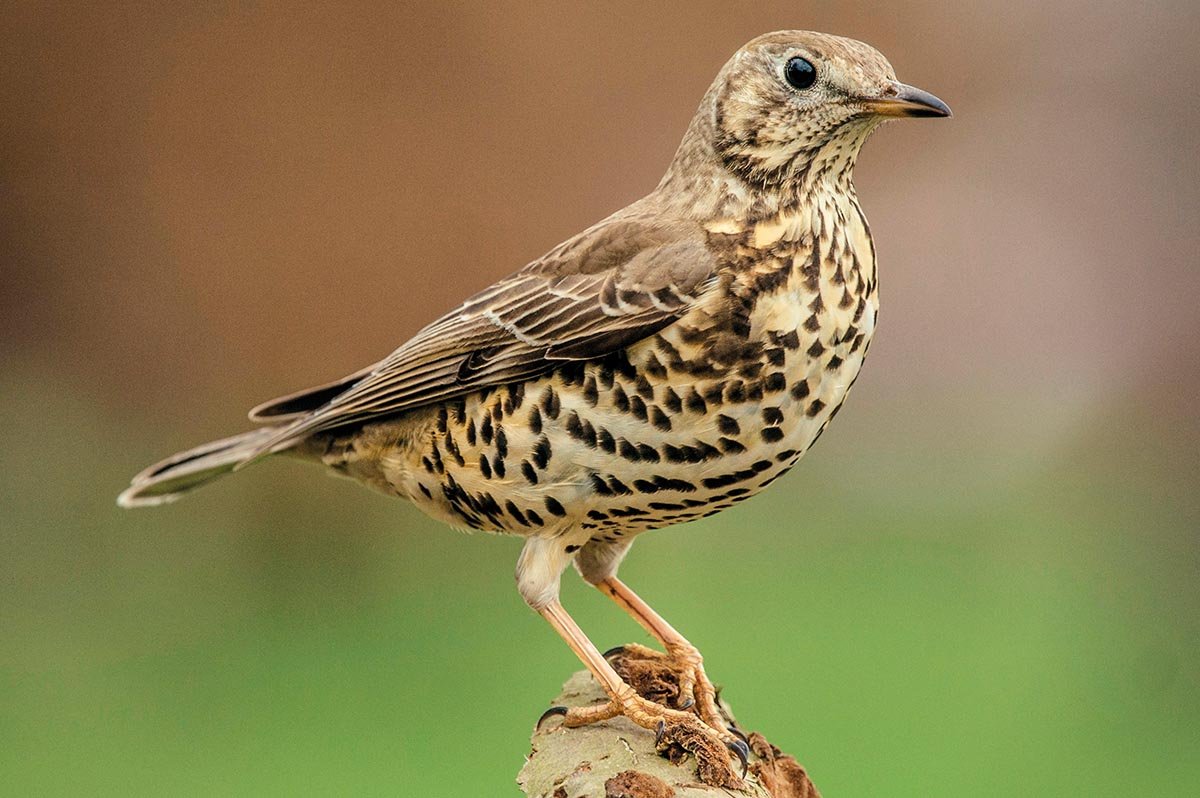
When it comes to names, as I have said before, scientists, naturalists and botanists are often myopic in their thinking – a female otter being termed a ‘sow’, for example. The family I had in mind yesterday is even more clumsily named – a beautiful species of birds bearing the unfortunate family name Turdus. To you and me this is the thrush family. You will know many of them: blackbirds, song thrushes and fieldfares being the ones you’re probably most likely to encounter. But it was the bruiser of the family, the mistle thrush, I was after.
It’s beautiful, pale greyish brown on its back and sides with a white belly dappled in black spots. It is considerably larger than its cousins and often easier to spot, as it likes to sing from the top of high trees.
It was brought to my attention last spring when I encountered one singing during a storm. I can’t remember what the storm was called, but it was blowing a hoolie with horizontal rain and sleet. Nonetheless, this bird had taken up residence on the top of the highest tree at the edge of a wood and was treating the world to its full repertoire. Rather like a Nelson, he wasn’t giving up his station, whatever the weather threw at him
If you can, type this link into Google to hear its song: http://bit.ly/41AZrl4
When you do, I’m sure you will agree it is up there with Bach, Mozart … Adele, indeed.
I mentioned this experience to my friend Brian and he said that this behaviour is behind the bird’s nickname, the storm cock. While everyone else in the hedgerow hunkers down in silence to weather a storm, the storm cock sings his heart out. Amazingly, this song cuts through any gale, and I imagine any potential Mrs Mistle considers it impressive.
With nothing much to do yesterday I took a walk down the old Wannie Line to see if I might hear it. I couldn’t have picked a better spring morning. I hopped out of my truck, let out the dogs, and before I had taken a step, I was bowled over by birdsong.
This is a superb spot where mature hawthorn, willow, and old birch trees create a delightful habitat for passerines (that’s small birds to you and me). The pièce de resistance is a garden nearby where the owners spend a king’s ransom on bird seed and I stood in wonder as something like the opening ceremony of the Olympics unfolded around me.
Families of birds arrived in turn, each singing ‘spring is here.’ There were goldfinch, every type of tit, robins, dunnocks, blackbirds, chaffinches, bullfinches and dozens more. I thought of recording them, but immediately thought no, leave the mobile in the pocket and entrust this glorious symphony to memory. (As I advance in age, it is increasingly the case that rather than recording birdsong and nice views on my mobile I prefer to commit them to my noggin, which I hope will recall these treasured moments in a future when my phone will be garnishing a shelf at Beamish Museum).
The dogs and I pottered off in search of the storm cock as magpies flew in half loops from bush to bush making their matchbox rattle and pushing out angry blackbirds which had just made a fresh cuppa. High above, a gull circled, while all the while the small birds kept up their music. But there was no sign of the mistle thrush, so off we headed to a nearby wood. Here it was quieter, though a few families had joined the singing party, including wrens (how can something so tiny be so noisy? ... mind, my friends often say the same about me).
The dogs ran on, a hen pheasant exploded out of the brambles. My eye was caught by the trunks of a group of 50-year-old beech trees. The base of every one was badly gnawed, in some cases nearly ringed. I had been warned about this by my friend Peter, an old woodsman, but it was worse than I had expected. Fortunately, I now have Trico in my armoury. This milk-like substance made of wool is hated by a plethora of creatures including deer, hares, voles and I hope the grey squirrel. We can of course manage them by trapping and shooting, but I’m afraid that until a contraceptive is developed, they are a plague we need tools to manage.
Still there was no storm cock, so we headed on and up onto the old moor, now a meadow. Again, I was pulled up short in my tracks, this time by skylarks in full voice. Rather like the swallows which arrive later in the spring, they can bring a tear to my eye, and it’s fun to scan the sky as they sing because the sound arrives some time after they emit it, which means they are not always where you think they should be. Once I get a hold of one in my line of sight, I watch in awe as they hold their station, with no branch to rest on, just their apparent endless energy.
By now, the wind had been building, the temperature was dropping, and as I walked, suddenly I heard a distinctive song. Melodic, varied, harmonic and beautiful, it was cutting through the wind and this time I did try to record it. Sadly, all that played back was the static of wind noise, so I put away my phone and stalked my quarry, creeping around the ponds and up a ditch to stand within 20ft of this tiny feathered marvel and its song. Then another started to sing, allowing me the privilege of a sing-off. Sadly, these were not mistle thrush, but male song thrush – smaller members of the thrush family and owners of superb voices, as you can hear here: https://bit.ly/4iqbTLS
It was a beautiful end to a delightful spring walk which, like any good party, I had shared with some wonderful families. I just wish I’d had a member of my family with me, (perhaps Philippa for her birthday). However, I still want to find my mistletoe-loving songster again, so perhaps next time I’ll make it a family affair.
Charlie Bennett is co-owner of Middleton North near Wallington, where he works to support existing wildlife and attract new species alongside sustainable stock farming designed to add to the diversity of wildlife in the area. For information, visit: www.middleton-north.co.uk
to enquire about volunteering, email
charlie.bennett@middleton-north.co.uk
• Charlie’s new book, Climbing Stiles, A Wander Through the Countryside & Beyond, is available in hardback priced £14.99 at bookshops and online at:
www.charliebennettauthor.co.uk