
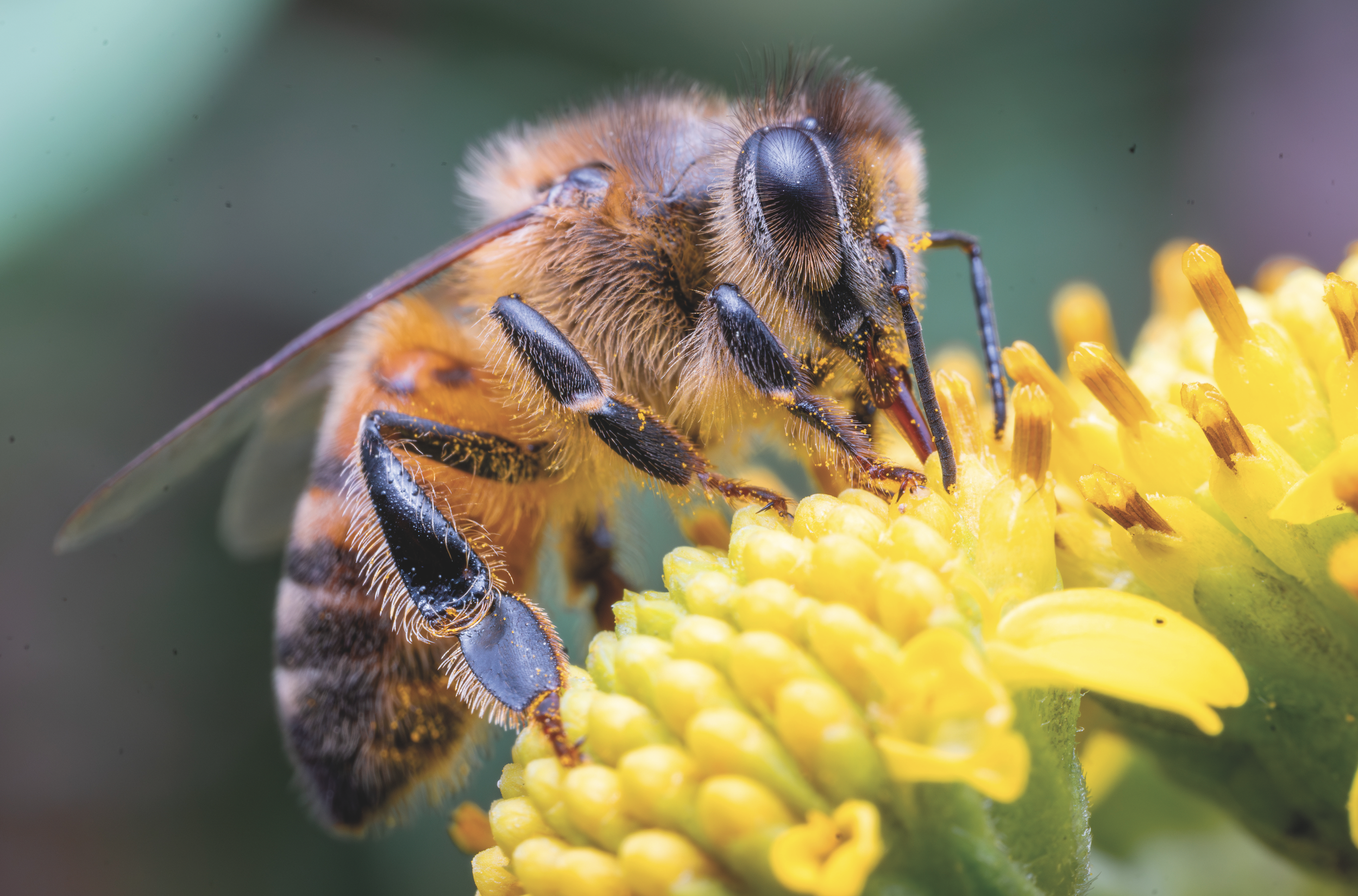
European honeybee (Apis mellifera) pollinating a yellow flower
First published in edition 210 of The Northumbrian, February/March 2026
In the latest instalment of his column chronicling country life in Northumberland, Charlie Bennett celebrates the wild honeybee
The shortest day, which has just passed as I write this column prior to the magazine’s deadline, is my favourite day of the year.
I’m not saying I suffer from SAD (Seasonal Affective Disorder), though Mrs Bennett might disagree (she sighs and raises her eyes to the heavens every time I moan, “it’s only 3pm and it’s flipping dark…”). But in winter I burn the daylight with care to make the most of it while it lasts. Then, once darkness settles, I’m drawn by an invisible umbilical cord to the fireside and the telly.
Once the days start getting longer, my activity outside increases and I generally feel richer in the knowledge that I have more time to get stuff done without a head torch. I look forward to this new abundance of time and celebrate it with a few large drams of Scottish Tea on the eve of the shortest day; a turning of the year which, you might be interested to learn, is over in a second. The magical name for it is solstice, which is Latin for “standing still”. This is the moment the sun reaches the Tropic of Capricorn and appears to stand still in the sky. At this moment, solstitium is achieved – this Latin term being composed of sol (sun) and sistere (stands still). From this moment we are in clover as the days become progressively lighter and warmer.
Interestingly, the date of the solstice is set to suit our calendars rather than the earth’s true orbit. The shortest sunset actually happens a few days before December 21, but let us not allow the truth to get in the way of a good knees-up.
Since people first realised there was a point in the year when things could only get better, they have made elaborate efforts to make sure they get the day right every year, so it won’t be forgotten or miscalculated. Stonehenge and numerous other sites across the Northern Hemisphere physically record the shortest day. The people who built these monuments are often described, perhaps derogatorily, as pagans; but I think they were true visionaries who realised how important it was to perk up on solstice day, as the good times now lay ahead.
I hope I’ve given you some context to the solstice, and how important it is for us to celebrate it. But it wasn’t my own “SAD”-ness that had me stocking the drinks cabinet in readiness for December 21. No, it was hearing about the behaviour of wild honeybees around this time that had my mind boggling.
Wild honeybees are a new thing for me. I kind of knew they existed because we have a huge nest of them in a redundant chimney. We first became aware of this when Mrs Bennett spotted honey dribbling down the sitting room wall. I wasn’t convinced, assuming something else had gone wrong in our crumbling old farmhouse. But no. After a tentative finger wipe and a lick, it was confirmed that it was honey, and that we had a healthy population of bees making the good stuff.
As the chimney is redundant, we leave them to it, an added bonus being that when we’re out in the sunshine they are our constant companions, often helping themselves to the dogs’ water bowls. They’re peaceful, and rather nice to have around, and after discovering the honey on the wall, I saw a lovely film about Matt Somerville, who makes log hives for wild honeybees, so I went to see him in Hampshire to learn how to make them too.
In future I’ll write in more depth about the wild honeybees I hope to attract to the farm, but for the purpose of this story, we are looking at their winter behaviour. They are extraordinary among insects in that they remain alive over winter. Their cousins, bumblebees and wasps, only leave a queen to over-winter and start the whole operation of colony-building from scratch every spring. But by keeping the family of daughters alive, wild honeybees have an obvious advantage.
Around the time of the solstice they start warming up the nest by flexing their flight muscles. Amazingly, their wings remain stationary, but their moving muscles create an extraordinary amount of heat. This encourages the queen to start laying eggs. This isn’t without risk, as most wild hives that die during winter do so from starvation. So, tucking into limited honey stores to warm up the nest in the midst of the cold season can be fatal. But if they pull it off, once spring comes and, importantly, nectar-rich flowers and trees start to blossom, the bees are ahead of the game. Their foragers can head out immediately to harvest nectar for honey, pollen for brood (larval bees), and for propolis (resin) for essential repairs and maintenance.
This has got me thinking: is the midst of winter a time when nature is completely asleep, or just hunkered down? Well, a lot of it is asleep. Hedgehogs and dormice are in hibernation – a good strategy for seeing through the lean months. But some other animals are going through a change.
Take, for example, roe deer. The female (doe) becomes pregnant in the July or August rut, but her fertilised embryo goes into stasis (solstice?). Then, at around the time of the shortest day, the fawn or fawns send a message to their mother, and the pregnancy starts to move forward again. This ensures that the doe doesn’t waste precious energy supporting her unborn offspring in winter, and that when the fawns arrive around late May, she will have enough forage to give them the milk they need and to show them the plants they will eat for the rest of their lives.
You might also be aware that nocturnally, the solstice is not a quiet time. Male tawny owls, for example, are twit-to-wooing to the females at this time, and if a female fancies the “hoot” she will screech back. This hoot/screech tennis allows them to locate each other and hopefully mate. Foxes are also vocal in winter, especially during their mating season from December to February, when they use barks, shrieks and screams to attract mates and warn rivals. These screams often sound like a lady having her wallet stolen, or like Mrs Bennett when she realises Mr Bennett has secretly eaten her last After Eight.
Again, the owls and foxes are simply getting ahead of the game, so that when they have their young, they arrive in the hospitable world of spring rather than the icy clutches of winter. I find all this incredibly encouraging. As I head for the fireside in the early darkness it is heartening to know that from December 21, nature is starting the engines to be ready and firing on all cylinders come the spring.
This is further inspired by my expanding knowledge of wild honeybees. It is currently a slight obsession as I discover they operate a democracy in finding new homes, how they prepare to cast a swarm, and how they deal with unwelcome guests. And above all, it is the thought that around the solstice they know the days are going to get longer. The fact that they act on that knowledge is inspiring, and makes me think that perhaps I too should get out of my chair and into the workshop to get ready for spring.
This might include cleaning and oiling tools, preparing nesting boxes, or cleaning out seed trays, but really it’s just about recalibrating my body clock to HAPPY (Having A sense of Purpose Pre-new Year). For thanks to my new industrious little friends, SAD is now (much to Mrs Bennett’s relief) a thing of the past.
Charlie Bennett is co-owner of Middleton North near Wallington, where he works to support existing wildlife and attract new species alongside sustainable stock farming designed to add to the diversity of wildlife in the area. For information, visit: www.middleton-north.co.uk
Charlie’s latest book, Climbing Stiles, A Wander Through the Countryside & Beyond, is available alongside his first, Down the Rabbit Hole: Adventures of an Unlikely Naturalist, both in hardback priced £14.99 at bookshops and online at:
www.charliebennettauthor.co.uk