
A grand day out
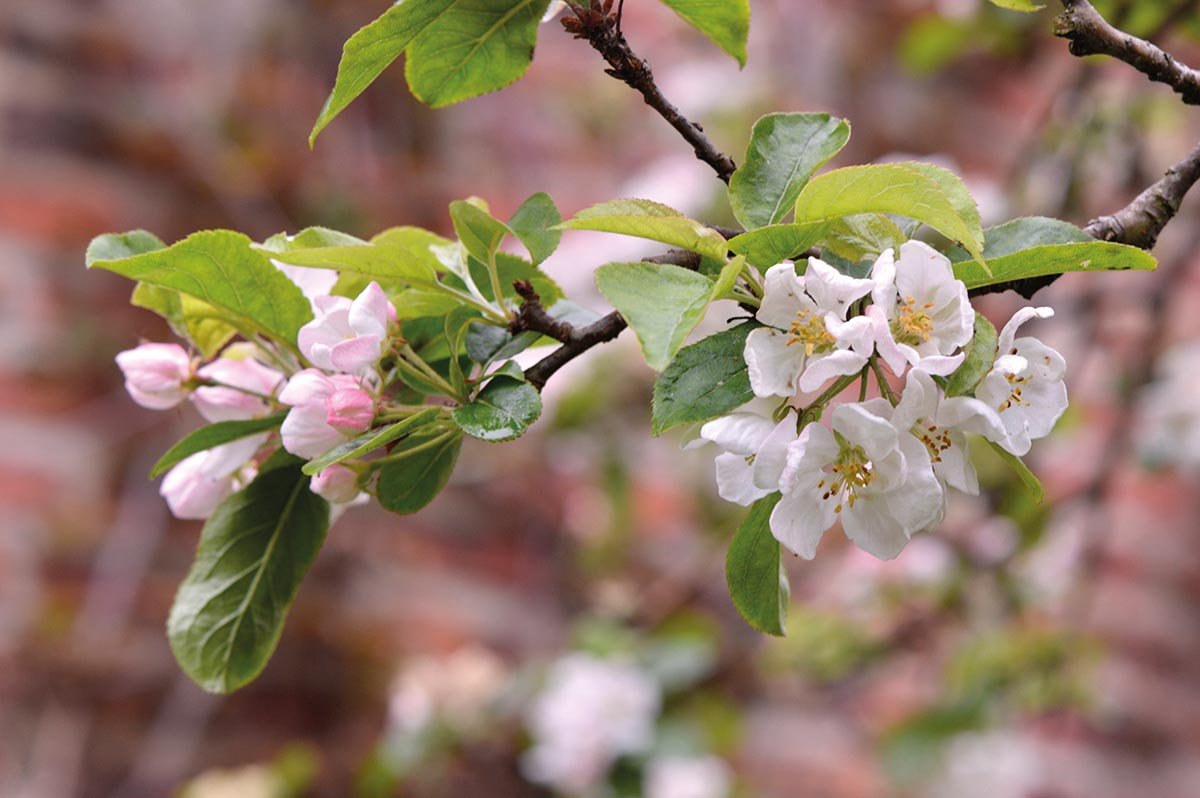
Blossom on crab apple ‘Red Sentinel’ (Photo by Susie White)
First published in edition 206 of The Northumbrian, June/July 2025
Susie White explores Morpeth Millennium Green, where a band of volunteers maintain a beautifully planted plot to provide a tranquil haven hidden from the bustle of a busy town centre
It’s always lovely to find a green space in the middle of a town; somewhere to pause while shopping or sit with a book while listening to birdsong. It’s 25 years since the Morpeth Millennium Green garden opened. Since then, visitors have been charmed by it, while for others it is a delight yet to be discovered.
A short passage leads off busy Newgate Street, passing the Old Bakehouse Tearoom where yellow corydalis with its ferny foliage sprouts along the pavement. The noise of traffic drops away as a sign reading ‘Garden open to the public’ emerges on the left. Walk between a pair of tall gates and the way opens out into a semi-woodland plot as calm descends.
That this special place is here at all is down to a dedicated group of people. “It was Bridget Gubbins,” volunteer Val tells me, “who applied to the Millennium Commission for funding to start the project. She’s a mover and a shaker. If it hadn’t been for Bridget this wouldn’t have happened. It was a derelict wasteland. There were abandoned cars, a broken-down greenhouse, brambles and rubbish.”
There are now 10 trustees and about six regular gardeners, plus other volunteers who help at events. This long, thin strip of land was once two burgage plots running behind the shops on Oldgate Street. It was owned by surrounding buildings and the local council and was sold to the Millennium Green Trust for £1. There was plenty of support for the project and grants from businesses such as the Co-op, and the handing over of the £1 was made into an event. “All the children came from the school with a penny each,” says Bill, Bridget’s husband and the garden’s gatekeeper. “Every once in a while, I meet one of them, now grown-up, who says ‘my penny helped to buy this!’”
The initial funding was enough to employ landscape gardener Mick Hall to create an initial design. Volunteers dug and cleared the site and schoolchildren were involved in the planting. That the garden has been given a Green Flag Award annually for the last 22 years shows how successful it has been.
This year there will be an anniversary party on August 23 for all those connected with the garden, and there are regular events, including tai chi, Christmas carol singing, and an annual fundraising fête. “It’s very much a community garden,” says volunteer Rod Mathieson, “a natural wildlife plot rather than a show garden, so we don’t have annual bedding. Everything is very sustainable.”
The parallel burgage plots create two levels separated by a long retaining wall. The lower level lawn is edged by a mixed hedge of hazel, cornus, holly and hawthorn planted in 2000. Cowslips flourish and are now “popping up everywhere,” says Val. There’s a woodland border near the entrance where foxgloves, periwinkles and lungworts flourish in the shade of a small grove of trees. The bronze-leaved celandine ‘Brazen Hussy’, with its yellow flowers is a spring delight, followed by wood cranesbill and Geranium macrorrhizum. A composting area is tucked away behind sarcococca and amelanchier and there’s a log pile to shelter wildlife.
The upper level gets more sun and here there’s a shrub border, a mix of dogwood, ceanothus, cotinus, pyracantha and buddleia. “The theme is scent and colour through the year,” says Rod. “The wall has just been rebuilt reusing all the mellow old bricks and decorated with circular tiles. They were made by mosaicist Julie Smith from Amble for somebody’s bathroom. When they weren’t wanted anymore she asked if we would like them . . . It’s called Effervescence, like bubbling water, and we like it as it makes a focal point while the wall is still bare.”
Set into the paving in front of a seating area is a large mosaic, the year 2000 at the centre of a compass surrounded by wildflowers, butterflies, beetles, ladybirds and snails. Made by Berwick-based Libby Orange, it features artwork by local schoolchildren. There are five smaller mosaics throughout the borders, also designed by children and celebrating wildlife.
That wildlife is encouraged by a wildflower garden where honesty, comfrey and wild garlic grow along with forget-me-nots, Jack by the hedge, red campion and primroses. Pyracantha is trained against the walls, valuable for its white flowers in spring and autumn berries. Welsh poppy, vetch and yellow Doronicums carpet the ground beneath a crab apple ‘Red Sentinel’, which is known as Joel’s Tree. Joel himself is the grandson of a trustee. He lives in Newcastle, where all the children born in a certain year were given a tree by the council. He had nowhere to plant it, so it came here. Now at university, he comes back to visit it.
Another special tree is a mulberry planted to commemorate the 16th century herbalist William Turner, who was born in Morpeth. Beneath it grow hardy geraniums and yellow archangel, with box balls marking the steps between the two levels. Below the retaining wall, Mick Hall designed a leaf-shaped bed that was originally going to be a bog garden, but there isn’t sufficient flow of water and it’s become a mixture of bergenia, asters, geums and bistort, with ornamental grasses, miscanthus and pheasant grass. The water would have overflowed from a basin commissioned in local sandstone when the garden was first made. Blackbirds bathe in it now, and when the sun is out there’s a jet of water powered by solar panels on the roof and cables that run under the paving. The garden is close to the River Wansbeck, so ducks sometimes enjoy the birdbath too. “Quite often they have their young in the garden,” says Bill. “When they hatch, the duck marches them down the hill. There’s a wall at the last house and the man living there takes the babies in a box and puts them over the wall!”
With pigeons crooning and chattering sparrows, there’s plenty of birdlife in this garden. The volunteers form a bird-feeding rota, twice a week for two weeks at a time, to top up the feeders that attract goldfinches and nuthatches. They’ve put up bird and bat boxes, and there’s a poetry box for people to reflect on nature and life itself. It was Val’s idea, after she saw one featured on TV’s Countryfile. “We get some interesting poems,” she says, “with some people pouring out their thoughts.”
The garden means different things to different people. There’s a quiet intimacy to the space and in lockdown it was especially valuable. “We have a real cross-section of visitors,” says Bill. “Folk come to have their lunch, or for peace and quiet. In summer, mothers come with their children because we don’t allow dogs, so they can let them crawl around on the grass. It’s a real amenity in the centre of the town.”
Susie’s latest book, Second Nature: The Story of a Naturalist’s Garden, published by Saraband, tells the story of the creation of Susie’s garden in the North Pennines