
Labour of love

A gardener trimming the famous yew hedges
First published in edition 204 of The Northumbrian, Feb/Mar 2025
Susie White explores the superbly restored gardens at Raby Castle in Co Durham, home to sublime planting, design and craftsmanship by a world-class team of designers and gardeners
Last May I joined a press tour of the newly remodelled gardens at Raby Castle, Park and Gardens near Staindrop in Co Durham. They are part of an exciting project known as The Rising which has also involved the restoration of a number of historic buildings and two thoughtfully designed new-builds. I don’t often write about gardens outside Northumberland, but this is such an important – and beautiful – development that I want to celebrate it.
I heard a few years ago that Lord and Lady Barnard had commissioned one of my favourite garden designers, Luciano Giubbilei, to plan a new scheme for the 5 acre Walled Garden that would incorporate Raby’s famous sculptural yew hedges. A scheme that sensitively respected the past while planting in a contemporary way. What I saw on my May visit, and again in September, exceeded my expectations.
It was Lady Barnard’s original concept to remodel the gardens, and from the initial idea seven years ago she has been involved at every step. She wanted them to have a naturalistic and half wild appearance without looking neglected. It’s a fine balance, and Luciano, whose thoughtful and understated work has seen him win gold medals at Chelsea, brought a sympathetic aesthetic to the design.
I talked to Dickon Harding, gardens and landscape manager at Raby Estates, and Becky Crowley who had just started work as assistant head gardener and will be looking after the Walled Garden. Becky was involved in some of the design with Luciano, creating a cut flower garden in front of the Gothic cottage orné which is historically the head gardener’s house and where Dickon now lives. “I’m very fortunate,” he says. “It’s a wonderful place to be.”
Becky joined the staff in early 2024. “I grew cut flowers at Chatsworth as well as working on a cut flower farm in America, and having worked in Luciano’s team I was delighted when the job came up and I went for it,” she says. Dickon came in as construction manager as the team were breaking ground, just as the big machines moved in. “It was a very exciting time to be part of it all,” he says.
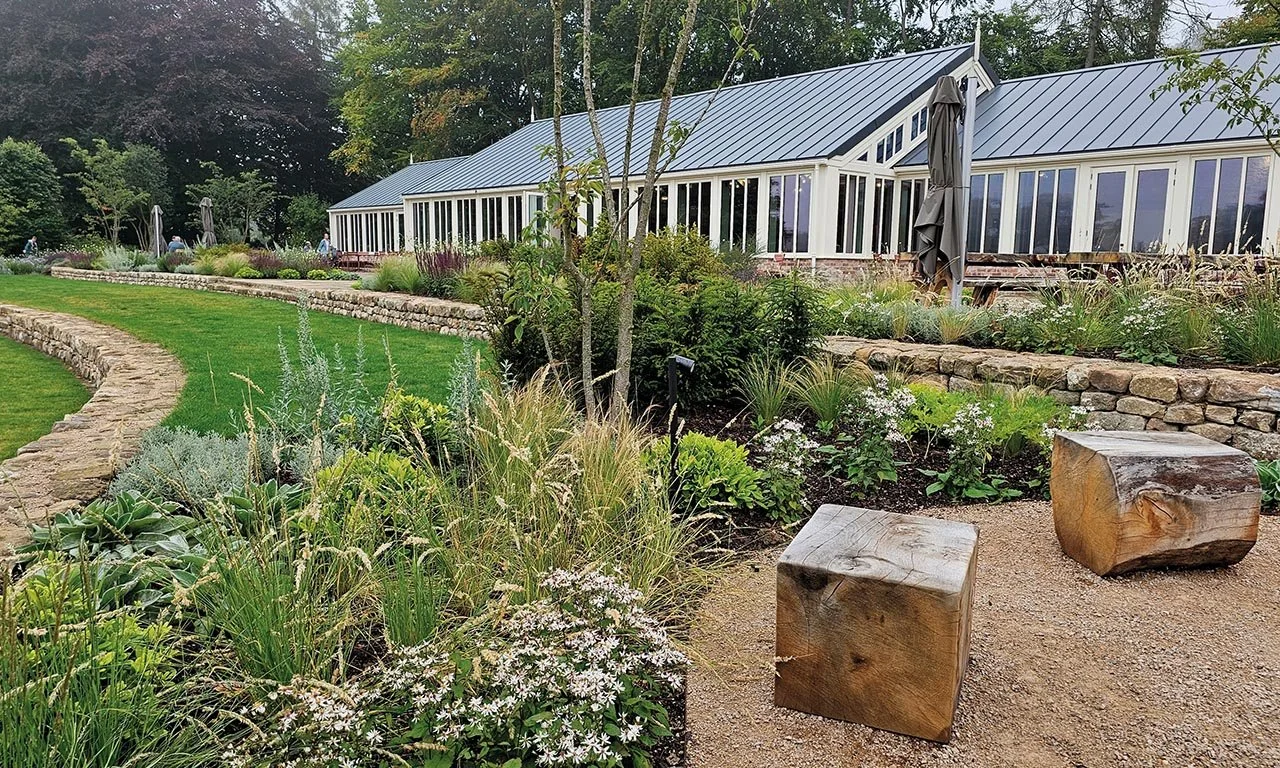
The Vinery above terraces designed by Alastair Baldwin
Construction began in August 2022 and took two years. “It was very efficiently done for such a big scheme,” says Dickon. “Everything within the Walled Garden was meticulously labelled, palletised and put into storage during the build by Luciano’s team. They catalogued each piece of statuary, each piece of stone down to the individual York stone flags, as well as reusing and recycling materials from all over the estate.”
Teesdale has a network of people with traditional skills and local contractors were brought in to work in the Walled Garden. Built from brick in the 1750s, this roughly rectangular garden is set on a gentle south-facing slope, the cloud-shaped 200-year-old yew hedges at its centre flanking a circular pool with a fountain. This long rectangle is divided into three spaces – the East Garden, a central Formal Garden now with a graceful rill running down its main path, and the West Garden. Luciano has land-sculpted the East Garden into a tiered grass amphitheatre, a place for summer music and performance, or just to sit and look out over the castle.
Above is a flower garden of grasses and perennials laid out in a pattern of blocks, each part with a different aspect to the planting. It gathers momentum as the season progresses with calimagrostis grasses brushing against tall white sanguisorbas, the purple domed heads of eupatorium, Joe Pye Weed, with nepetas and Cirsium rivulare ‘Atropurpureum’ attracting plentiful insects. The rising and falling of these undulating perennials, their fluid softness, the perfect foil for the brickwork and the castle’s stone walls.
Around the Formal Garden, four new yew mazes pick up on the colour and texture of the huge hedges. Amelanchier woodlands are laid out to either side, their meandering pathways leading in and out of foliage-rich planting: Japanese forest grass, Anemone ‘Honorine Joubert’, Rogersias, perennial honesty and persicaria. “These woodland plants, the ground covering wild strawberry, epimediums and woodruff, are starting to knit together as a plant community,” says Becky.
The West Garden will be the productive space, combining raised beds growing seasonal vegetables, a greenhouse displaying hot house plants and a cut flower garden full of roses, peonies, dahlias and sweet peas. To link the various areas, Luciano’s design uses simple repetition in soft colours, such as graceful wands of Gaura lindheimeri, with its white pink flushed flowers that seem to float in the air.
Luciano will visit this year, which helps Becky and the team to understand and stick to his vision. “It will be a help to know where to allow self-seeding into paths,” she says, “and to understand the subtle details, those nuances that create atmosphere.” It’s this continuity, the fact that she’s worked on both the design and maintenance that helps to realise and be sympathetic with the designer’s vision. “Luciano’s planting is designed to hold structure over autumn and winter,” she says, “so there will be some self-seeding and we will have to hoe and make decisions on what to leave. I love being involved in both sides, in the design but also in developing the garden over time”
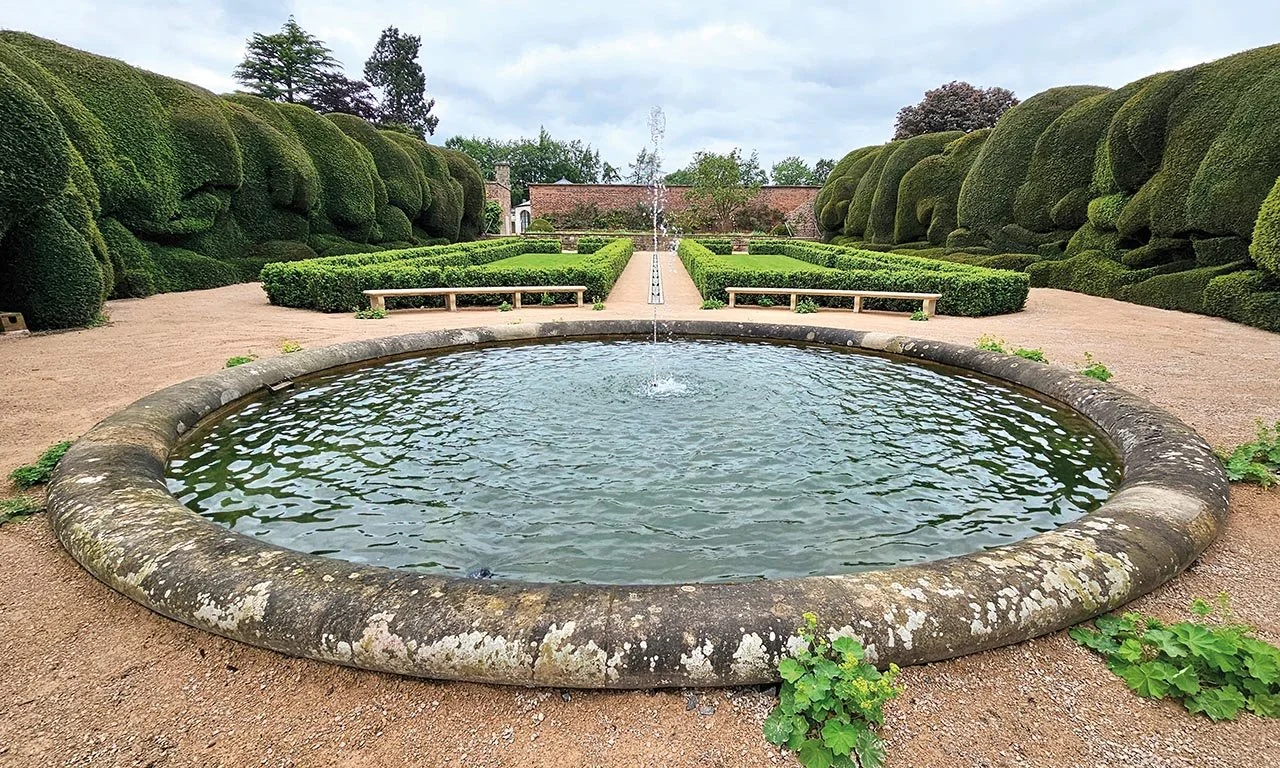
A fountain plays in the central pond between elephantine hedges
Outside the walled garden to the north stand some fine historic buildings. Previously unseen by the public, these have been beautifully restored with the same craftsmanship and attention to detail. There’s the Dutch Barn, a nationally significant building, high arched with two fascinating brick piers to allow ventilation. The 18th century Riding School was for exercising Raby’s thoroughbred horses in all weathers. And in the Coach House and Stables is a wonderfully imaginative display showing life in Teesdale carved as a huge relief table from estate oak by local craftsman Anthony Nixon. It was the idea of Lady Barnard, who loves the valley and says: “Teesdale is an amazing part of the world, completely unique and the flora and fauna are just incredible.”
The planting outside these restored buildings uses similar soft colours to Luciano’s choices, but this, and a wavy contoured terraced slope leading up to The Vinery restaurant, is the work of Yorkshire landscape architect Alastair Baldwin. Though distinct areas with distinct designs, both designers have repeated some of the same plants to link the schemes, and the atmosphere in both is soft and informal. The Vinery, a newly built glasshouse on the site of a previous one, uses produce from the estate in delicious lunches and wonderful cakes.
Huge solid tables on the terrace are carved from fallen timber from storm Arwen and you can sit surrounded by waving Stipa tenuissima, scented herbs, scabious, echinacea and Salvia ‘Caradonna’ interspersed with blocks of yew. Viewed over the purple blue and silver scheme is the castle set in its 18th century deer park. The impression I’m left with is that everything at Raby has been done with the greatest of care, using quality materials, dedicated craftsmanship, skill and thought and above all imagination and vision.
Susie’s latest book, Second Nature: The Story of a Naturalist’s Garden, published by Saraband, tells the story of the creation of Susie’s garden in the North Pennines