
What beck’ning ghost, along the moon-light shade*
First published in edition 203 of The Northumbrian, Dec 2024 / Jan 2025
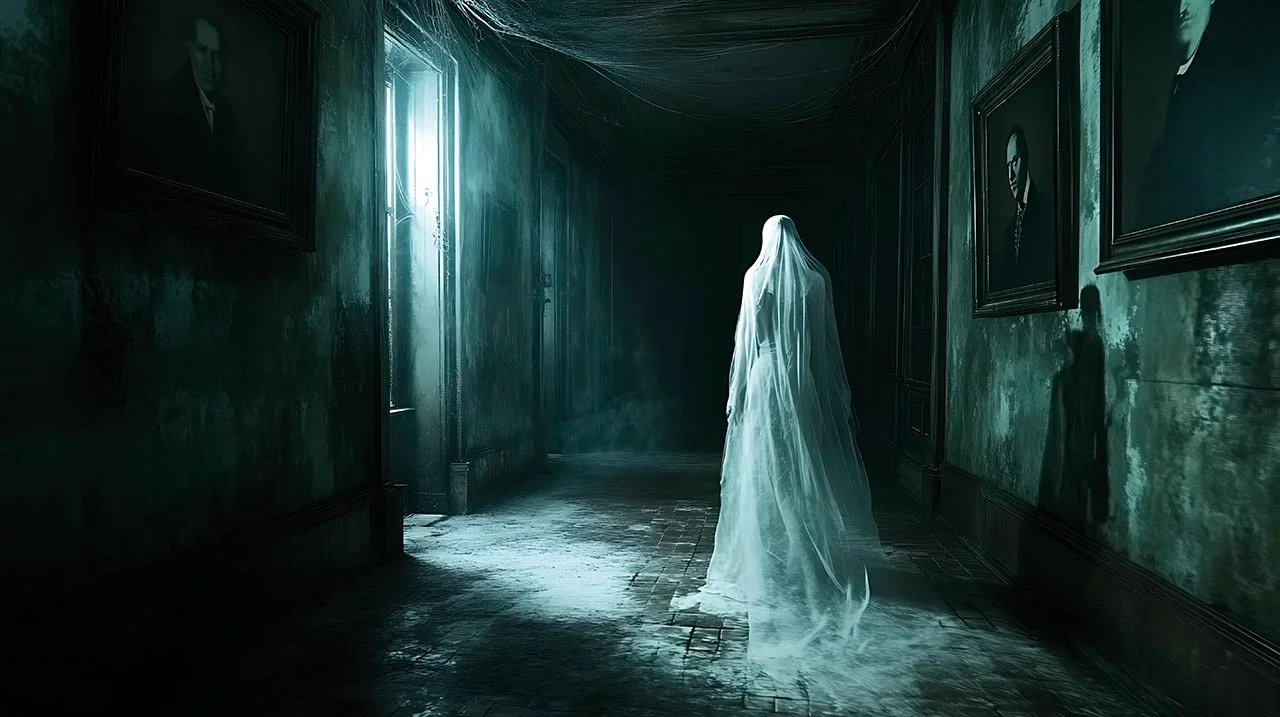
People the world over love a ghost story at Christmas, and as E JAY GILBERT reports in her new book, while the same tropes, such as the White Lady, endure worldwide, each spirit is peculiar to its locality
*Elegy to the Memory of an Unfortunate Lady, Alexander Pope (1688-1744)
At the start of October, I went to Bodmin Jail in Cornwall. Noted for having been the first reform prison, today it is a thriving tourist attraction where light shows in underground caverns tell its frightening history and on the way out you can see the original hanging pit. It is also home to a hotel where, after you check in, an obliging boy takes your bags up to your room and says: “Enjoy your sentence.”
I was there to give a talk about my new book, Haunted, Ghost Stories and their Afterlives, during an event delightfully entitled The Dark Symposium. Having expected this semi-academic conference to take place in a seminar room, I was thrilled to be escorted instead into the aforementioned caverns, where I was invited to stand at a podium with dry ice swirling around its base (I felt more like the music legend Prince than anything else!).
A key point in my book is that, although the same ghostly tropes recur everywhere, they tend to take on local flavour as they are intertwined with the culture, history and geography of an area. In Cornwall, I talked about Cornish ghosts, but afterwards, a chap with a North East accent came to say hello. I asked him where he was from. He said: “Crawcrook, but my mam’s from Rowlands Gill. You were talking about white ladies and when I was a kid my mam always told me stories about the White Lady of Gibside Hall.”
An interesting coincidence, I thought. Almost spooky. She gets around, that particular spectre, and she is, as I told this man, really the main character of my book. The White Lady of Gibside Hall – commonly believed to be some lingering shred of the late Queen Mother’s ancestor, Mary Eleanor Bowes – was the local legend of my childhood in Winlaton Mill, but she doesn’t stand alone. The North East of England is known for its castles, fortified stately homes and stark-faced bastle houses; a legacy of the embattled borderlands between two kingdoms. Once-grand houses of this ilk exist all over the country and the vast majority – at least legend has it – are riddled with ghosts. But then, ghosts sell.
In 2017, a survey was conducted by statista.com asking UK citizens whether they believed in the paranormal. The outcome suggested that 33% of UK adults were willing to admit to a belief in ‘ghosts, ghouls, spirits or other types of paranormal activity’. A similar survey conducted by Newcastle’s newspaper, The Chronicle, however, reported that 67% of its respondents believed in the paranormal. In 2009, Northumbria Police received a call from a man who claimed that he could see ‘eight witches’ on his roof; an evidently unacceptable situation which he felt they should do something about. Numerous others across Yorkshire, Cumbria, North Wales and East Anglia have chosen the police as their first port of call when they became aware of a visitor of the less corporeal sort, suggesting that some people approach the police before trying their luck with a priest.
Gibside’s White Lady has spiritual cousins all over the world: the Mexican La Llorona springs to mind, and the Japanese yurei. However, the way the spirit is understood and appreciated has its roots in the community and context that birthed and sustains her. The same is true of the White Lady of St Michael’s Mount, or Y Ladi Wen of Carew Castle. All ghosts are like this. While our love of ghost stories may be universal, our spirits themselves are specific and local, growing out of and feeding back into our communities.
The White Lady of Gibside is a product of her landscape, her time, and our time. When I was a child, Looking For The White Lady was a common pursuit. On long summer evenings, we would cycle for miles, the hair prickling on the backs of our necks, anticipating a flash of white glimpsed from the corner of the eye, or another child barrelling back down a hill at full pelt, looking as if he might have seen a ghost. We were looking to be frightened.
This is the impulse that drives ghost hunters to track the remarkably peripatetic ghost of Anne Boleyn from Hever Castle to Blickling Hall to the Tower of London. It’s the reason tourists linger in Marazion in Cornwall, hoping to catch a glimpse of a ghostly stagecoach transporting the White Lady to St Michael’s Mount. But it doesn’t explain the similarities between all these pallid women – nor the subtle differences in the stories we tell about them, varying not only with geographic distance, but with chronological distance, too. It doesn’t explain what drives us, all over the British Isles and beyond, to anticipate the same group of traits in a fly-by-night spectre defined by her gender.
Mary Eleanor Bowes of Gibside Hall, pictured above, led a colourful, stranger-than-fiction life. At one point the wealthiest heiress in Britain, the death in 1776 of her first husband, the Earl of Strathmore, ushered in a period of increasing disrepute for her. An affair with the working-class George Gray resulted in multiple pregnancies, all of which she illegally aborted while the affair continued. At this point in her life, Mary was held in contempt by much of polite society, so it is interesting to find no trace of this in any of the White Lady stories that circulate about Gibside Hall. The majority revolve instead around her second marriage to Andrew Robinson Stoney, during which she gained the appellation ‘The Unhappy Countess’.
Stoney, an Anglo-Irish lieutenant posing as a captain in the British Army, was the man whose name gave rise to the phrase ‘stoney broke’, so persistent was his state of financial ruin. The story of his seduction of Mary reads more like a contemporary tale of online sock puppet fraud than 18th century courtship. Intrigued by her vast wealth, he hit upon the idea of writing a series of articles for The Morning Post under a false name, criticising the countess’s moral character. He countered each article with a piece in her defence, and finally challenged the paper’s editor to a duel for Mary’s honour. Mary, romantic by nature, had no reason to disbelieve him when he claimed to be mortally wounded, and indulged his dying wish by marrying him. Nobody could have foreseen his sudden and miraculous recovery.
Despite the remarkable deviousness of this scheme, at least Mary, all-too aware of the draw of her huge fortune, had made a prenuptial agreement intended to prevent her husband controlling her wealth. In line with the wishes of her long-deceased father, Stoney took her name, but he meant to take her fortune too, and by physical force he induced Mary to sign a revocation of the prenup. Thus began a period of sustained physical and mental abuse, during which Mary was frequently confined to Gibside Hall. In 1785, she staged a daring escape and filed for divorce on the grounds of cruelty. Stoney, unwilling to admit defeat, abducted her.
Although there was much sympathy for her plight at the time of her eventual rescue, society placed heavy judgement upon her, both for her previous affairs and for an entanglement with a lawyer during the subsequent divorce trials. Mary lost her battle against 1780s public opinion, and in 1800, aged 51, she lost her life to an unrecorded illness (some reports have it that she was buried at Westminster Abbey in a pearl-studded bridal gown, as if hoping for a happy marriage in Heaven). Stoney, meanwhile, lost his own battle for control of the Bowes fortune, and later to invalidate Mary’s will, and he died, as he lived, in penury.
The once-grand Gibside Hall tumbled down over the following centuries. But the grounds and chapel are still there – and the dogged, determined White Lady. A key element in most stories of the Gibside White Lady is that she is benign, benevolent, and determined. A frequently told tale is of her being seen in a white carriage, escaping the villain who tried to keep her captive in the castle. Boys picking potatoes in the fields near Gibside once watched her leave and reported that she lifted a pale hand in salute. My grandfather, alongside numerous friends, claimed to have witnessed the carriage. Implicit in this tale is sympathy for the fleeing spirit and admiration for leaving a plight any woman must. It is this part of Mary Eleanor’s story which has endured, not her infidelities, nor the shocking reputation that dogged her.
The White Lady of Gibside, like many such spirits, has become so embedded in the local community that only about half of those who told their stories to me knew even snatches of the supposed foundation of the tale beyond a general idea of her as a woman in flight from evil. But there are scraps of it in the way she is seen and expected to be seen today. Children walking in the Derwent Valley are still encouraged to keep an eye out for a flash of white in the trees.
Of course, ghost stories serve a purpose. From the slate mines of Wales, to the pit villages of Northumberland, to the tin seams of Cornwall and beyond, the mining history of some parts of the UK has led to entrenched belief in protective spirits, shifting with the times but never eradicated. So powerful was this belief among the Cornish that their ghostly companions travelled with them to the USA. No mine could be thought safe without its resident ‘knockers’ and the fact that Californian mines produced the same phenomena that confirmed the presence of spirits in Cornwall merely cemented the connection.
Telling ghost stories is a much-loved pastime the world over, whether those spirits are really believed in or not. As the stories I have collected indicate, however, although many of our legends adhere to broad archetypes, they are also often specific, local variations, whose characteristics mean they simply could not have appeared anywhere else. Our ghosts grow out of our communities, then feed back into them in a process of constant iteration shaped by local culture, geography and history. A White Lady in rural Northumberland can only ever be, at best, a distant cousin of her central London ghost walk counterpart. Ghost stories twist in the telling, and the spirit in which they are told can have a significant effect. In the North East, that spirit remains extremely potent.
Dr E Jay Gilbert is a writer, academic and researcher based in Oxford, originally from the North East of England. She is a lecturer in Applied Linguistics at The Open University and her new book, Haunted: Ghost Stories and their Afterlives is published by Manilla Press