
What did the Germans do for us?
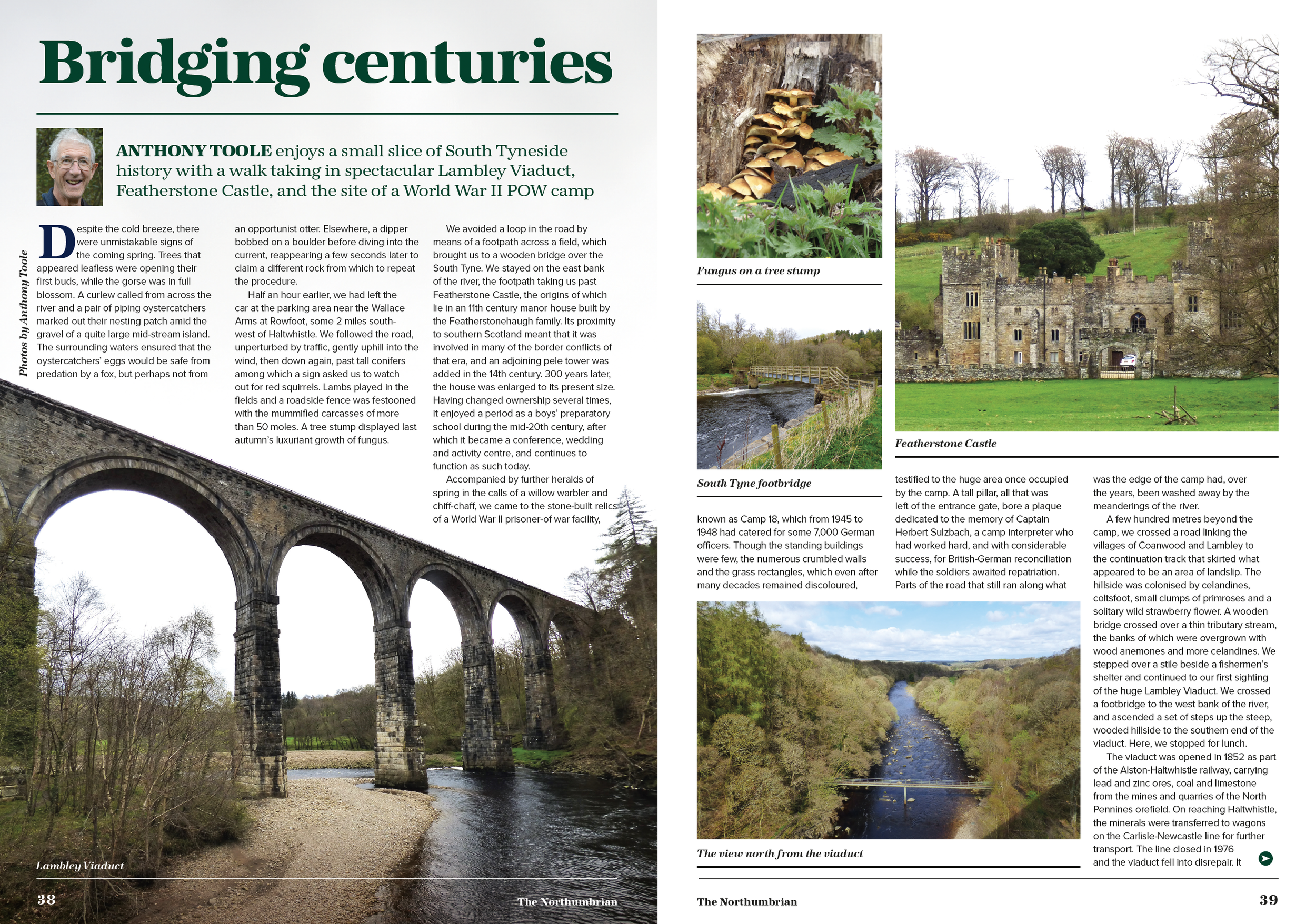
The article which prompted this letter
Your article on the South Tyne area in issue 201 of The Northumbrian contained a tantalising mention of Herbert Sulzbach, of whom I had not previously heard. Looking for more information, I obtained Ainslie Hepburn’s book, A Jew who Defeated Nazism, which makes fascinating reading.
Camp 18 at Featherstone did indeed house some of the most committed Nazi prisoners of war, and Sulzbach did an extraordinary job in bringing many of them around to be upstanding, democratic citizens of the new Germany. Many rose to high office, among them an officer who became a war crimes prosecutor and featured in the Treblinka Trials.
But I was left wondering what effect Northumberland itself had on the inmates of Camp 18, a number of whom never returned to Germany. Ms Hepburn indicates that one Wehrmacht officer became a policeman in Haltwhistle! The camp newspaper Die Zeit am Tyne (The Times on the Tyne) was printed by the Hexham Courant, it was translated into English by the pupils of Haydon Bridge School, and some 1,000 Germans turned up for the 1946 Remembrance Day service in Hexham Abbey. That must have been some sight!
Germans were sent out into Newcastle and elsewhere to learn the fundamentals of democracy, and when they finally went home they must have carried something of Northumberland in their hearts. Many of them considered their time in Camp 18 to have been a highlight of their lives.
And what did the Germans do for us? Northumberland was well populated with PoW camps. There was a large camp in Glendale, and when I was young in Chillingham in the 1950s there were several Germans who came to visit us. My mother was German, and had come to England in 1949. One in particular became an upstanding local figure. Their experiences of Northumberland were for the most part positive. My mother never spoke about her upbringing in Germany, but in later years she was prevailed upon to talk to Kirknewton Women’s Institute about her experiences, and I’m told she said that never once experienced any negativity about being German in Northumberland, and had been met everywhere with courtesy and kindness.
In the acknowledgements in her book, Ms Hepburn mentions a chap called Anthony Hellen, who she says ‘has extensive
knowledge of Prisoner of War camps, particularly in Northumberland’. It seems from a cursory search that he was formerly in the Geography Department of Newcastle University. He has lectured on the 1,500 POW camps in Britain, with particular reference to the 25,000 Germans who elected to remain in Britain, “and their impact on their host communities.” I bet he’d have some fascinating stories to tell about Northumberland.
As for Sulzbach – what a man! A proud and loyal German soldier in the First World War, driven out by the Nazis in the 1930s because he was a jew, a British Army officer in the Second World War and an indefatigable worker for reconciliation between races and religions until his death in the 1980s – there can’t be many people who had, inter alia, the Iron Cross First Class and the Order of the British Empire.
Pat Malone, Bodmin, Cornwall
Our sincere thanks to Mr Malone for this fascinating email, which has sent one of our writers down quite the rabbit hole, from which I fear it will be quite some time before she reappears. Rest assured, we are looking at this Mr Malone, and in the meantime, if any other readers have anything to add, we would be pleased to hear from you.