
Memories of Cambois
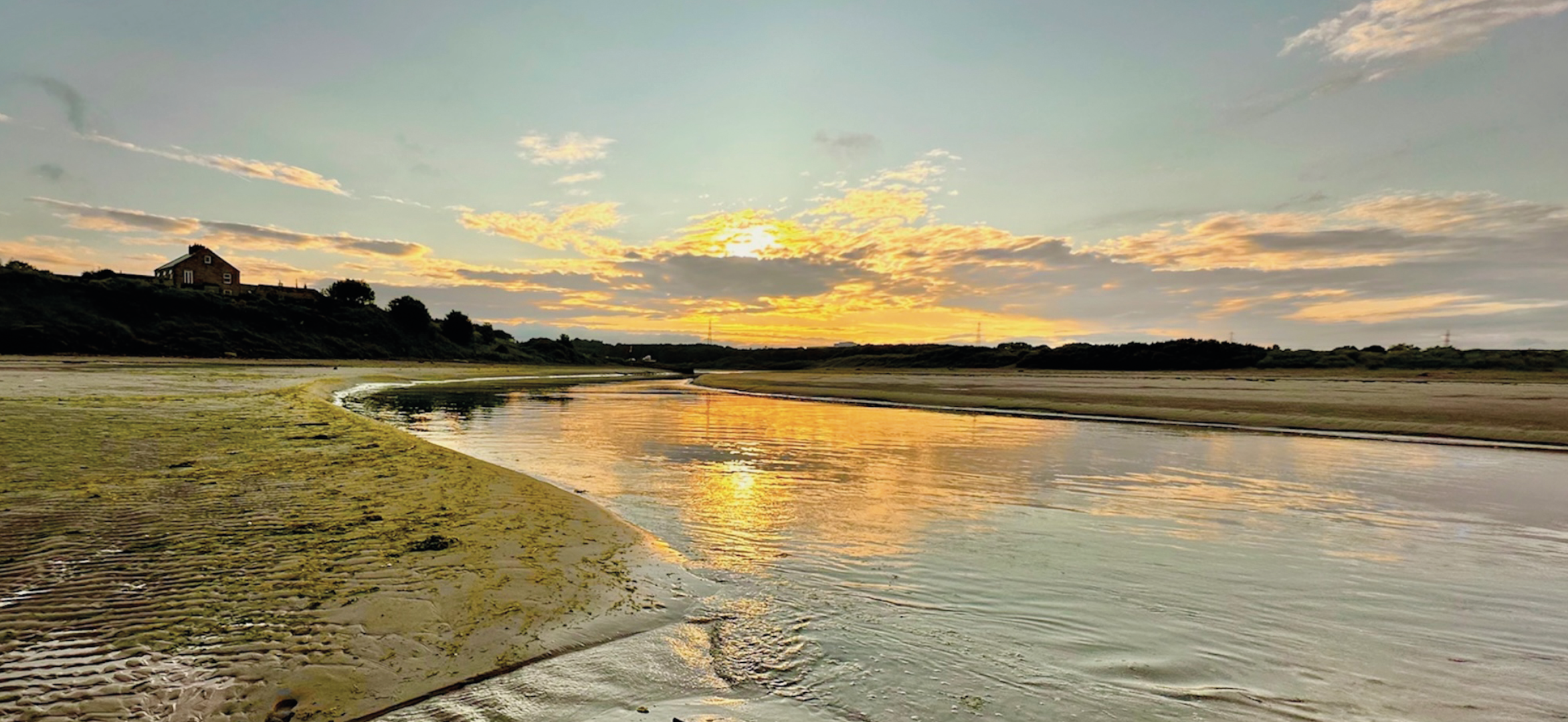
Photo: Simon Williams
Enormous thanks to Margaret Sleeman for her memories of growing up in Cambois, below, which were prompted by the letter from Ken Nesbitt in edition 202 (Oct/Nov 2024) requesting information about the origin of the nickname ‘Bogey Cheeky’ or ‘Boca Chica’ he remembered from the Blyth Ferry when he was growing up. Many thanks also to Simon Williams at Crest Photography for the photo he has kindly supplied to accompany Mrs Sleeman’s memories. It never fails to amaze and delight us at The Northumbrian how your letters prompt such fascinating conversations. Do keep them coming! Mrs Sleeman writes:
In response to the enquiry on this page about the Ferry ‘Bogey Cheeky’ in The Northumbrian issue 202 (Oct/Nov 2024) from Ken Nesbitt, the ferry was called the High Ferry and was part of our heritage growing up in Cambois (pronounced Camus). Boca Chica, meanwhile, was the name of a street in Cambois lived in by coalminers. The name Boca Chica was derived from sailors who served under Admiral Vernon at the siege of Cartagena and everyone thought it was an unusual name for a colliery row.
The ferry was used by everyone to go to Blyth for their shopping, mainly the twice-weekly market. Hundreds of workers used it from the shipbreaking yard Bolko’s, where ships came in from all over the world to be broken up and villagers queued up to purchase the furniture from the ships. Other users of the ferry were coalminers, fishermen, and children going to the grammar school in Blyth.
Cambois was a pit village and a wonderful place to live when we were young. We had a fabulous beach (still have) more than a mile long. We spent most of our school holidays there with jam sandwiches and a bottle of water each. Our parents never worried about us. The only message was to keep away from the River Wansbeck, which ran into the sea at the top end of the beach.
Cambois had everything we could ask for. Almost all the men and boys worked at the colliery and before the baths were built they washed in a tin bath in front of the fire. In fact, everyone in the family washed in the tin bath. The bath was placed on the ‘clippy mat’ lovingly made by the wives. The clippings for the mats were made from coats, skirts, trousers, etc bought from the jumble sales held in the Institute hall. Children were given the job of cutting the clippings. Almost every colliery house had an outside toilet which was either in the backyard or you had to cross the street ‘to go’.
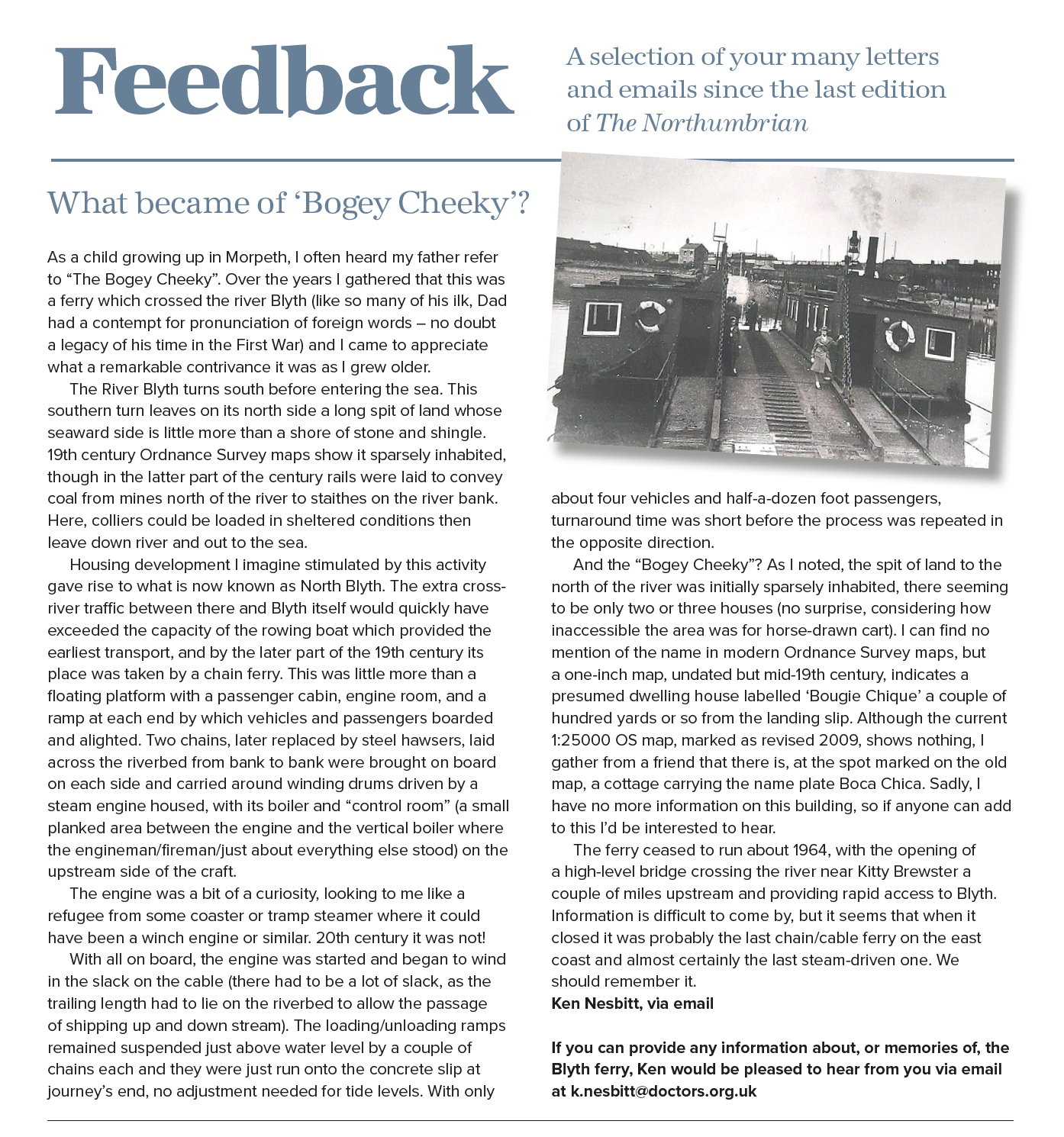
The letter from Ken Nesbitt which prompted Margaret to share her memories
The Institute was the hub of the community. Everything happened there – weddings, dances, the over-60s club, the Women’s Institute, the Women’s Guild, snooker, the library, films for the kids on a Thursday night (6d to get in and a free raffle ticket). We had boys’ clubs and youth clubs, rowing clubs, cricket and football clubs and many more activities for everyone. Every year the leek show was held at the Institute. What a competition that was. Enormous leeks were shown from allotments and gardens, and the first prize could be a television, which was wonderful. Everyone who entered received a prize and the secrets of how to grow such huge leeks were never revealed to anyone. They were carefully washed and wrapped in towels like babies before being taken to be judged.
What a wonderful life we had! There was no stealing because no-one had anything worth taking. Doors were never locked, and there was no graffiti because we loved our village. My mam used to go to Blyth shopping and leave the door open for the insurance man to come in and collect his money. A sandwich was made for him and a kettle left ready to boil to make himself a cup of tea. In the park we had a couple of swings and a teapot lid. Nothing was ever broken.
Once a year was Gala Day. The village band played while all the children marched down the road behind it towards the park. All the shows/rides arrived with their fabulous caravans. Races were run for the children as well as the adults. Lovely prizes were handed out which were treasured. Each child was given 2/6 to spend on the shows. Each little one was given a paper bag containing cake and a sandwich. Happy days!
The Co-op was for everyone, with a drapery, butcher, greengrocer, hardware as well as everyday food. Everyone had their ‘check’ number which you gave for every purchase and every six months you received your dividend which could be something like 1/8 for every pound you spent. A nice little earner greatly received. Everyone can still remember their check number from over 60 years ago. We had a small Co-op at the top of our street where my mam would send me for a fresh loaf. It was unsliced and unwrapped. I was always told not to bite the corners off before I got back, but I could never resist the smell and taste and arrived back with a neatly bitten loaf. Delicious! We had a barber shop above the Co-op butcher where the barber practised yoga between haircuts. My mam got the shock of her life one day when she walked in with my brother and the barber was balanced with his head on a bed of nails!
Those are just a few memories of our lovely little village by the sea. The pit closed in 1962 and all the colliery rows were pulled down. However, everyone who lived there, and some still there to this day, has wonderful memories to keep. We have our own Cambois Facebook page where older residents often put on photos and memories which bring a smile to our faces. Margaret Sleeman