
For the love of a fox
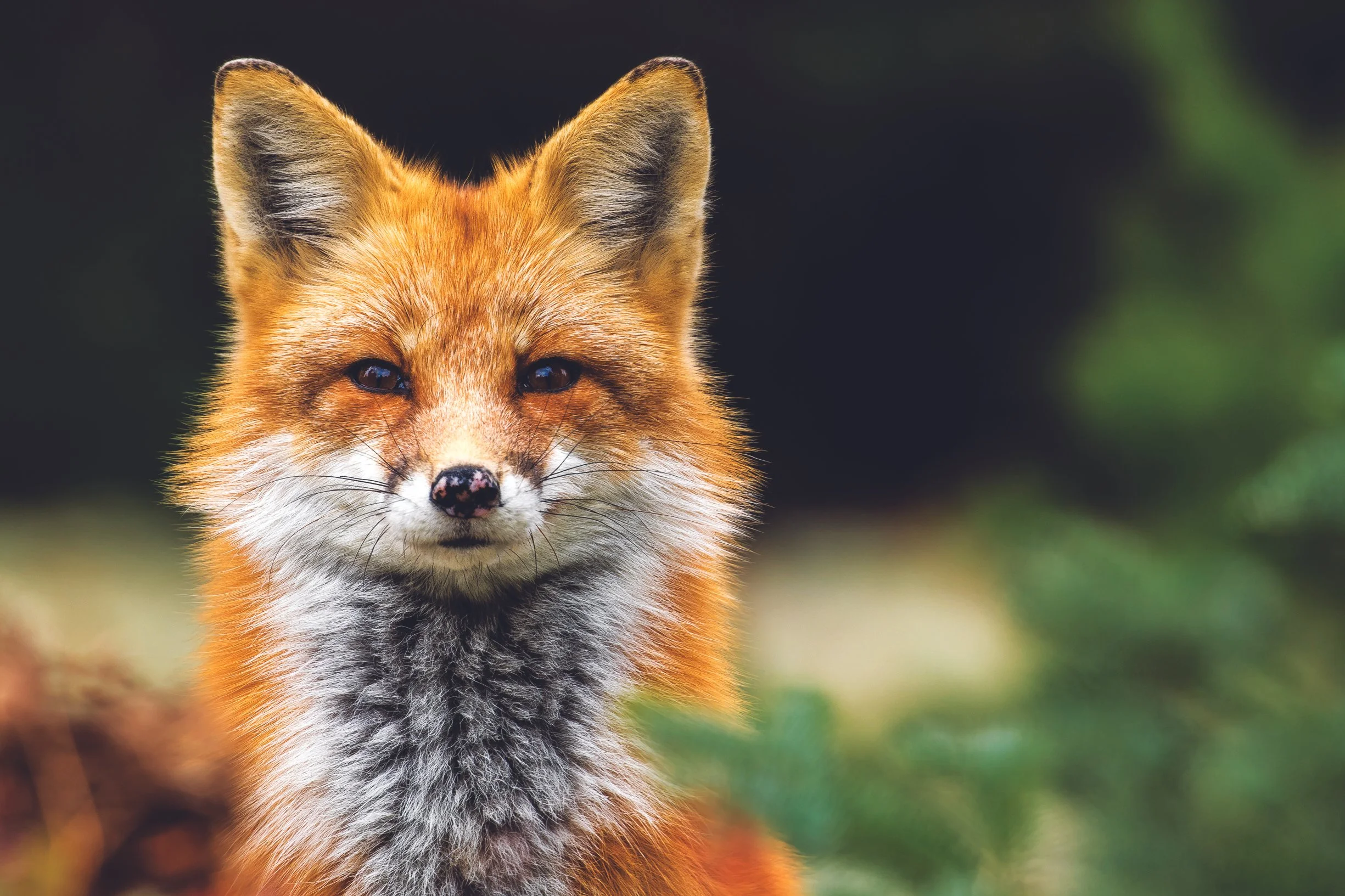
This week, our columnist Charlie Bennett is mostly communing with vulpes vulpes
I suspect it is reasonable to assume that, if you’re like me, funerals are not your favourite cup of tea. I certainly don’t leap out of bed bright-eyed and bushy-tailed on these occasions, which for some reason seem generally to take place in ghastly crems on dank, drizzly mornings.
I don’t understand how we have come to accept crematoria (most of them, at least – there are notable exceptions) as suitable places of departure. Most bring to mind the miserably utilitarian bus stations I remember as a child in the 1970s, at their best as they retreated in the driver’s rear-view mirror.
Having said that, I have on occasion been fortunate to attend a funeral where the setting was worthy, the most recent being on a sunny day at Hartburn church. If you don’t know this old Templar’s place of worship, then you should visit it, as it is one of Northumberland’s finest, and, having completed a moving service, the vicar led us out into the beautiful old churchyard to put my favourite aunt to rest in a fitting setting.
This was a perfect day, satisfyingly chilly with not a cloud in the sky. In my memory, a robin might have been singing in a holly bush, but otherwise it was silent. Then, as we gathered for the denouement, my attention was caught by a movement beyond the graveyard wall. The church is on the edge of a dene below which flows the River Hart. Studying the landscape, I realised that, on the other side of the dene amongst the bracken, a fox was sitting watching us, its head cocked to one side, as dogs’ often are when they are engaged in something that piques their interest.
Illuminated by the low sun setting off the russet red of its coat, the fox watched the proceedings intently and, as the last words were spoken, moved off gently.
I had a tear in my eye and a lump in my throat. Not only for the late aunt, but for the connection I felt with the fox and, in some strange way, for the deep understanding I felt I had subconsciously observed between the fox and the departed.
Am I being over-sentimental, or fanciful, about a fox? Some will say so, but I think not. For humans have been connected to foxes in one way or another for millennia, existing in tandem on every continent apart from Antarctica, and our link is strong.
Foxes do, however, have a bad habit that is not good for their wellbeing, or indeed ours, in that they like to steal our lunch, and, sometimes, our livelihoods. We humans like to keep our livestock close at hand, where we believe they are safe. But this corralling of sheep, poultry and game presents a fox version of McDonald’s which requires constant protection. Thus, you might think that people who have to contend with these highly intelligent predators would hold them in lower esteem than rats or Parisian bed bugs, yet Mr Fox is often highly respected.
The reason for this becomes apparent when we look into their lives in a little more detail. The name fox comes from the old English meaning “thick-haired tail”. Its intriguing Latin name Vulpes vulpes just means fox (funnily enough, not two foxes), while the other words associated with it are generally rather lovely. ‘Vixen’, for example, is another old English word (when ‘f’ was transposed by ‘v’), while the fox collective noun is, rather wonderfully, a ‘leash’ or a ‘skulk’.
Foxes are beautiful, with a flattened skull, upright triangular ears, a pointed, slightly upright snout and of course a bushy tail, or brush. Around the world they vary in colour, but in the UK the fox is usually russet red with a white tip on its tail.
They weigh 5kg-8kg and grow to about 40cm at the shoulder. Unlike domestic dogs, they are not long-lived, few progressing much past three years of age. In terms of diet, they are best described as opportunistic omnivores. “On ze menu zis evening Monsieur Reynard, is a berd, a medley of beetles, wabbits, wats, a veeld vole, a fawn and, for pooding, a brace ov verms...”
Foxes mate in the winter, as signified by those eerie screeches from the woods that seem to grace every Agatha Christie film (even when the murder has taken place in mid-summer). A few weeks after the fox and vixen have made sweet music, a litter of four or five cubs will be born. Both parents will take responsibility for feeding their offspring, and may be joined in this task by one or two of last year’s cubs, which will stay close to home and help out until they have found their own territories.
They are crepuscular (another wonderful word), which means they are largely active at dawn and dusk, which is worth noting if you want to see them. If you miss them, then you can still see where they’ve been as they often deposit their poo (known as scat) on mole hills or rocks. This scat is twisted, smelly and often contains the fur of the animals the fox has been eating.
Highly successful opportunists, foxes occupy a wide range of habitats. If food is plentiful, they can survive in around 25 hectares (about 62 acres in old money). However, if you get into an area where food is more scarce, such as the Scottish Highlands, their range grows massively – potentially up to 4,000 hectares.
Smaller habitats such as urban landscapes have an abundance of food and town foxes have adapted to live closely with humans, becoming far bolder than their country cousins and often venturing out during the day. But in all its guises, town and country, the fox is very much an apex predator. This is mainly because the animals that once preyed on them, including bears and wolves, are largely no longer with us, though one predator that will take a fox, given the chance, is the golden eagle.
You might think a badger would have a go, too – it is certainly strong enough – but foxes and badgers often tolerate each other to such an extent that they will share a den or sett. How the fireside chat goes I don’t know, but it does seen to work.
To succeed as it does, the fox is a wily opportunist, and as such it has lent our language many descriptors. If I were to beat you in a game of draughts, for instance, you might say that I had “out-foxed” you, or call me “cunning as a fox”. But the linguistic use of the word is not restricted to acts of cunning. For these are beautiful creatures, so a good-looking woman (in my cancellable generation) may be described as “foxy” (I refer you to The Doors song, Twentieth Century Fox).
Keen on the study of changing social mores in linguistics (and a brave soul), I set out to see if these descriptions remain appropriate. My findings were that women of my generation are okay with being called a fox (some even blushed and laughed), whereas those of a generation younger tolerated it but don’t much care for it. Clearly, I did not ask anyone younger, as I may have had my face slapped.
It’s probably time that I put this story to ground. I fear that I haven’t quite put my finger on the mysterious beauty of this animal, and this is no bad thing, as if I were to succeed in this then surely a little of their magic would be taken away.
Suffice to say, the fox’s seldom-viewed life is something I’m always delighted to glimpse. Whether that be a cub studying my bemused labrador and me because the wind was coming with it and it couldn’t smell our dangerous scent, or the time I watched a cock pheasant chase a big dog fox along a hedgerow. That, and the many times I have simply watched one moving sinuously through the countryside, unseen (to most) and unheard. On all these occasions, my senses have become quickened and I have felt part of what is around me, rather than just an observer.
If, when the time comes, I have the honour of a brambly plot in Hartburn churchyard, I would like to think a fox might amble along to the dene to see me off. Or perhaps the foxes which do this are not so much turning up to bid farewell to those hefted to the countryside, but actually to welcome them to the next place, bright-eyed and bushy-tailed.
Charlie Bennett and his wife Charlotte own the Middleton North estate near Wallington, where they work to support existing wildlife and attract new species alongside sustainable stock farming designed to add to the diversity of wildlife in the area. www.middleton-north.co.uk
• To enquire about volunteering, email charlie.bennett@middleton-north.co.uk
• Charlie’s book, Down the Rabbit Hole, the Misadventures of an Unlikely Naturalist, is available in hardback at: www.charlie
bennettauthor.co.uk