Getting to know your daemons
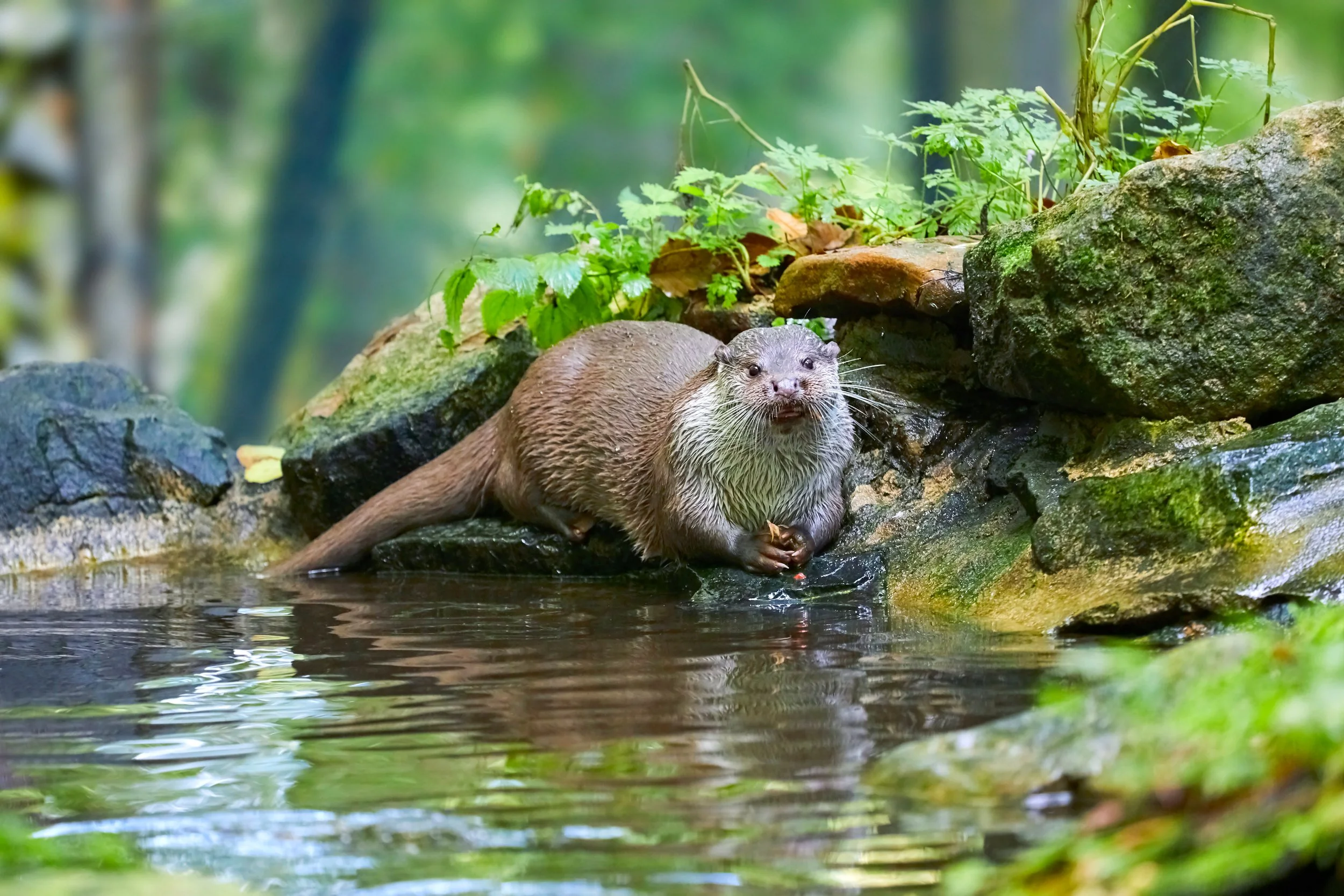
Charlie’s daemon is the otter . . . what’s yours?
This week, our columnist Charlie Bennett is mostly dealing with his daemons
I often wonder why certain animals have such a profound effect on me. The closest I’ve come to explain it lies in Philip Pullman’s Dark Materials trilogy. In these books, every character has an animal alter ego – a daemon. This animal is of opposite sex to the character and often acts as their moral compass and voice of reason. If the character is separated from their daemon, they die.
A visceral connection to a wild creature – is such a thing possible? I think it is. But before we dive into my personal daemons, some advice on finding your own...
We are encouraged these days to get out into nature. This is excellent advice, but I fear this sometimes takes the form of an ‘experience’, or day out. Something you can ring fence in your diary. But to get really close to nature, you need to go deeper. This requires time and the ability to switch off from the everyday.
An example – in mid-summer I like to get up early to go and sit by one of our ponds. It’s important to be comfortable, so I take an old coat to sit on and a flask of coffee. Often, the morning starts misty, the sun that has never really gone to bed lighting the sky a burnt orange. A few birds will start up – sedge warblers whistling and popping, skylarks calling to mates from on high, the distinctive squeak of a swallow as it takes an emerging nymph from the surface of the pond. And I sit quietly, taking it all in.
Slowly, everyday worries start to fall away. A dragonfly appears, quartering the pond like the swallow on the hunt for breakfast. Now, as I begin to tune in, I catch movement under the water as a newt breaks cover to dart dragon-like to a copse of weed. Soon, I am fully immersed, as if a gossamer tent has been cast over the pond to create a world consisting of nature and me. I am no longer just observing – I’m part of it.
This is when your daemon might appear, because if you are still and in the moment, wildlife will accept you as part of its world, rather than seeing you as a threat. I find that one (or all) of three creatures may appear at this time, somehow lifting me out of myself and into their world.
First, a roe deer may appear ghost-like beside the pond. Roe deer are browsers, constantly moving and feeding. They seldom drink from the pond because they pick up the moisture they need from what they eat. They move very gently and inquisitively, and are a joy to watch.
Then, a swallow – a creature which seems somehow hefted to me – may show itself. The swallow’s first arrival in spring can make me emotional, tearful even, like seeing a very old friend after years of separation. Similarly, its departure is sad, as I often miss it – there one day, part of my landscape, yet gone the next. Why do I feel so connected? I think because of the swallow’s beauty in the air and the sense of joy it exudes as it goes about its business. Also, the meeting and parting is a reminder of life’s fragility.
To my final and most likely daemon – the otter. I am fortunate to have seen many otters, generally while fishing. Over the years I’ve learnt that to be successful as a fisherman, you have to think like a fish (Where is food? Where is cover from predators? Where can I rest? Where is a place to mate? Where is a good source of oxygen?) and over the years you learn to read the water for these tells.
This is another immersive experience, and, like the theory that the more you do something the more it becomes muscle memory, so does reading water. Fellow fishermen will describe a river as ‘fishy’ in spring. Press them and they may initially struggle to explain themselves, but push a little and they will dig into their subconscious to explain that riverside plants are developing, the colour of the water changes and becomes (this might just be in my mind) more ‘sparkly’, and early insects begin to emerge on warmer days.
Another power – our innate hunter-gatherer – is also at work here. Generations going back as far as we have eaten fish and game have known when it is time to hunt a chosen prey, which is why the 17,000-year-old cave paintings in Lascaux, France, represent a calendar of which animals are ready to hunt at which times of year.
So, I am wired to the ways of the river, and this brings a stillness, an ability to move quietly, a sixth sense of what might be ahead. Last year I was trout fishing on the River Lyd in Devon. This is a beautiful river in a deep valley, surrounded by ancient cow pastures with gnarled old trees dotted along its banks. This makes for tricky casting, but if you get into the river quietly, a short cast is often possible. The trout are wild, coiled on hair triggers, which means that the slightest suspicion of danger and they’re gone.
As I approached a pool on a bend, my senses told me something was up. Electricity sharpening my mind, I crept around some rushes, my senses telling me, ‘go slow, something’s there, you just haven’t seen it yet’. Then, there she was – a female (sow) otter. (This is the most un-pig like creature on earth, but the female is a sow and the male is a boar, which are lazy nomenclatures in my book. More of an elegant hen or a beautiful mare, perhaps?)
My otter was busy catching crayfish, diving down, no doubt turning stones over with her dexterous fingers to grasp her prey, which is no mean feat, as crayfish have vicious pincers. She then brought her prize to an island of driftwood to gobble it up. I watched, transfixed, for I don’t how long. That’s the joy of daemon watching – time is a human-made construct and evaporates when you’re immersed in nature. Eventually, I withdrew quietly, her feeding more important than my fishing, sat down in a sunny spot and committed the experience to memory.
This is one of many otter encounters. Like the swallow and the roe deer, the otter has a physical pull on my heart. Why? Well, its physicality is amazing – sinuous, fast, and tenacious. And it has a friendly face, curious and canny. It is also accomplished at fishing. Whereas fly-fishing is a difficult occupation, done above the surface, trying, as described above, to read the runes of what lies beneath, it takes great practice to decipher the messages and hopefully catch a fish. The otter probably does all that too, but it can also enter the fishy realm underwater, where it is in its element. Yes, it’s good being human, but I’d give a lot to be an otter for a day.
Where does this leave us? Well, it reminds me how much I crave these experiences with my daemons, and the sense of wellbeing which follows. So, if you get the chance, find yourself a quiet spot and switch off. This can take time and practice, but I promise that amazing things will happen, and in time you will have your own daemons to cherish.
Charlie Bennett and his wife Charlotte own the Middleton North estate near Wallington, where they work to support existing wildlife and attract new species alongside sustainable stock farming designed to add to the diversity of wildlife in the area (www.middleton-north.co.uk).
To enquire about volunteering, email charlie.bennett@middleton-north.co.uk
• Charlie’s book, Down the Rabbit Hole, the Misadventures of an Unlikely Naturalist, is available in hardback at: www.charliebennettauthor.co.uk