
Down the rabbit hole
First published in edition 208 of The Northumbrian, Oct/Nov 2025
In the latest instalment of his column chronicling his encounters with country life in a corner of Northumberland, Charlie Bennett is mostly channelling his inner lumberjack
I hope that as we head helter-skelter into autumn that you have lots of nice memories of a delightfully warm and sunny summer? You might have thought that I have spent the clement months lounging on the beach, watching cricket, or snoozing in the shade of an old oak. I am sorry to say you would be wrong. A great deal of my time has been spent chopping and stacking wood. You could be thinking this odd for the summer months when thoughts of log fires should be banished to back of most people’s minds. However, we live in Northumberland, in a house that is (in local parlance) “Baltic” at the best of times, so we have a fire nearly every day of the year – and that means we need a lot of wood.
Luckily, we are blessed with woodland on the farm, and with the help of storms and the need to thin younger plantations, if we can get out there with chainsaws, we’re pretty self-sufficient.
But this hasn’t always been the case. When we lived in Somerset, we had a cottage with a garden but no access to wood. Thus, I took to being a log highwayman. If I spotted a fallen limb in the road, I’d sneak out in my old Land Rover in the dead of night and purloin it (or I’d ask the landowner if I could have it and nearly always they were delighted to say yes).
One night I set out when it was blowing a hooley. For an accidental arborist, this was a good omen, and I remember thinking the storm could bring rich pickings in the morning. On this occasion, I had gone for that impossible thing – a quick drink. That’s a bit like stopping at one square of chocolate or not licking your lips when you’re eating a doughnut, and when I entered The Stag’s Head, the fire was roaring and, as my Irish friends would say, “the craic was moighty”. No surprise, it quickly became a slow drink.
Fast-forward to the next day and, sore-headed, there I was digging over a flower bed. At the time I was learning my trade as a horticulturalist at the delightful East Lambrook Manor. The task that morning was not an easy one by any means, as the head gardener insisted that we double-dig everything and fold in tons of well-rotted compost. As time went on, I started to develop worsening pains in my chest, so I phoned Mrs Bennett to ask if she could get me an appointment with the doctor the next day. About a second later the GP was on the phone demanding to see me immediately. He was concerned that I might be having a heart attack. That garnered my attention, and I ran for the Super Cinq (an ancient Renault 5 I’d bought for 100 quid) and headed at not immoderate speed to the Doc Shop. I was welcomed at the door and rushed into the surgery where, after listening to my inner workings and prodding me with various thingummy bobs, the doc looked stumped. “Not your heart, I’m glad to say, Charlie. Have you lifted anything heavy recently?” My immediate answer was “No.” Then emerged a glimpse through the Guinness-induced fog to the night before. “But I might have come across a tree on the walk back from the pub last night.”
This isn’t my only mishap over years of wrestling wood back to the hearth. I have written before about when I learnt to fly. You might remember I was standing on a substantial beech log, having just handed my son a chainsaw, when the log, which was the size of a mammoth, decided to spin. I was ejected backwards, where my head brought me a to a crash landing and another trip to our friend in a white coat (the GP) resulted.
On another occasion, I decided to fell a tree. Felling a trees is the black run of wood chopping, but I’d been on a course and felt comfortable knocking down a 60ft ash. What I hadn’t considered, however, is that trees have minds of their own. All may look well, but years of competing with their neighbours can create strange forces in a tree trunk, and rather than falling neatly away in the opposite direction to where I stood, this one came straight back at me. Fortunately, I discovered the reflexes of a fighter pilot and managed to leap out of the way as it flew past, smashing through a fence and blocking the road.
A common trait among farmers is never to admit to unforced errors, and that tree was logged and the fence mended as fast as you can say “amateur”.
The above are all life lessons in foraging for wood. Yes, I have possibly eroded my quota of cats’ lives, and I’m not sure St Peter will be pleased to see me clad in Stihl orange when I pitch up at the pearly gates, though yer man downstairs might be more accommodating. The fact is, I must keep the home fires burning regardless, though I have learnt my lesson and no longer try to fell trees, or do anything much apart from cutting up the easy stuff.
So, let’s assume we have a trailer full of lumber. This is taken back to the shed where we cut the lengths into logs and put them through a splitter that lives on the back of the tractor. Again, this has its risks, as the splitter works under the sort of pressure that would make Trump see Putin for what he really is.
You must read each log as you split it. A gnarly one, by which I mean it has lots of branches growing out of it, is what I call a “bastard”, the reason being that they are unreasonable and thus difficult to deal with. The splitter will do it, but in the process the log may explode and send several pounds of wood whistling past your ear on its way to Morpeth. So, I avoid bastards (Donald, you might take note if you are reading this).
An hour or two of splitting reasonably minded logs will yield a satisfying pile. Now, when cutting logs you need to think about the lovely fire they’re destined for, and this requires starter wood, fast-burning logs, and slow-burning ones. This combination allows you to start a fire, find it still lit when you return from toiling for hours in the spring sleet, get it going again when it goes out, or tamp it down overnight and start with a warm glow in the morning.
Thus, we enter the realm of the log library. The issue with logs is that they arrive at different times because we come across timber on the farm nearly all year round. Each batch will season at a different rate. To get technical, a decent log should have a moisture content of less than 20 per cent. This means different batches have to be stored chronologically or classified separately so that you can achieve even seasoning through the stacks.
For logs, there is no Dewey Decimal System (it’s used by libraries to arrange books via subject using a numerical system developed by Melvil Dewey in 1876). What I do keep in mind, however, is the classification or identity of the types and sizes of logs we have. On our farm we get a wide range of hardwoods – oak, ash, beech, hawthorn, cherry, elder, sycamore and alder – while our most common softwood is scots pine. All have different characteristics. I find oak takes the longest to season, scots pine is the quickest, and the rest settle somewhere between the two. You can influence this by providing optimum conditions, direct sunlight and wind being the best combination for the fastest seasoning.
Ideally, you stack them facing south, with a cover on top, in a place where the west wind can blow across the face of the pile. This isn’t always possible, which is why my Uncle Robert had the genius idea of seasoning logs inside. What’s the point of bookshelves full of books you never read? “Stack ‘em with wood!” he’d say, merrily lobbing a precious first edition of Down the Rabbit Hole into the grate. You know that corner between the spare bed and the radiator? Just fill it with old whisky cases packed with logs – the perfect ambush for visitors going for a pee in the dark.
Sadly, Uncle Robert, one of the most delightful men you could ever meet, is now with St Peter. His idea of Stihl orange was a ghastly non-alcoholic drink, so I’m sure he skipped into Heaven, located the Grouse bucket and the Players Navy Cut, and proceeded to keep the folk up there smiling into eternity. Following his demise, my Aunty Jane was relieved to get her house back, there being enough wood stashed in Robert’s various log libraries to fire a reasonably sized liner across the Atlantic.
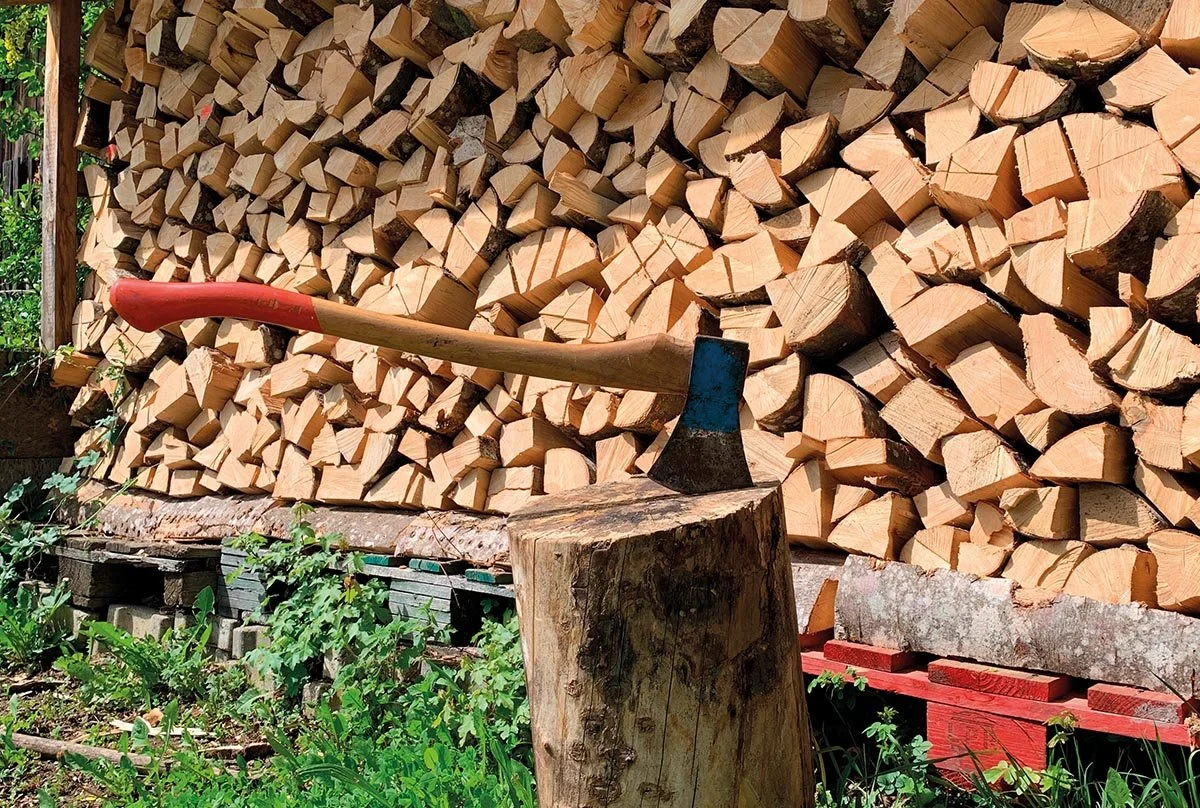
I too enjoy some internal log storage, but I delight in creating log libraries outside and in the shed. It’s a bit like dry-stone walling. My rule is that once a log is picked up, it has to go on the stack. Not only that, but the stack must be pleasing to the eye. Family members find this boring, so we generally end up with a beautiful log face with a massive mound of higgledy piggledy logs behind it – a worthy compromise to get the family in on the action.
By now you might be thinking it’s time for me to get central heating and a life, but there is a deep joy in working with wood at any time of the year, which is deepened by burning logs into which you have invested time and energy. Thus, I recommend you start a log library of your own, inside or out. “But I don’t have a fire . . .” you might be thinking. Don’t worry – I’ll be round in a year or so to collect the seasoned rewards.
Charlie Bennett is co-owner of Middleton North near Wallington, where he works to support existing wildlife and attract new species alongside sustainable stock farming designed to add to the diversity of wildlife in the area. For information, visit: www.middleton-north.co.uk
To enquire about volunteering, email charlie.bennett@middleton-north.co.uk
• Charlie’s new book, Climbing Stiles, A Wander Through the Countryside & Beyond, is available in hardback priced £14.99 at bookshops and at: www.charliebennettauthor.co.uk