
Season’s greetings
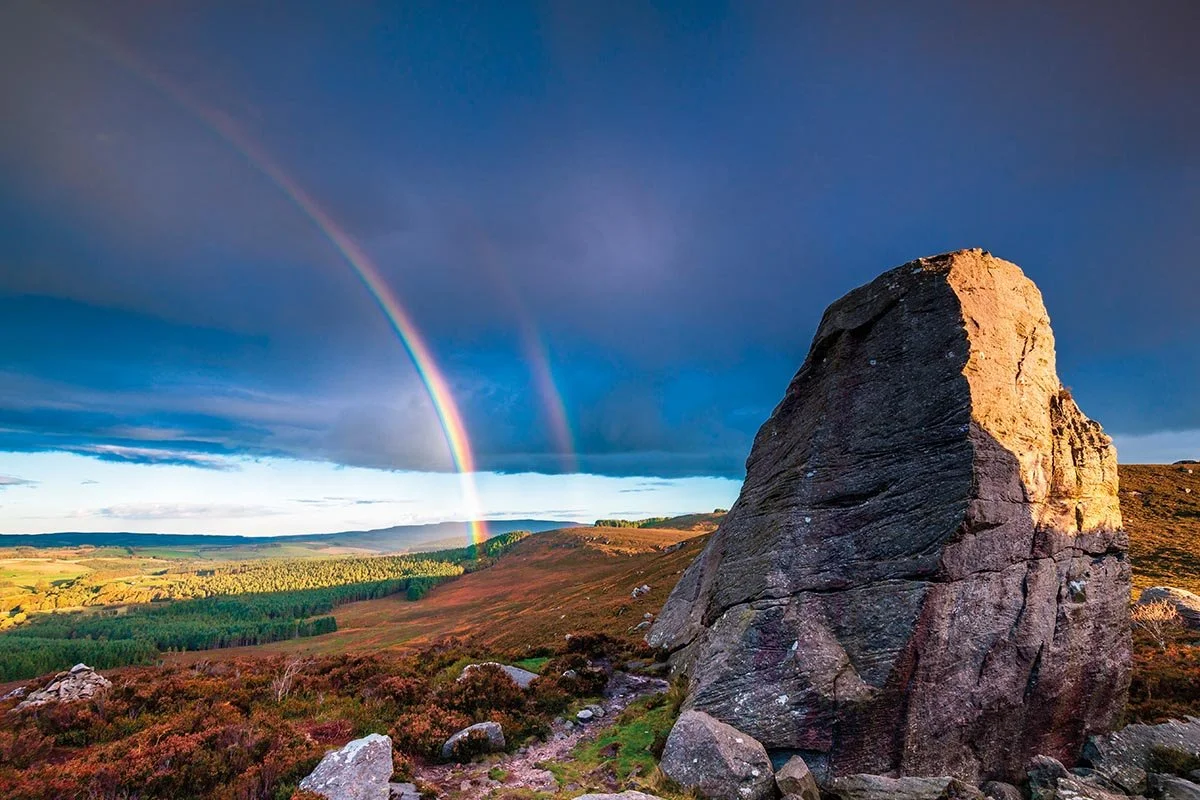
The mighty Drake Stone at Harbottle
First published in edition 208 of The Northumbrian, Oct/Nov 2025
Northumberland Wildlife Trust chief executive Mike Pratt celebrates the return of autumn while reflecting on the increasing merging of the seasons and its effect on the natural world
I recently met an avid reader of the Northumbrian who kindly said she had a previous article of mine on her noticeboard in the kitchen, as it was a ‘year-round up’ of all the wild things and places to see them around Northumberland. She liked to glance at it to keep her in kilter with the seasonality of local wildlife. I took that as quite a compliment, and it’s the sort of thing I also pull out of publications and keep, as I like to read about the phenological changes we see and experience every day, week and month, as well as the main seasons we recognise and how they change year to year, sometimes radically and increasingly unpredictably.
This ‘unseasonability’ is increasingly noticeable. The other day I walked over a hill castle’s grasslands to find them covered in fresh dandelions and other spring flowers in late September. Even birds and insects are confused. Some migratory birds are arriving later to breed only to find there isn’t the right food at the right time for their nestlings. Though for the most part we have had marked seasons this year, though hotter spring and summer.
I am very plugged into the cycles of nature. It gives me a natural framework to experience and live by, and it keeps me attuned to the biorhythms of natural happenings, from sky events to seasonal food or activities, recognised celebrations or ones that I’ve invented to mark every aspect of the dynamic life around me. Like the regular feasts of the first parasol, blewit, chanterelle and cep mushrooms I look out for, all of which have been either later or earlier than expected so far.
So, since we are now past the autumnal equinox and heading into late autumn, I thought I’d reflect on the sorts of things we can anticipate coming our way. It’s my favourite season, maybe as I was born in early November. I love the sequencing of its never-ending happenings in the qualities of the light and sky, the aromas of the soil and vegetation, the constant changing of the colours, and even the tastes of it in those fungal and other delights I watch for and forage every year. This is truly a time of heightened sensory perception in nature.
It’s not always the big things I notice. I love the way strands of summer linger into early autumn; I hanker for the last swallows on their third broods, and for the odd swift floating through, perhaps from Lapland. Drowsy butterflies settling on overripe fruit, bees and wasps, ladybirds studding ivy leaves. There’s the ripening of everything, from hazelnuts to the many fruits; sleepy hedgehogs putting on their hibernation weight; badgers renewing bedding. It’s endless.
It’s as if the life pulse of the warmer months is pushing the boundaries of seasonal transition, attempting to extend or move the margins with its aliveness; while all the time that life is closing down, becoming torpid, readying for the great recycling.
Where would I go to immerse myself in autumn’s essences? I’d start in woods and forests. They are the holders of many of the season’s secrets and splendours, and Kielder in its immensity offers endless possibilities, while the burns running into the lake, the broadleaves around Bakethin, and the castle are all fine foraging places. They also have a great variety of colours, trees and shrubbery. You might see one of the last adders, and slow worms or common lizards basking on the track sides on a sunny day, readying themselves for the retreat to their hibernacula.
Other woods on my list at the moment include the Lee near Simonside. In fact, any of the thinly self-planted woods down the little burns of that area are lovely and offer the odd surprise, such as a very large crab apple tree I came across with ancient hazel, rowan, sallow and alders – more than ten species in a small grove by the water’s edge.
At any time, the area around the Drake Stone at Harbottle, with its birch woods, rocky outcrops, heather moor and lough, is beautiful, and at the moment it is at its best. Recently, I saw a big flock of redpolls and siskins there as I stood soaking up the unique atmosphere by this great head of fell sandstone. Combine a visit with the meadows and ruins of Harbottle Castle, where there’ll likely be ravens and, if you’re lucky, field mushrooms. Afterwards, I recommend you nip down to The Star for a pint.
I also like to visit old churchyards with berry bushes in October to catch the first incoming redwings and fieldfares. Will this be a good waxwing year? It’s certainly an exceptional one for hedgerow fruit, so we can hope so.
The coast has the power to transport us into the autumn spirit as pink-footed geese arrive in skeins from Iceland. I once followed these amazing migratory birds south as I journeyed from Greenland through the length of Iceland, seeing them in every field along on the way and arriving back in England to witness their first arrivals. Visiting some of our less obvious estuaries such as Blyth and Wansbeck can yield passing waders and wildfowl, and if the wind is in the right direction, Lindisfarne is worth a special trip for passerines, brent geese, and whooper swans inland.
Northumberland is blessed with such a range of opportunities to see the seasons change, it is pretty easy to do all the above and more. There is one more benefit of all of this that comes for free when you are out there soaking it up, especially in those aromatic rainbow-coloured woods, and that’s Shinrin-yoku. What’s that, you say? It’s the proper name for ‘forest bathing’ – and being out in the woods at this time of year is incredibly revitalising. Just soak it all in.
Those trees breathe out analgesics and help to reduce our stress. I know this for sure now, as I was recently involved, via Northumberland Wildlife Trust, in a research programme with Dr Luke Bashford at Newcastle University. He is a neuroscientist studying how our brains and bodies react to moving from stressful, urban places into nature. It’s something we aim to do more work on locally; looking at the potential of nature to calm us in testing times. Take it from Dr Bashford – and from me – it’s really good for you to get out there this autumn!
Mike’s books of prose and poetry about the natural world, including Infinite Wonder, Loving Nature Back to Health, are available via Northumberland Wildlife Trust at www.nwt.org.uk and at selected bookshops, also online at Mike’s website:
www.livingmindfullywild.com