Season of plenty
Noctilucent cloud
First published in edition 207 of The Northumbrian, Aug/Sept 2025
Northumberland Wildlife Trust chief executive Mike Pratt celebrates the return of what has been a true summer both in weather and wildlife terms, encouraging the return of nature
One swallow does not make a summer, but 20 of them chattering on the wires outside my window definitely does. It seems that we are in danger of being able to say we have had, or are even still having, a proper summer, and after the wetness that pervaded 2024, this seeming return to normal seasonality is a relief.
We know the seasons are an increasingly movable feast, as we witness the extremes and unpredictability of weather that climate scientists have predicted for years. But at the moment at least, since we’re getting some rain as well, it feels like good news for us and for nature. It may be a one-off, even too hot a reminder of global warming to some, but so far, I’m enjoying it!
I like the apparent return to insect, bird and other wildlife abundance. We know the reverse is true in national and local trends, but our summer has reminded us of how it could be if we allow nature space and time to recover.
Insects first. Have you noticed the number of dead ones on your car windscreen this year? And occasional clouds of aphids, harvest flies and others rising across rivers, gardens and fields as if from nowhere, to be swept up greedily by those swallows, swifts and martins. Even wasps and crane flies have been back. We see fewer every year, but they have been here this summer, reminders of camping and picnics on my personal baseline of the 1970s. At one point I saw a cloud of moths under an outdoor lamp – something I’ve not seen in the UK for decades. And the butterflies which were hammered last year are around in good numbers and species this year.
As the insects have flourished, the birds have bred well. Multiple clutches of garden, field and hedge birds have delighted us. The wren has been calling constantly since March and has raised at least three broods. The same goes for blackbird, robin, tree and house sparrows, goldfinch and dunnock, and those hirundines. Unintentionally, we have created a service station in our garden for these fledglings. We even watched a meadow pipit and then two young stonechats balancing on the lilies and bathing in our garden pond. Everything seems to have done well here.
Rabbit populations have exploded, creating scenes reminiscent of Watership Down on the Druridge coastline. As a consequence, their nemesis, stoats and weasels, are seen more at Hauxley and the dunes. Leverets also seem to be in good evidence. It almost seems that nature is in balance again.
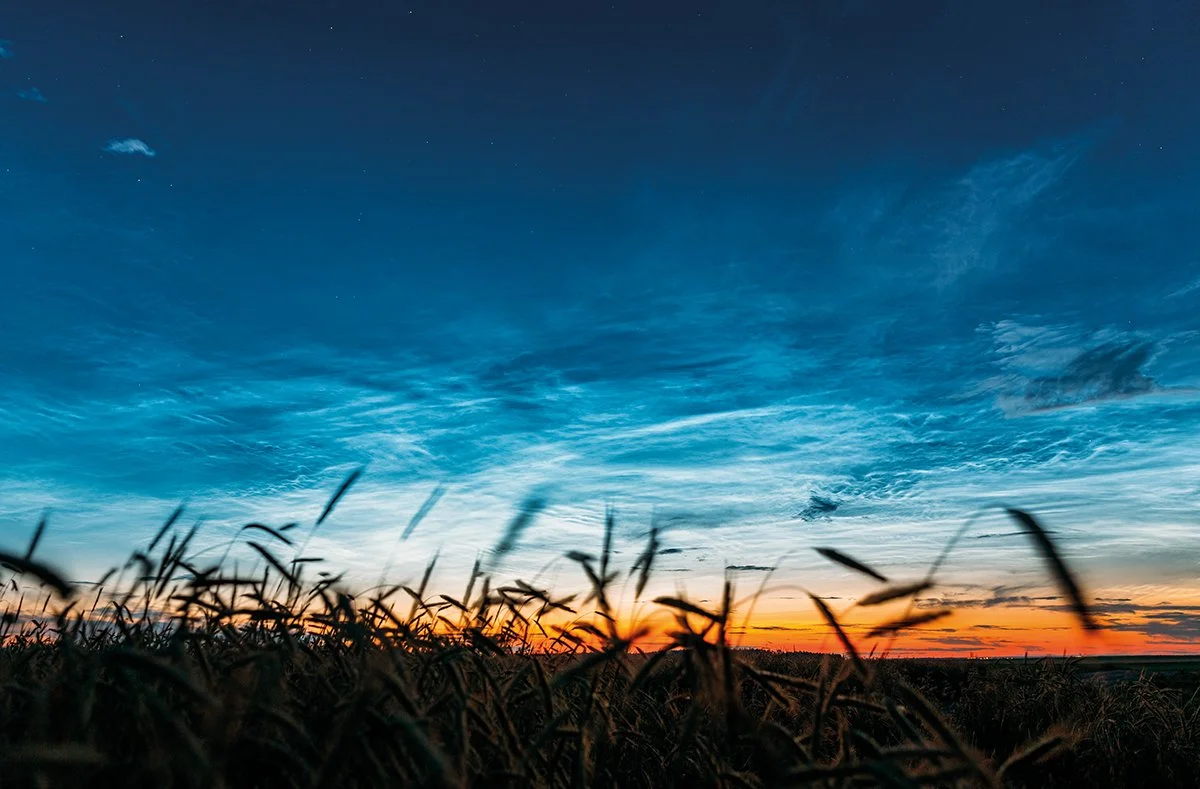
There are other good things about the summer, like the return of dolphins and minke whales off the coast around Amble, where they have been spotted chasing herring and mackerel. There are also stunning sunsets and sky phenomena. One late evening travelling back from Kielder I saw what I thought was a particularly wide sunbeam piercing the clouds. Reminiscent of the Northern Lights, it was in fact a rare thing called a noctilucent cloud, apparently the highest type of cloud in our atmosphere. And yesterday we saw a dynamic sunset, the sky magenta and mauve tempering to sienna. It’s been warm enough to eat and sit out all evening, and swim in rivers and the sea. All of it is a blessing.
You might be waiting for a ‘But’ by now. It all sounds too good to be true, too ‘roseate tern-spectacled.’ Maybe the heat has gone to my head? But I’m just making the most of it, taking in the wonder nature offers when it works the magic we are built to tune into. When there is a lot of life around us, we thrive too.
Rather than a but, the big question is how can we optimise this for ourselves and the planet? Get a sense of abundance, diversity and all it brings, of being in a healthy environment? How can we make this not seem like a total exception? We can’t control the weather, and to make a dint in global warming we need to act fast politically, not just individually or in the UK, but across the world. But that – cooperating for bigger wins – is something we don’t seem to be good at right now.
So what can we influence? It is in the local landscapes where we live that we have made change happen for millennia. This is done by adopting the right mindset, leaning towards nature and balance rather than away from it, managing land and even the economy with nature in mind and balancing farming and forestry to achieve a living, productive, nature-filled place. That is when every season, every year, will feel rich and life-affirming.
Where to start? In our gardens and our villages, in our parks and even on roadsides, as many people are doing already. Every village I visit in Northumberland seems to be taking action saving squirrels, creating ponds and planting trees, often involving children. There is a slow but sure move towards a green revolution, despite a bigger negative picture. Northumberland Wildlife Trust is supporting this effort and wants to do more, especially between the coast and Kielder, with Rothbury in its heart.
This 40 mile-wide corridor across north Northumberland – from the wilding coast at Druridge to wild Kielder and the borderlands, to the College Valley and Cheviots and down through the border mires to Hadrian’s Wall corridor – is perhaps the biggest opportunity for communities, farmers and landowners to deliver connected wins for nature.
It’s already a beautiful series of landscapes in north and west Northumberland and the coast, with areas of great nature quality. But more connectivity and nature-led farmed and community-managed areas will create a uniquely bio-diverse and abundant place, perhaps with nothing like it anywhere else in England. That’s what the Wildlife Trusts, the National Trust, Northumberland National Park, and a variety of farmers and landowners are working towards, and we hope to inspire more of them, in addition to enabling local people to do their bit. The scale of this vision matters because it really does offer climate resilience, which means less unpredictable and more enjoyable seasons longer term.
We’ve done the maps, and the Local Nature Recovery Strategy, something every region needs to produce, has looked at all the existing and potential for nature north of the Tyne to come up with the picture described above.
Data and instinct are telling us we have an exciting opportunity here. A network for nature we can all be part of, fuelling farming, food, wellbeing, and the economy. The sort of thing we do well in Northumberland already.
It’s worth reflecting on the possibilities while sitting here in the sun watching the commas and meadow browns, the grass veneer, burnet and orange underwing moths, the leafcutter bees squeezing into tiny holes, bumble bees immersed in artichoke flowers, listening to the birds and watching the swallows floating on the summer breeze. It’s a lovely summer, isn’t it?
Mike’s books of prose and poetry about the natural world, including Infinite Wonder, Loving Nature Back to Health, are available via Northumberland Wildlife Trust at www.nwt.org.uk and at selected bookshops, and online at:
www.livingmindfullywild.com