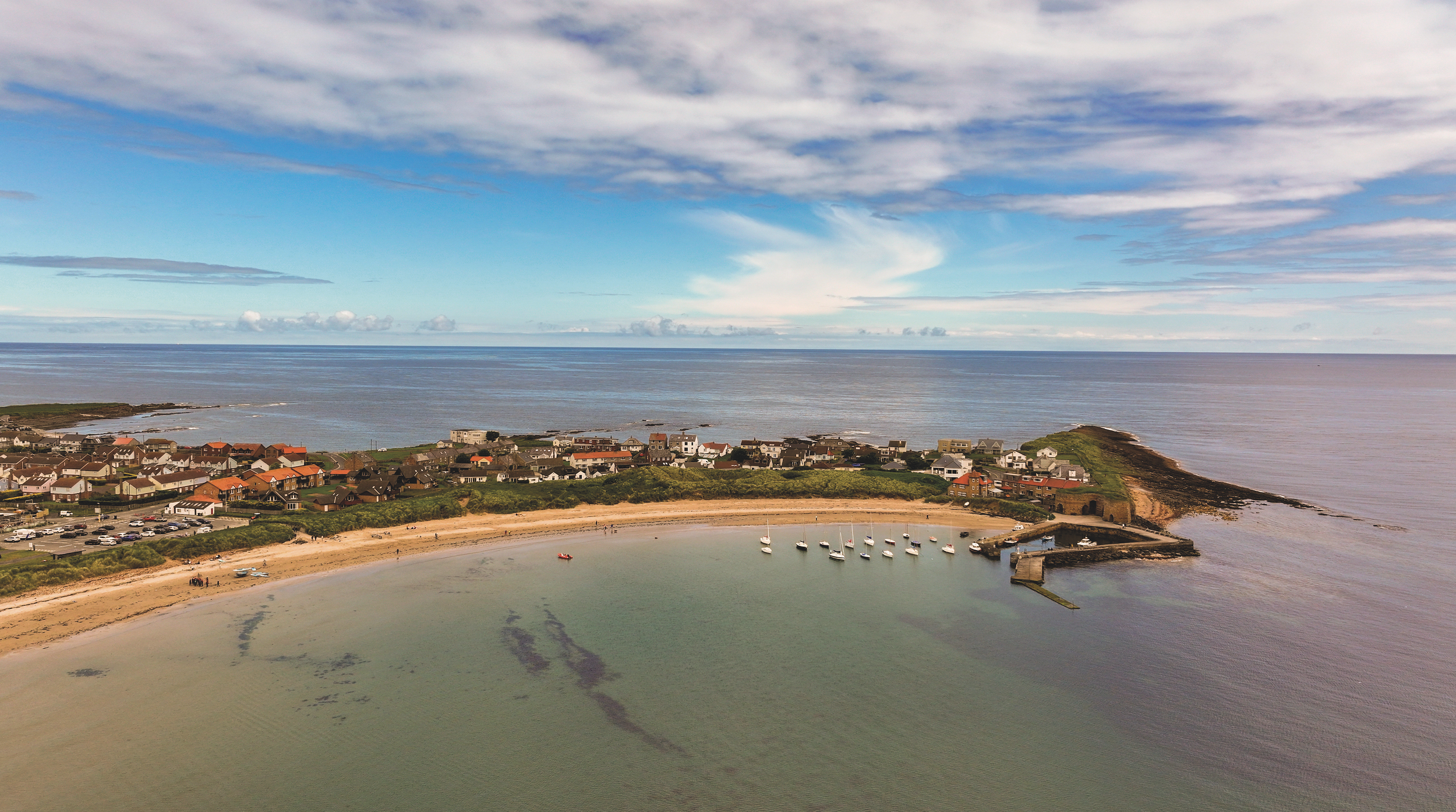
Liminal places: Beadnell Village is set at the end of the sheltered, sweeping crescent of Beadnell Bay
First published in edition 212 of The Northumbrian, June/July 2026
Northumberland Wildlife Trust chief executive Mike Pratt reflects on how our vast skies and liminal lands create a rare sense of connection with nature that inspires a vision for a wilder future
What is it, I wonder, that makes Northumberland feel so fundamentally different from the rest of the North East and even the larger area that was known as Northumbria?
I love travelling to far-off northern places, exploring them in a bid to assimilate all the elements of the vast, open wildness I so often crave, soaking up the sense of spaciousness and nature that comes from seemingly endless skies, land and seascapes, far from human activity, embraced by that sense of unbounded wildness that is the true north.
While not on the same scale as the sub-Arctic, Scandinavia, or the Icelandic ‘wastes’, I feel those far north places simply represent further extremes of what I see and experience in microcosm here in Northumberland when I am out walking its countryside, coastline, hills and valleys. Could it be that a sense of the true north starts right here in the county named after it?
Being a North Yorkshire man and having friends in the far south (i.e Manchester) who think they live in the north, I have to tread carefully here, but surely there is something utterly different, subtly magnificent, about Northumberland? My wife and I (she is an adopted northerner from London) feel this every time we walk and camp in its countryside, coast and borders. As I write, we are just back from walking the beaches of Bamburgh, Beadnell, Ross Links, and Boulmer in all weathers; a few days during which we both felt this again profoundly.
On the face of it, these are ‘just’ beaches, yet they are so much more than that; uniquely flat and planar, light-reflecting as only beaches in Northumberland seem to be. Standing on an almost deserted Bamburgh beach, just a few tiny figures in the farscape and the castle a cinematic backdrop, the weather alternating between heavy downpour and laser-sharp sunshine, it felt multi-dimensional as only this area can. Elemental, even simple, as it was, it allowed us the shared sense of being part of a shape-shifting vastness of sky, sea and sand into which we were slowly dissolving (or that may have been the rain . . . ).
We also spend a lot of time on the Jurassic coast near Whitby, famed for its superb beaches and dramatic cliffs. But Northumberland is different. Without the backdrop of soaring cliffs and less inhabited, it is the Northumbrian light that differentiates it as a place of vast planes of light-reflecting sand and silvered seas beneath endless skies.
That is why this is often dubbed the land of far horizons, and surely this is what people come back to Northumberland for time and time again, and why they choose to live here? It cleaves open our hearts and souls in exposing us to the great natural world we share.
Why does it matter? Maybe of itself it doesn’t, because everywhere has its special qualities after all. But it does matter because this unique land, sea and skyscape lends this place its unique sense of infinite space; an overview effect in reverse, from the ground up.
Maybe this is at its greatest experienced from the Farne Islands or Lindisfarne, where the Celtic monks who hailed from a similar setting on Iona sought out these so-called liminal places, which are thinly separated from the godly realm as they saw it – a place apart. In so many parts of the county, the ever-changing interplay of light and land creates a unique wrap-around. In this it can have a spiritual effect, this land which invites contemplation and reflection, which may again explain the presence of the northern saints.
This sense also infuses the still clean rivers, bogs and mosses across the Cheviots and North Pennines, the Simonside and Sandstone Hills, and Kielderhead. Despite, or because of, their elevation, there remains the feeling of boundless expanse which resonates with my experiences in so-called real wilderness (nowhere being totally natural any more).
I’m returning to see my beloved arctic foxes next winter in north west Iceland; a place of massive unspoiled tundra and boggy grasslands that will be covered in snow and ice. There, I might be on the bleak beauty of Cheviot or Whitelee, where there are no white foxes, but there is our own Reynard and, now and again, a white hare. Both share the quality of a place apart, imparting an immersion in a void, just as we experienced back there at Bamburgh.
Here, I might imagine myself up in Shetland, where similarities with the Northumbrian coastline and beaches are obvious, though the farther north is even more isolated. The forever reaching forests of the northern Taiga from Finland, Sweden to Russia with their lakes and wetlands that hide bears and wolves inhabit another magnitude and scale, yet at times they are not unlike being off the trail at Kielder, immersed in seemingly boundless forest.
There are differences, of course, in these truly wild ecosystems, which remain full of animals we have lost or never had and still hold a sense of actual danger. Here, we might deepen our own sense of wild connectivity, reintroducing or encouraging pine marten, wildcat, even lynx and eagle one day. But even without them, a sense of immersion in wildness is found in parts of Northumberland more than most places.
That’s why this is a perfect place to develop a sense of a more connected landscape full of wildlife; to reconnect to our Northumbrian liminal landscape. That’s where the ‘corridor effect’ comes in; something only possible in England in Northumberland and Cumbria, across the borderlands. For only here exists the natural opportunity to connect and spread a sense of spaciousness and wildness, interspersed with productive agriculture, forestry and other land uses, between the coast and Kielder and along the Hadrian’s Wall corridor. These can become the linear strengthening rods for nature recovery in the county, with the rest forming a light touch matrix of farmed land rich in biodiversity and abundance.
Such a vision is encapsulated in the new Local Nature Recovery Strategy developed over the last two years and now available to see on the Northumberland County Council website, and echoed in Northumberland Wildlife Trust’s strategic vision and its Wilder Northumberland advice Network. This is all aimed at generating more wildlife and developing opportunities for people to interact with nature in a way that truly leans into the great landscape legacy and natural northern attributes of this place.
So, when we wildlife-focused people talk of recovering nature, regenerating wildlife and the like, these are expressions of a wider partnership involving those who see a wilder future in this part of the world. Something that can be realised by building on our region’s natural inclination to be the wildest, most uniquely dynamic liminal places in England.
Northumberland is a place of spacious natural wonder you don’t have to risk your life to visit or go far to experience. For that we can be thankful.
Mike’s books of prose and poetry about the natural world are available via Northumberland Wildlife Trust at
www.nwt.org.uk and at Mike’s website:
www.livingmindfullywild.com