
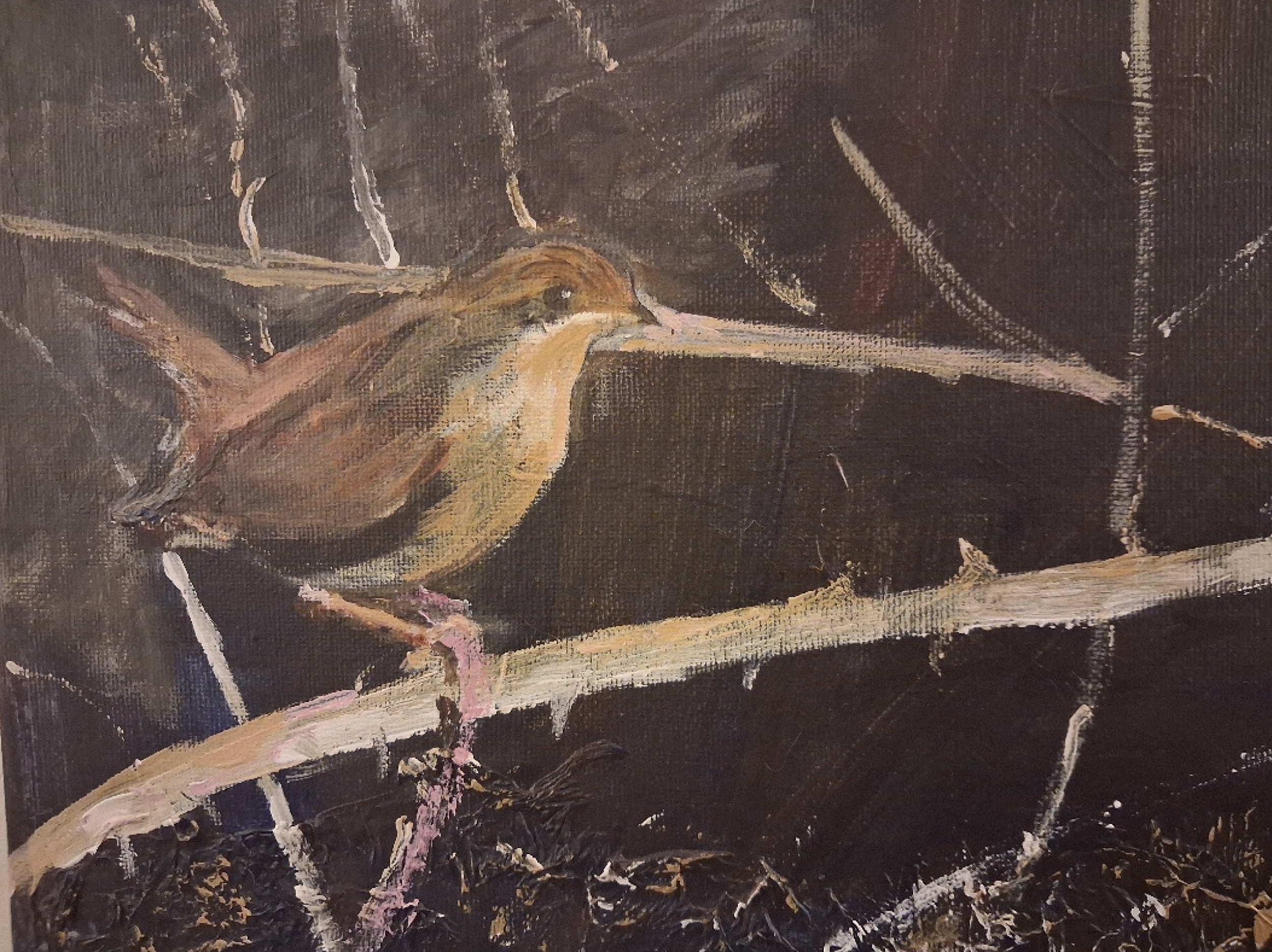
Painting by Mrs BE Bennett
First published in edition 211 of The Northumbrian, April/May 2026
In the latest instalment of his column chronicling country life, Charlie Bennett salutes the brave and busy wren
On my potterings about the countryside, I enjoy regular encounters with favourite species. Our local rooks, for instance. I often hear their kaws and croaks at a distance – up close if I disturb an unwary parliamentarian. But my most-anticipated encounter is with the wren.
Wrens are energetic, noisy little birds, venerated by the ancient druids for their wisdom and ability to adapt. The Anglo-Saxons probably had it better wrapped up, likening them to the busy little people that bustle about a town’s marketplace.
Wrens don’t appear to be shy, and the ones I have come to know best have lived in our outbuildings. In my workshop at our old house, one would often flit past as I toiled on some project or other. Alighting, it would either get on with the business of eating the shed’s spider population or simply sit and watch me.
I’m not sure how long they live, but after we sold the house, the next owner built a boat in that same workshop. He called it Little Wren after a bird that watched him build it from keel to sea.
Wrens have tiny, dark, glistening eyes that penetrate your soul rather like a hare’s do. I imagine them asking: “What are you doing, man? Why are you mending that bike when you could be catching spiders?”
I stare back in wonder. For this is the most perfectly neat little bird, regal almost with its turned-up tail, bobbing about as if to say: “Look at me, not a feather out of place; you should pay attention, you scruffy bumpkin.”
The wren is known as King of the Birds; a title nothing to do with monarchic behaviour and everything to do with cunning. For one day a very long time ago, the birds gathered to decide who was king. After a few pints at the Duck & Grouse it was decided that whoever flew the highest would be crowned. So, off they flew. The eagle thought he had it in the bag and he reached a dizzying height, the countryside below shrinking into a patchwork of tiny fields, spinneys and hamlets. When eventually he could fly no higher, he turned confidently earthwards, but at that moment a cunning little wren which had been hiding in the eagle’s feathers popped out and flew higher still, claiming the crown.
This regal mantle perhaps resonated with a human royal. For during the reign of George VI a farthing was issued with a wren on the tails side, the monarch on the other. (If you’ve ever wondered why the back of a coin is called “tails”, it’s because tails are the opposite to heads, apparently – and lexicographers are cleverer than me).
The farthing, the smallest coin in circulation, worth a quarter of a penny, was designed by Harold Wilson Parker. I have a fascination with small and miniature artefacts and am delighted that a world-famous designer was assigned this little coin, dedicating to it the expertise he might a gold sovereign. What better means of celebrating that than the resilient little wren?
Folklore doesn’t entirely leave the wren basking in glory, however. In Ireland they used to have Wren Day, when the birds were hunted and paraded atop decorated poles to mark the coming of the new year. Like highwaymen, it didn’t matter if they were caught dead or alive.
Perhaps the wren’s most painful encounter was a jenny wren giving man fire. (To explain, Jenny Wren was a doll’s dressmaker in Charles Dickens’ Our Mutual Friend, her intricate work reflecting the tenacity and tiny movements of the wren). In country lore, a jenny wren spotted how cold men were (e.g. my workshop with no heating) and decided to go to the sun to get fire for the human. This was a perilous journey and on the way back she singed all her feathers. Landing with a tiny bump, she gave man the fire, but she was left flightless and freezing. The other birds took pity on her and each give her a feather. Apart, that is, from the owl. (What is it with owls? The one in Winnie the Pooh – Owl – is an old windbag full of his own self-importance and intelligence, yet misspells his own name as Wol. But then, WOL could stand for Wise Old Lady, in which case, no wonder Owl was so grumpy).
Obviously, the fire story is a myth, but the wren’s kindness really does exist in the wild. As described, they are tiny birds. Not the smallest (that honour goes to the goldcrest), but at about 10g or 0.35oz, the wren weighs about as much as a £1 coin. To keep body and soul together it has to feed constantly on a high protein diet of spiders, grubs, caterpillars and tadpoles. The winter cold makes life more precarious, and a male wren will find a roost in a wall or other snug place and then advertise his roost in his song. His cry is quickly taken up, with up to 60 wrens of both sexes huddling together in this refuge, using one another’s body heat to stave off the chill.
It is not known if the male homemaker is being charitable, using other wrens to keep himself warm, or if this is all a ruse to find a mate, as the females who join the commune allow him his way with them. In any event, he works hard, carefully placing dried moss and a few plumped-up cushions inside each dwelling. He then sets off around his territory singing loudly about his new des reses, and will mate with each female which takes to one of these new homes. Then, once the chicks hatch (and there can be up to four in each nest) he helps the females feed them.
I’ve been fortunate to see a family of fledged wrens. I was fishing with a friend on the River Ullapool in Scotland and, cresting a mound in an ancient wood, I saw what looked like a gathering of tiny elfin people, darting about as though connected with invisible string. It was a mother wren with four chicks which she was teaching to hunt. These tiny brown bundles were fully formed and just as active as their parent, yet were only about the size of 1p pieces. As ever in these situations, I forgot about fishing to sit and watch this little hunting party until it was time to go and find my own supper.
Wrens are widespread, nesting across town and country. The easiest way to find them is to listen out for their song. For such a small bird they are loud, thanks to a dual-chambered vocal organ called a syrinx, which acts like a resonating chamber to amplify sound and produce complex, high-pitched notes. The volume, which can be ten times more powerful per unit of weight than a crowing cockerel, is used to defend territories, attract mates and communicate with other wrens.
If you hear it, peel your eyes open and in time you will see a small brown blur whiz past, likely heading for cover like a bramble bush. Stay still and wrens will eventually emerge to hunt for food or nesting material, and they are a joy to watch.
To wrap up this story, I commend to you one of my favourite poets, Patrick Barrington. He wrote many humorous poems, including one about a pet hippopotamus, which inspires this ode to the wren, which I hope to see again soon:
I knew a little wren
He lived in my shed
I fed him upon spiders and little
bits of bread
He was my companion on many
cheery walks
So I had his portrait drawn by a celebrity in chalks.
(Author’s note: the painting on this page is by Mrs BE Bennett, WOL).
Charlie Bennett is co-owner of Middleton North near Wallington, where he works to support existing wildlife and attract new species alongside sustainable stock farming designed to add to the diversity of wildlife in the area. For information, visit: www.middleton-north.co.uk
Charlie’s books, Climbing Stiles, A Wander Through the Countryside & Beyond, and Down the Rabbit Hole: Adventures of an Unlikely Naturalist, are available at:
www.charliebennettauthor.co.uk