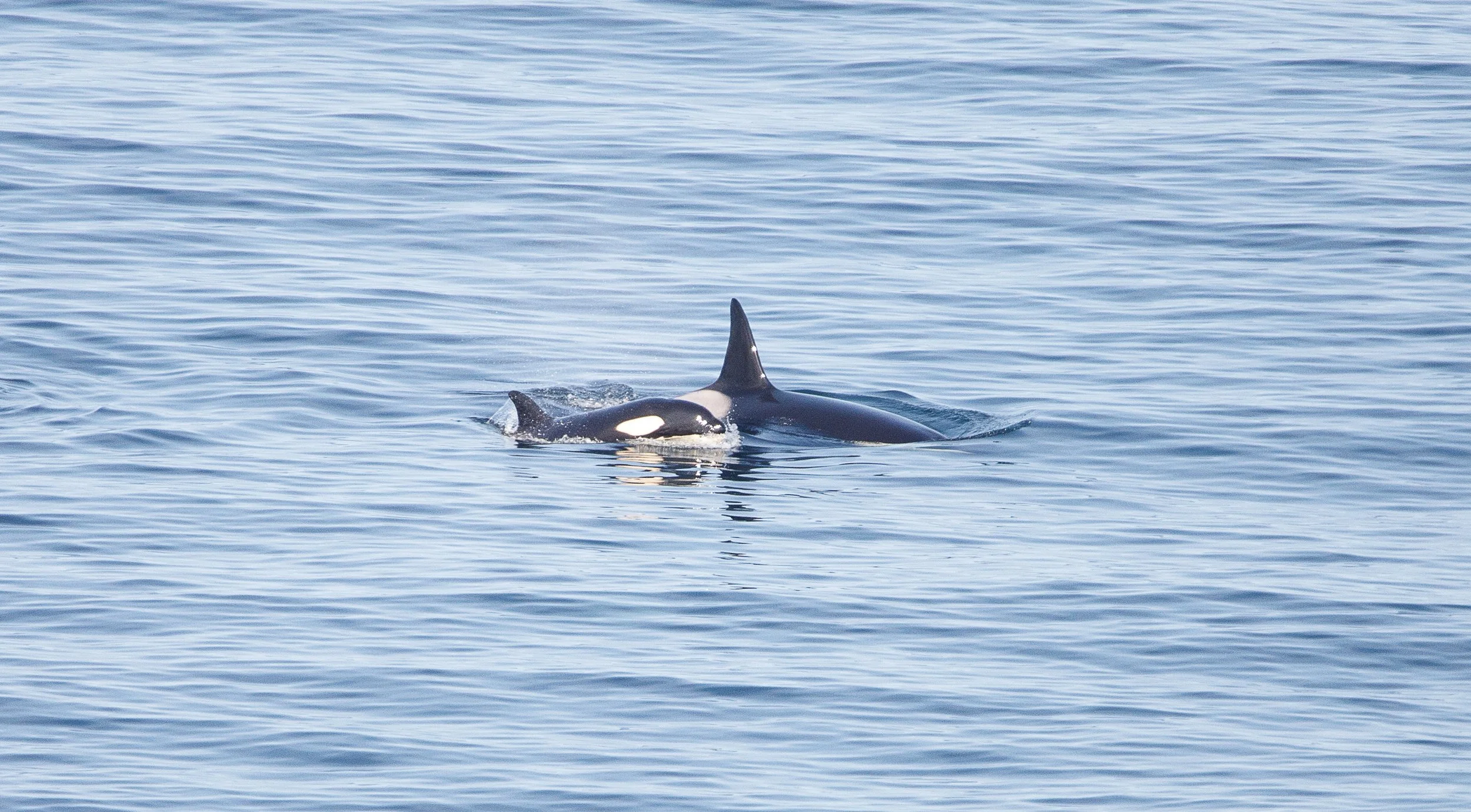
A mother and calf in the pod spotted by Mike
First published in edition 213 of The Northumbrian, August/September 2026
From an unforgettable encounter with orcas to the restoration of our marine habitats, Northumberland Wildlife Trust CEO Mike Pratt explores how these magnificent travellers offer hope
Close-up wildlife encounters can put life into perspective and illustrate unexpected synergies. Orcas have been seen this summer off the Farne Islands, and how lucky those who’ve seen them are (unless you’re a seal!). The ‘27s’ pod, featured in David Attenborough’s Wild Isles TV series, was identified as the probable group. Now split into two pods, one of just two males and two females, they were tracked from their usual haunt in Shetland and Orkney to Northumberland.
I’ve also recently encountered them, not on our home turf but on theirs, off Unst, the northernmost island in the North Sea. My wife Jacky observed them after their Northumbrian jaunt in a small bay close to where we were staying. We watched them for nine hours as they pursued fish and the odd seal, watching as four fins haunted islets. At one point the matriarch was within 12 metres of us – so close we could hear her breath! It was a magical encounter that will stay with us.
Later we saw others with calves and one day I hope to see them off the Farnes or Coquet Island. Their presence is mesmerising and wherever they occur, these are the unforgettable moments. It was wonderful to escape even our stunning local landscape to find some headspace from work, and it was so meaningful to have this encounter with an iconic species that had also visited Northumberland.
It also showed the power of nature to move over great distances seemingly effortlessly: this year’s influx of painted lady butterflies from Morocco; the cuckoos which come from Congo; the swifts, swallows and martins, African birdlife, and arctic and other terns that travel thousands of miles to breed here. Wildlife truly has no borders.
This demonstrates how every ecosystem on the planet is interconnected, which is why the health of each affects the other. Orcas visiting the Farnes are a sign that the North Sea, one of the most overexploited and industrialised in the world, where fish stocks have crashed many times, is in recovery. There’s a way to go and much change needed; the impacts of wind farms, shipping, pollution and industrial fishing all need mitigation, but there are positive signs.
We are seeing more cetaceans, more bottlenose dolphins and other species, more minke whales and now orcas here. Bluefin tuna have been seen, and more humpback whales following what appear to be rejuvenated herring migrations in summer. But the once common mackerel is now so threatened Waitrose won’t stock it, and our puffins and roseate terns still struggle to find sand eels, so it is a mixed picture beneath those turbulent waters.
For seabirds, it is more complex; in the aftermath of avian flu many species are still in recovery, and the fall-off of sand eels and other prey has dented puffin and other populations. Kittiwakes seem to be doing well. Climate and overfishing are widely affecting them, but less so locally. We know that some species such as porpoise and kittiwakes are sensitive to disturbance from the construction of large offshore wind farms, so this is a dynamic situation as the needs of humankind butt up against those of the species that live alongside us.
Overall, it seems that marine wildlife is trying to edge back where it can, or fighting to survive in colonies it has occupied for thousands of years, despite today’s threats. Numerous organisations are working to improve and protect Northumberland’s marine environment. The county council coordinates coastal planning and management of the Northumberland Coast National Landscape, the Marine Management Organisation oversees marine planning, and the Northumberland Inshore Fisheries and Conservation Authority manages inshore fisheries.
With Natural England, the RSPB, the National Trust and other organisations, they help to safeguard wildlife, from safeguarding the vulnerable little terns nesting at Long Nanny and our local grey seals, to protecting the internationally important bird colonies on the Farnes and Coquet Island, while monitoring cetaceans and other pelagic species found offshore. Many inshore fishermen, too, are adopting more sustainable methods.
There’s always more we can do. Northumberland and Durham Wildlife Trusts’ Stronger Shores project works with coastal communities to develop local conservation solutions. The project has explored how nature can limit the impacts of coastal erosion and flooding. It engages communities in the wonders of our marine spaces and is trialling exciting marine sciences, exploring the environmental factors affecting seagrass restoration to encourage communities to build a deeper connection with their marine spaces.
Seagrass is under much pressure in Northumberland where, apart from on Lindisfarne, it is extremely patchy and almost gone, taking the species it supported with it. A major highlight has been the Amble-based North Side project, which has engaged the community with the work of Dr Martina Bristow, monitoring a rare patch of seagrass. The project team engaged with artists to explore the former significance of seagrass here, creating stunning pieces that were displayed on banners in Amble town centre and exhibited in the Drywater Centre.
Hopefully, as this sort of work continues, communities’ connections with their coastlines and sea will grow, and we are now planning a larger marine conservation initiative to build on this. In time, this will help us to better balance the needs of people and wildlife. For as our orca encounter demonstrates, it’s not just sorting out one part of the sea that will lead to a thriving marine world; it’s all joined up. As David Attenborough’s film Ocean showed, the sea can quickly recover its biodiversity and abundance; we just need to give it a chance to do so.
When that happens, we will no longer be astonished to see orcas off the Farnes, big pods of 50 minke whales, thriving seabird colonies, and improved fish catches. These things will be just normal, as they were in the past. Our travelling orcas are an exciting sign of what is possible.
Mike’s books of prose and poetry about the natural world are available via Northumberland Wildlife Trust at
www.nwt.org.uk and at Mike’s website:
www.livingmindfullywild.com