
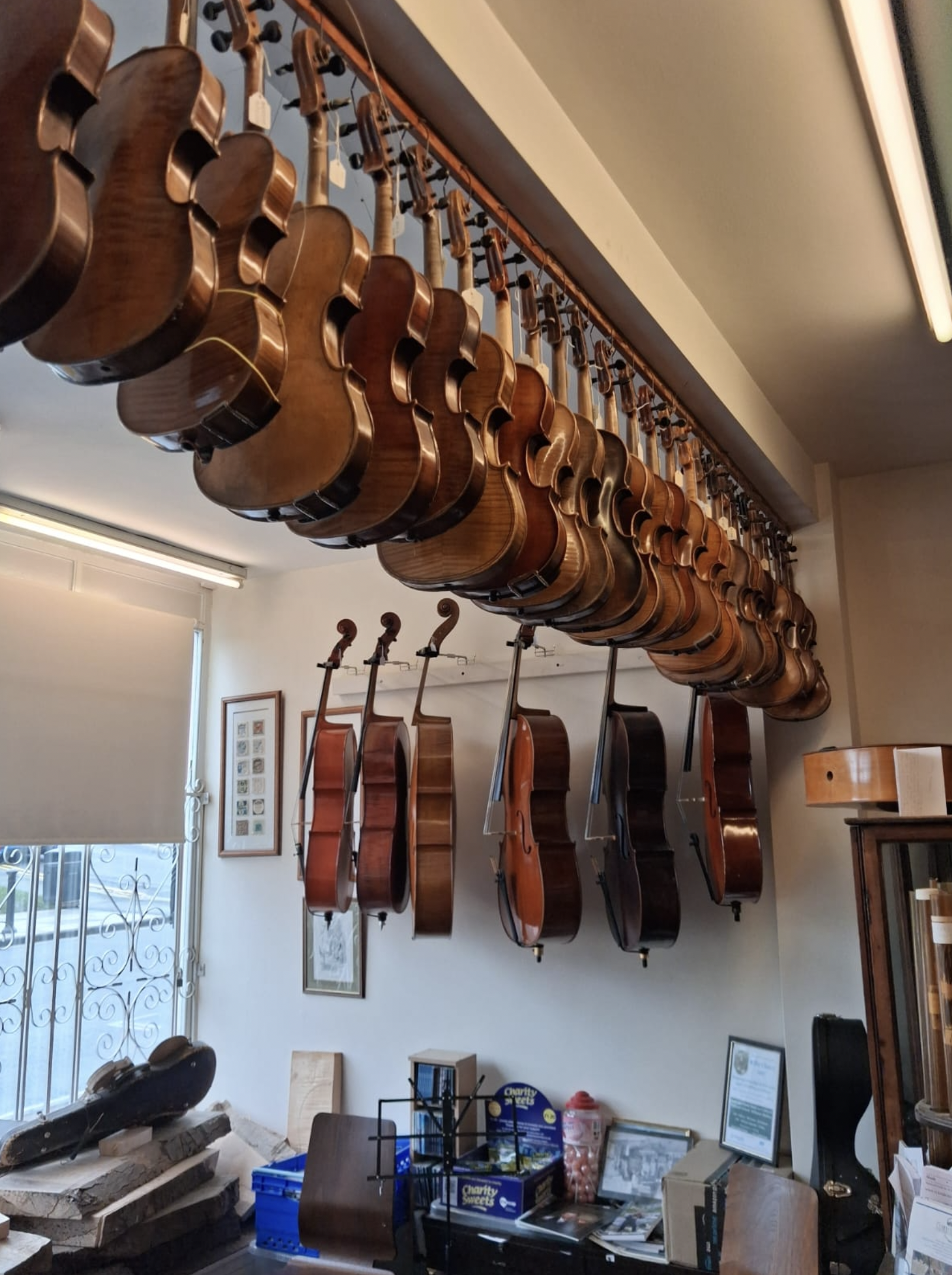
Inside Hexham Violin Shop
First published in edition 212 of The Northumbrian, June/July 2026
In the latest instalment of his column chronicling country life, Charlie Bennett explores Hexham Violin Shop
Go back about 50 years, and towns were very different, dominated by local shops providing essential goods. Butchers, grocers, hardware stores, agricultural suppliers and more provided for everyday needs. Meanwhile, leisure time had to be catered for. There was basic television and of course radio, but people also made their own entertainment, often in the form of music. So, places like a violin or piano shop were commonplace.
As time has marched on, this kind of retailer has all-but disappeared, as our leisure time has been absorbed by electronic boxes consumed on the sofa. But one day I was chatting to my son’s girlfriend as she practised her violin and she said it was made by a violin maker in Hexham. It makes a beautiful sound and she plays well, and its origin was a surprise to me as I knew that the great violins come from the Italian town of Cremona, where the families of Stradivarius, Amati, and Guarneri have for centuries made the world’s best instruments. So who was this local maker? Well, it is Hexham Violin Shop, and following a bit of emailing explaining my interest in it for my next book, Hidden in Plain Sight, the owner Stephen Ramsay invited me to visit.
If you don’t know Hexham, it’s a fascinating town with a long history. The Violin Shop is on the edge of the original town centre and you can tell from the lane names off Hencotes (a place where chickens were kept) that you are in a place where industrious work took place.
The shop retains its lovely Victorian shopfront and I had great expectations for it; hoping it would be like the wand shop, Ollivander’s, in Harry Potter. For those untouched by Potter, this is akin to the old shops at Beamish or York Castle Museum – all green baize, wood and brass – and as I opened the door a bell rang and I stood in awe, as hung from every rafter were violins of multiple hues, while mahogany cases held rows of bows rather like the wands I had imagined. In the Potter books, the wand chooses the wizard, and here the bow is even more discerning, but more of that later.
Hanging from a rail in an alcove was a row of glossy cellos and in a corner there was a huge double bass with a fraternal view over its smaller siblings. All these instruments looked inviting, even to a musical squib like me (JK Rowling’s failed magicians are known as squibs, by the way). Stephen appeared. He has a friendly face and was dressed for his work in old, comfortable clothes that could take a bit of rabbit glue, paint or varnish. His handshake was firm, while his hands were deft and obviously capable of the most intricate work.
He engages in two main activities – the making and repairing of stringed instruments, and the buying and selling of new and used ones. The buying and selling require knowledge and experience. Each tells a story that isn’t always obvious at first sight, and many have had long lives, having arrived here from all over the globe. Stephen has an encyclopaedic knowledge and after some thought about his stock, he produced a case from which first he took a bow made by Frank Donald Napier – a leading bow maker for WE Hill & Sons around 1920. The wooden part is called the ‘stick’ and in this case was finely carved from a single piece of pernambuco, a now protected Brazilian hardwood prized (according to the website of a very smart violin maker named Dolce): “for its perfect balance of density, strength, and elasticity, which allows for a rich tone, crisp articulation, and excellent bounce.”
The bow frog (the bit at the base that encloses the mechanism responsible for tightening and holding the bow hair ribbon) was ebony with inlaid mother of pearl, while the grip wound with silver wire at the tip was also silver inlaid. In all it was a delight to behold, and even to me it felt perfectly balanced. So, who might buy such a bow? Every player likes one that suits their playing style and physiognomy, and may try numerous options before picking one.
In the case below the bow was the violin, made by the great Longman & Lukey & Co, London, 1769-1790. Stephen assured me it would compete with Cremona-made violins, and it is now accepted that the Italians don’t have the monopoly on fine instruments.
Interestingly, violins must be played or they lose their resonance. If left in storage or museum cabinets, they lose tension, which can take weeks of playing and tuning to restore. So, if a musician likes the look of an instrument, they may trial it for a few weeks before deciding if it is for them, and if they buy it, theirs could be a lifelong relationship.
This bow and violin both felt delicate, and it seems that apart from the obvious risk of being accidentally dropped or squashed, the enemy of every violin is temperature. Two centuries ago, central heating and warm cars didn’t exist, but now, taking an old violin straight from the cold into a warm environment can cause cracks. But makers are clever, because a violin is made to come apart. It is held together not with Araldite, but with rabbit glue, and under heat this pops open. So, a damaged violin can be stuck back together, while the glue allows relatively easy access should an inspection or repair be needed. Stephen makes beautiful little noggins (my word) that bridge the split and hold the instrument back together in such a way that the old resonance is returned.
Ah, I seem to have strayed from the path, as usual. We were talking about the buying and selling of violins. How did the instrument we inspected come to be for sale? It’s a rare occurrence, as these items are often heirlooms. Your family might chuck out your old chair or wellies when you shuffle off this mortal coil, but violins are treasured like medals or jewellery to be passed down. In this case, the owner had played it into her nineties. When she died, there was no-one to play it and the difficult decision was made to sell. For the violin’s sake, this is probably a good thing, as it needs to be played.
You don’t have to buy a lovely old violin, though. No, you could get Stephen to make one for you. Now I don’t know about you, but I love a workshop. A place where amazing things are made is often as delightful as the objects that march out of the door, and Stephen’s is no exception. A smallish room around 12ft x 20ft, you can’t see the ceiling for violins, while the walls are adorned with shelves and cupboards holding pots of glue, paint, varnish and no doubt many other elixirs. One wall bears the tools of the trade, while other implements are slotted into workbench ends. Some of the tools date to the 17th century and, like many skilled makers, Stephen is their custodian, hopeful of passing them on to the next generation of luthiers. The shop’s original owner, David Mann, also keeps a hand in, manning his workbench aged 75.
According to Stephen, once you start making violins you can’t stop. He began making guitars as a boy, learnt violin making at college, then went to work for a London violin maker. But that wasn’t enough – he would carry on making them at home in the evening. If that isn’t a vocation, then I don’t know what is. All that knowledge has manifested into a mindboggling skillset and Stephen is a skilled carver of all the components and decorative work every violin bears. Which brings us to Five Sheep Four Goats. On his workbench sat a violin-type neck, intricately carved like the prow of a Viking ship. This was for a Hardanger fiddle – a Scandinavian instrument with exterior strings like a violin, plus five under strings inside that resonate for a rounded, deep sound. Five Sheep Four Goats, Stephen explained, is a Scandinavian folk tune perfect for the Hardanger, often accompanied by a flute and accordion. There is not much to be gleaned about what the ruminants in the tune are up to, but as you listen you can imagine them cocking their heads as they peacefully chew their cud to the music. Lucky ruminants.
I could tell Stephen was itching to get back to his work, so I thanked him and left this delightful place, the tinkling shop bell fading behind me. As I walked away it seemed to me that today, more than ever, we still need the butcher, the baker, and the violin maker.
Info at: www.hexhamviolinshop.ltd
To visit the shop, email:
hexhamviolinshop@outlook.com
Charlie Bennett is co-owner of Middleton North near Wallington, where he works to support wildlife and attract new species alongside sustainable stock farming designed to add to the diversity of wildlife. Info at: www.middleton-north.co.uk
Charlie’s books, Climbing Stiles, A Wander Through the Countryside & Beyond, and Down the Rabbit Hole: Adventures of an Unlikely Naturalist, are available at:
www.charliebennettauthor.co.uk