
Cuddy’s duck
First published in edition 204 of The Northumbrian, Feb/Mar 2025
Ian Kerr profiles St Cuthbert’s favourite, the eider duck
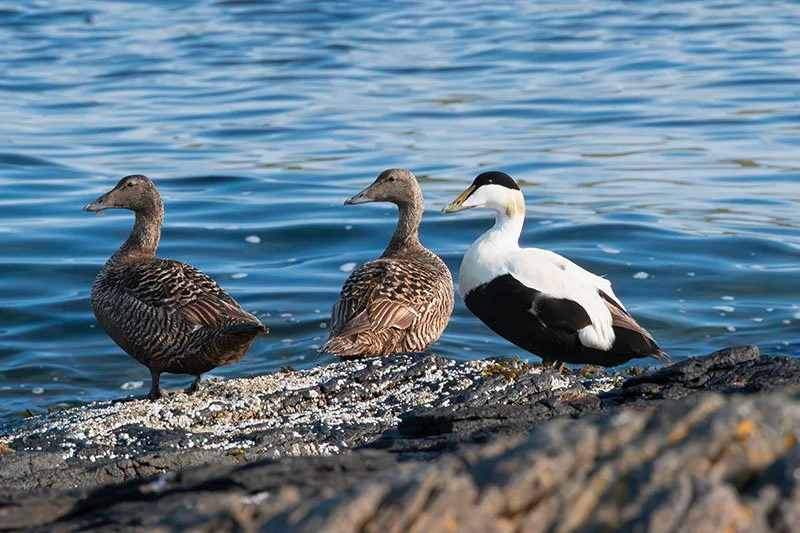
On still winter days, when the sky is blue and the sea is flat, one of the most delightful sounds along the coast is the crooning call of strikingly handsome drake eiders as they court their females. Resplendent in black and white plumage with moss green nape patches, they often surround a lone female and compete for attention, their gentle calls carrying across the water.
Often the rather drab brown females studiously ignore their efforts and carry on attempting to dive and feed, something that seems to drive the drakes to increased efforts.
These courting groups, so vocal when most other birds are silent, are a welcome reminder that although it is still winter, spring is at least in the air, and something we can all look forward to.
Eiders, heavily built, sturdy enough to cope with the worst sea conditions, and capable of riding out the roughest storms, are by far the most plentiful of our sea ducks. They are also resident, so a familiar sight along the coast throughout the year. They spend their time either resting on rocks or sandbanks or in feeding groups of varying sizes, busily diving for crustaceans and molluscs, primarily mussels.
They have a couple of local names, St Cuthbert’s duck or, more informally, Cuddy’s duck, because of their supposed association with the Northumbrian saint, his links with Holy Island and particularly with the Farne Islands, their local breeding stronghold. The famous old story is that Cuthbert (634-687) regularly left his duties and fellow monks on Holy Island for periods of solitude and prayer on the Farnes, where he befriended the eiders.
Female eiders are remarkably tame during the breeding season, refusing to leave their eggs even if people are standing over them. Cuthbert, recognising this lack of fear, is claimed to have laid down rules for their protection. The Lindisfarne Gospels, that remarkable surviving document of the early medieval period and now one of our national treasures, was written as a tribute to Cuthbert and his miracle-working shortly after his death during his final exile on Inner Farne. If the tale is true – and it’s a big if – it would make Cuthbert our first conservationist by well over a millennium, with no-one else bothering about the welfare of eiders until the late Victorian period.
Just about everything we know of Cuthbert comes from the writing of the Venerable Bede (673-735). As their lives overlapped, it’s possible, perhaps even likely, that the two met and talked.Unfortunately, Bede’s stories of Cuthbert make no mention of links with eiders. In fact, it’s something that doesn’t seem to appear in local folklore until the 12th century, more than four centuries after his death.
Whatever the truth, these links are stated as fact in many publications. When I was writing the latest edition of my book Birds of Holy Island I spent a lot of time trying to find any information which might throw light on the subject. I was totally unsuccessful. The whole tale may be nothing more than a medieval myth, but it’s a great story that I’d love to be true.
True or false, down the centuries Cuthbert and eiders have been inextricably linked, and I doubt if there’s a town or village along our coast without its local Eider, Cuthbert’s or Cuddy’s cottage, or other reminders of the story. At Amble, for example, a stained glass window at St Cuthbert’s Church depicts the saint with three eiders, two drakes and one duck at his feet. When the sculptor Fenwick Lawson provided a huge bronze statue of Cuthbert for Lindisfarne Priory, it had, almost inevitably, an eider peeping out from under his robes.
The eider was also the obvious choice of emblem of the old Tyneside Bird Club when it was formed in 1958. The name was later changed to the Northumberland & Tyneside Bird Club to more accurately reflect its geographic area, but the emblem remains. I think that if Northumberland was ever to have a county bird – and why not? – it would surely have to be the eider.
Unfortunately, associations with Cuthbert didn’t do much to protect the eiders, as over the centuries they have been exploited by humans. Birds have been killed for their meat and their eggs have gone to the kitchen. They’ve also been exploited for the fine, soft down lining of their nests. Its insulation properties have been long famed, leading of course to the term eiderdown for the warm, snug bedding only recently largely replaced by the modern duvet.
By 1874 the naturalist John Hancock said the duck was ‘by no means abundant’ though shortly afterwards it was given a degree of protection by the then owners of the Farne Islands. Happily, by 1932 another local naturalist, George Bolam, said the population had increased to more than 120 breeding females on the Farnes.
The population appears to have declined once more during World War II, when food shortages led to eggs being taken and, even more alarmingly, there were reports that parties of eiders on the sea were used as handy targets for machine gun practice. Since then, the population has remained relatively stable, though some birds perished during the worst of the avian flu epidemic of 2022. Around 400 females usually nest on the Farne Islands, with only slightly lesser numbers on Coquet Island. Both sites provide protection from human disturbance compared with otherwise suitable areas on the mainland where even occasional nesting attempts are now rare.
I emphasise the word female in connection with nesting because the eider duck is one of nature’s single mothers. After mating, the drake continues a carefree bachelor life with no involvement at all in the mundane tasks of caring for eggs or young. Instead, the ducks, which lead their young into the sea as quickly as possible after hatching, team up with others to form crèches, with several ducks tending groups of ducklings. The presence of two or three females gives slightly more protection for the young from a range of predators, mainly big gulls.
Despite their small size, the ducklings are capable of following their mothers from the islands to suitable feeding places, mainly in sheltered bays along the coast, where the crèches are one of the most endearing sights of summer days along the coast.