
Islands in the mist
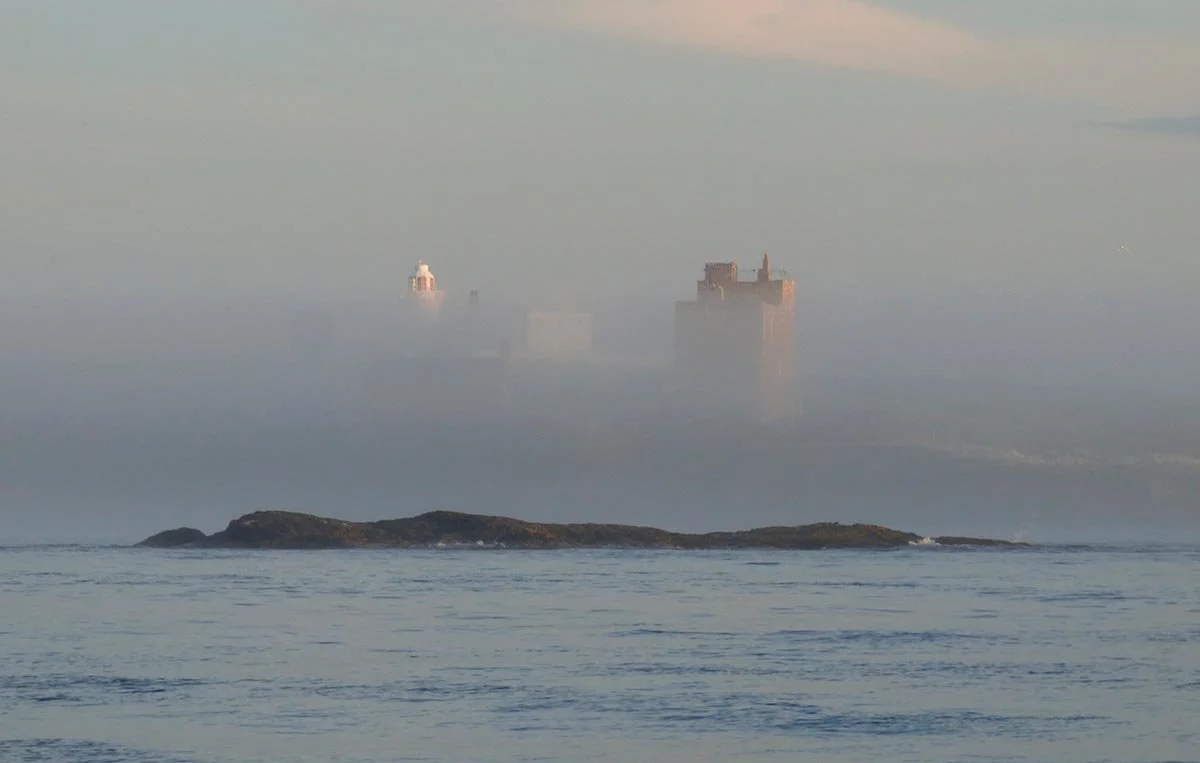
Inner Farne appears to hover above the haze
First published in edition 209 of The Northumbrian, Dec 2025/Jan 2026
Anthony Toole joins a sunset boat trip to find the Farne Islands rising and fading in drifting mist and what might have been an everyday voyage transformed into a brush with the extraordinary
It was early evening in Seahouses Harbour. There was not a cloud in the sky and the day’s heat lingered. Fledgling starlings, not yet having learnt to be afraid of humans, lined up on the arm of the seat beside us, while a few adult birds kept their distance. A herring gull stood on the sea wall and a black-backed gull surveyed the scene from a high perch.
At 7pm, we boarded a boat for what promised to be a memorable sunset cruise around the Farne Islands. How memorable, however, we did not anticipate. With around 50 passengers, the vessel was about half full, the sea was calm and the sharp light picked out every wave crest and ripple of the boat’s wake. Then, without warning, perhaps 1/4 mile from the harbour, we entered a bank of mist and everything changed.
The haze was thin and hung in a shallow layer over the sea. It made the land disappear while the sky above remained blue, a pair of gannets flying north clearly visible. The sun and its reflection on the water lost their sharpness in the mist, diffused into something JMW Turner might have relished for a painting. The now hazy rays shone past the boat onto the eastern mist to create what in the mountains would be referred to as a Brocken spectre. A brighter patch was enclosed by a halo of light inside which appeared the faintest rainbow colours enhanced by the polarising lenses of my sunglasses. The sun was just a little too high to project an image of our boat onto the cloud to complete the spectral vision, but this pattern of ghostliness materialising from mist became a theme of the trip.
The first form to emerge from the haze was the lighthouse of Inner Farne. This was followed by the upper levels of the island’s cliffs, while the lower reaches faded into obscurity, leaving the island to hover like a dreamscape above the cloud. Next came the low-lying rocks of East and West Wideopens, where the mist thinned sufficiently to reveal the flocks of herring gulls, shags and cormorants roosting there. Then we were back into the vapour, which swallowed us as we crossed the gap to Staple Island.
Here it thinned again to allow a superb view of the hundreds of birds that clung to the Pinnacles. Most abundant were kittiwakes, their nests, which appeared glued to the rocks by little more than strong-smelling guano, filled by chicks ready to fly, their distinctive calls incessant. Guillemots and razorbills perched on other ledges, while cormorants, shags and black-backed gulls paraded across the Pinnacles’ flat tops.
Next to appear almost subliminally through the mist was Longstone Lighthouse, from which Grace Darling and her father rowed out to rescue survivors of a shipwreck on Big Harcar in 1838. A gap opened in the mist and vivid sunlight spread over the island, warming the grey seals on its rocks and a couple of humans relaxing at the base of the lighthouse.
Passing the low reef of Big Harcar in the sunshine, we came to Brownsman, where the one-time lighthouse and rangers’ house were taking on the first hint of an evening glow. A small flock of puffins bobbed about on the water near the shore, at least one of them carrying a beak full of sand eels. Then, as we approached Inner Farne once more, we were again swallowed by the mist. At first, only the very tops of the lighthouse and pele tower were visible, separated magically from the shore by the strip of haze, while a pair of apparently ghostly yachts rested at anchor in the eastern channel. Then, as we drew closer, the air cleared and the evening glow became more pronounced, revealing the shore dotted with young terns.
We paused beneath the west cliffs of Inner Farne while a crew member pulled a lobster pot up from the deep. He took out a lobster and a velvet crab, which he carried around for everyone to see. Several passengers had probably never seen a live lobster before. This one was a female clutching beneath her tail several thousands of eggs which she might carry for as long as a year before releasing them into the sea. Two children were given the thrill of returning the animals to the water.
Dusk was now approaching, and though the sun had almost certainly dipped below the horizon, refraction by the thickened layers of the atmosphere allowed it to remain visible. The boat paused again as we watched it set. Tiny ripples bobbed on the surface of the sea, and as the sun slowly sank, air molecules and colloidal particles of mist a thousand times larger scattered the shorter wavelength colours of its spectrum into space. The sky turned a vivid red with what was left. Although the sun appeared not to move, a patch of low cloud ate slowly into its bottom curve. In a minute, the sun was half gone. A minute later and only a quarter remained. Within two more minutes, it had vanished, leaving only the silhouette of Bamburgh Castle to occupy the horizon.
Our trip had been scheduled to end at 9pm, but it was nearer 10pm when we re-entered Seahouses Harbour. No-one complained. The mist had prevented us seeing all that we might have, but as an experience, it had raised things to a higher level altogether. And though it might not have been unique, it was an experience that would not be repeated very often. We felt very privileged.