
A walk on the wild side
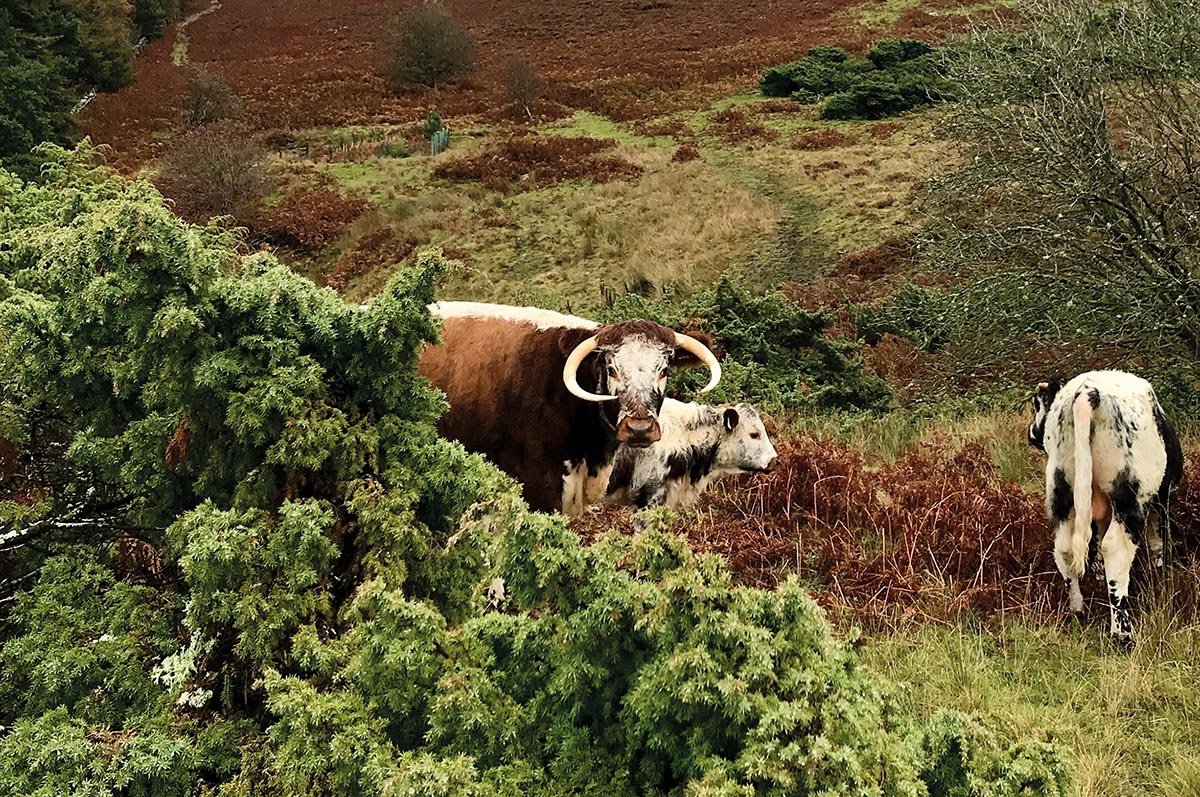
Longhorn cattle roam among the juniper that flavours Hepple Gin
First published in edition 209 of The Northumbrian, Dec 2025/Jan 2026
On the Hepple Estate, wax cap fungi, shaggy cattle, Exmoor ponies and a perfectly mixed martini reveal how managed wilding is reshaping both land and livelihood, discovers Jane Pikett
The drizzle is in for the day (possibly the week) when we set out; that whisper soft Northumbrian mizzle that seems to rise as much as it falls, beading the gorse, glinting off the shaggy flanks of Highland cattle, and making you surprisingly wet in a surprisingly short time, no matter how efficacious the waxed jacket.
Before I have even zipped my coat, Hepple Wilds ecologist Richard Thompson is crouched over a patch of grass, pointing. “Aha, here’s a mushroom,” he says, clearly delighted. “Looks pretty exciting to me.”
I am not entirely sure how exciting a mushroom can really be, but I am here to learn, so I bob obediently down to study a blackening waxcap, or witch’s hat – a grassland species that starts a fiery burnt orange red and deepens with age to near black. Richard describes it in reverent terms – for fungi is his thing. What I don’t anticipate is how, within an hour, it will begin to enchant me, too. For fungi, it turns out, are the gateway into understanding the deeper story of Hepple – a 4,000-acre estate committed to ‘managed wilding’, where ecological renewal is threaded through every decision, from pasture management to the making of gin. What grows at the soil surface, including the dozens of varieties of fungi we encounter, tells a story about what is happening beneath it, within it, and around it.
Quietly spoken, utterly at one with the landscape and all its minutiae, Richard leads many of the activities that bring people like me here – guided walks, Land Rover safaris, fungi days, gin experiences, creative workshops. For him this work is not a bolt-on – it’s a calling. “Biodiversity is in a crisis. That’s well-documented,” he explains as we walk. “So it’s vitally important that we reconnect people with nature.” Bringing people into the landscape, helping them to understand it, be immersed in it, will, it is hoped, spark the same love of nature that drives the work here.
Witnessing the land in transition, as it is here, illustrates the power of nature to recover and renew. This was once a driven grouse moor, a patchwork of heather monoculture, blocks of plantation forestry for timber, and heavily grazed sheep pasture. Together, these practices created a landscape that, although familiar, was poor in biodiversity. Now, after the removal of more than 6 miles of internal fencing and the introduction of Exmoor ponies, longhorn and Highland cattle – animals much closer to the wild herbivores that would naturally have shaped these landscapes in the past – and the creation of wetlands, the transformation is quietly, steadily underway.
Under previous grouse moor management, tree growth was suppressed. Now, woodland is emerging, and fungi – tiny, brilliant proof of soil health – are testament to the land’s recovery. “Biodiversity underpins everything we do,” Richard explains, illustrating its importance in terms of a simple chain reaction: losing a small, seemingly insignificant flower could wipe out the invertebrates that depend on it. In turn, the beetles and birds that feed on those invertebrates suffer. This knock-on, cascading effect underpins the natural world, and once diversity begins to disappear, ecosystems can unravel quickly.
The timber industry is a real-time example of why biodiversity matters. With Sitka spruce making up around 80% of UK timber, a beetle outbreak is now threatening the species, and because the industry lacks diversity, the consequences could be severe. The same principle applies to agriculture: when crop systems rely on a single species, a single disease or pest can wipe out a harvest. Without diversity, both natural and human-made systems are more vulnerable to collapse.
For decades, this estate, under intensive sheep grazing and heather management for grouse, was a simplified upland landscape. Sheep, Richard explains, are not native grazers. Their nibbling suppresses young trees and flowering plants, and too much of it can collapse fields into bowling greens. The cattle, ponies and wild pigs here now graze unevenly and dynamically; tearing, pulling and disturbing in ways that create microhabitats. Together, these grazing animals move across the land, now rid of miles of fences, in a more varied and dynamic way, helping to create a richer, more diverse and more natural mosaic of habitats.
Exmoor ponies, he explains, adapted over centuries to harsh, rugged landscapes, thrive on the rough vegetation here. Their grazing creates short, open patches of habitat valuable for species such as reptiles that need sunny spots to bask and invertebrates that benefit from warm, exposed soil. On cue, we encounter a small group of ponies – compact, watchful, their coats glossed by the rain. They are curious, nudging at us to open a gate that separates them from what lies beyond. “Not today,” says Richard to them softly.
The pigs that roam here – wiry black and tan creatures with wild boar genetics – are hiding today, but their presence is everywhere in the roughened soil. “That,” Richard says, indicating a churned patch, “is exactly what we want. Disturbance – space for things to start again.”
On higher ground, he shows me where trees are returning to the former grouse moor. Birch, scots pine, rowan, alder, juniper – some planted, many self-seeded – now grow. Heather, when left uncut for decades, breaks down and makes room for saplings. The cure, Richard says, is patience.
If fungi are the motif of our walk, water is the thread tying everything together. Historically, uplands were drained to make them productive. This widespread draining has dramatically altered ecosystems. Water, Richard emphasises, is fundamental to life: most organisms rely on it, and countless plants and invertebrates depend on wet habitats to survive. Restoring natural hydrology is therefore critical for rebuilding biodiversity. Much of the estate’s hands-on conservation work has focused on re-wetting the land. This includes blocking old drains, building “leaky dams” that mimic beaver activity, and creating ponds and scrapes, all designed to hold water on the ground for longer and recreate the wet habitats that once characterised the area. There are now wetlands across seven acres and more than 400 acres of deep peat have been restored.
One of the estate’s earliest signs of success was heralded by a surge in dragonfly numbers – now the Hepple Wilds emblem – the population rising sharply once the land began holding water again. Dragonflies mean insect life. Insect life means birds. Birds mean seeds and dispersal. And the benefits ripple far beyond the estate. “If more estates upstream hold water,” says Richard, “you have fewer floods downstream.” Thus a soggy hilltop can protect a village miles away.
Bog myrtle – once reduced to patches – is now returning. Richard beaks off a leaf and rubs it between his fingers; the smell is resinous, medicinal, strangely comforting. “It’s rare here, but it loves these wet places. And once you give it water, it takes off.” It happens to be a gin botanical too.
Speaking of which, by lunchtime the drizzle has sharpened into proper rain, and we head back inside to find the estate’s owner, Sir Walter Riddell, expertly mixing me a martini. A Hepple martini, of course: cold, snow-bright, whispering of juniper, pine and northern air. Walter grew up between Hepple and London, moving back here permanently a few years ago, and speaks about the place with the candour of someone who loves it deeply enough to change it. “You can decide not to care about climate change for the sake of a few years of economic growth, but at some point nature will turn up, slap you in the face and say, ‘that’s not possible anymore’,” he says of the global climate crisis.
His childhood memories – wild corners near the burn, building dams, exploring the bits least touched by farming – became the blueprint for the estate today. Traditional farming and grouse shooting barely broke even, yet the economics of commodity markets, he says, “just push you to produce more.” More sheep, more birds, more timber. That incentive structure is, in his view, fundamentally destructive. Then, the distillery changed it all. Hepple Gin, launched in 2014, showed that the land’s value lay not in volume, but in quality – in botanicals harvested with care, in flavour shaped by soil, water, and weather. High value, low impact. The idea grew: if nature could make gin extraordinary, what else could it make? “Prioritising natural processes is vital, because food production can’t exist without natural systems,” Walter says. “We can’t manage one small landscape with the expectation it will fix everything, but we can show what’s possible.”
After lunch the weather eases, and we head back out. Our treasure hunt reveals more fungi, including parrot wax cap in bright green turning yellow; a golden spindle rising from the ground like tiny flames; meadow wax caps, scarlet wax caps, crimson wax caps, and a snowy wax cap – an exquisite ivory in colour. “These fungi,” Richard explains, “prefer damp but free-draining soils. Their presence tells you the grassland is healthy. Properly functioning.” A patch growing from a dung heap delights him: “This is exactly what you want — beetles, invertebrates, fungi all doing their job.”
We find a russula with brittle gills, and a bay bolete, a cousin of the cep, which favours the Scots pine which thrive here. He pauses and bends low, gently scooping up a tiny toad speckled brown and orange. “People don’t realise how beautiful they are,” he says, showing me. And this, I realise, is Richard’s gift as a guide: he slows you down, he makes the small things visible, and this is the hinge on which the whole ecosystem turns.
By late afternoon the cloud has thinned, revealing the open sweep of the estate. From the Iron Age hillfort of Witchy Neuk, Richard describes the contrast between Hepple’s mosaic of thistles, rushes, wildflowers and regenerating scrub and familiar green rectangles of farmland. “Our fields might have 30 or 40 species,” he said. “On some farmland, may be two.”
This difference is what visitors come to experience on guided wild walks, gin-paired hill days, safari-style drives, fungi foraging sessions, and bespoke adventures through the estate’s wildest corners. Food production continues wisely and lightly – biodiversity is the compass now. There are hopes for a deer larder so the estate can process and sell its own venison. Cattle numbers are modest for ecological grazing.
“We are fortunate in Northumberland to have these big, quiet areas where things can recover quietly like this,” Richard observes as we descend the hillfort. Fortunate indeed, that we have the space to create a wilder ecosystem driven by natural processes and light-touch management, where success can be measured by ecological strength, visitor pleasure, growth and renewal. As we walk back past juniper (including a bush planted by the then-Prince Charles in 2018, plaque and all), the land feels both ancient and new – a place remembering itself. Richard stops one last time, scooping up a final mushroom, bright as a painted bead. “Beautiful, aren’t they? And they’re telling you this ground is doing exactly what you want it to do.”
In the drizzle, among the fungi, in the hum of returning life, the message is unmistakable: this is a landscape healing – slowly, unpredictably, gloriously – and inviting us to look closer.