
A Grundy wild encounter
First published in edition 210 of The Northumbrian, February/March 2026
John Grundy charts a lifetime of competitive mishaps, unnerving encounters and affectionate observation, discovering that Northumberland’s sheep are mostly gentle, occasionally alarming, and always worth paying attention to
When I was a little baby, my mother entered me, as mothers do, or did in those days, into a bonny-baby competition. She was very confident of success, because as all people of taste could plainly see, I was a most attractive child. But in the event, not only did I fail to win, I didn’t even receive an honourable mention. Oh, the anguish! As you can imagine, my mother was mortified by the judges’ inability to recognise bonniness when it was staring them in the face, whereas I, inevitably, have been left damaged by the shame ever since.
More recently, since I have been on the telly and written things, I get asked to do talks at local history groups, WIs and so on, and I quite often find myself on the other side of the process, becoming the judge myself at competitions they have organised. I quite like doing it, but sometimes I find it difficult and occasionally entirely impossible. A few years ago, for example, I was asked to judge the children’s pet competition at a large and quite prominent country show deep in rural Northumberland. I couldn’t do it. I was confronted by seven or eight assorted and much-loved and bonny pets along with their entirely bonny owners, not to mention their equally bonny and highly committed mothers, and I couldn’t do it. I gave them all first prize. The organisers had to print out emergency winners’ certificates.
But once – probably quite a lot of times if I’m being honest – but certainly once, I was clear about my choice. The competition I’m talking about took place in 2013 at a WI meeting at Lanehead in Tarset, a mile or two north of Bellingham on the way to Kielder. It was a cake competition and the theme for the bakes was the landscape and the built environment of the area. One lady chickened out and replaced her offering with a little cartoon of herself and a limerick which went:
There was a poor lady from Lanehead,
Whose cake entry filled her with dread.
Why?
I reckoned they’d hoot,
At my Bastle with Fruit.
So I wrote them a poem instead.
She was very witty, but she didn’t win. The cake I was drawn to was a deeply realistic representation of a typical Cheviot sheep in front of an equally realistic Cheviot dry stone wall. I’m not sure you could have eaten it. It looked great, but I don’t think I could have brought myself to slice such an agreeable-looking creature. If it had been mine, I would have kept it uneaten on a shelf as a feature for years until, like a real sheep (or a judge), it became desiccated and withered away, and that may well have been its fate.
I like sheep. People have a tendency to snigger suggestively when you say things like that, but it’s true that I like them and over the years have written about them, or at least referred to them, relatively affectionately, lots of times in this magazine.
Those who know me best, however, recalling how timid I have shown myself to be when confronted by other animals such as dogs, horses, cows, and on one occasion by an unexpected meeting with a deer, will suspect that I like sheep mainly because I am not frightened of them.
This may be true in most cases, but I have to admit that it hasn’t always been so. When I was a boy, I remember playing football with friends in a narrow, steep-sided valley when a line of sheep appeared, like Apache braves in a 1950s movie, along the ridge beside us. They watched us for a while and then started to advance down the hill towards us. We laughed indulgently, but then they came faster and closer, and we laughed less and a little nervously until eventually, when it was clear that they weren’t going to stop, we broke ranks and ran away from them – shamefacedly, but fast.
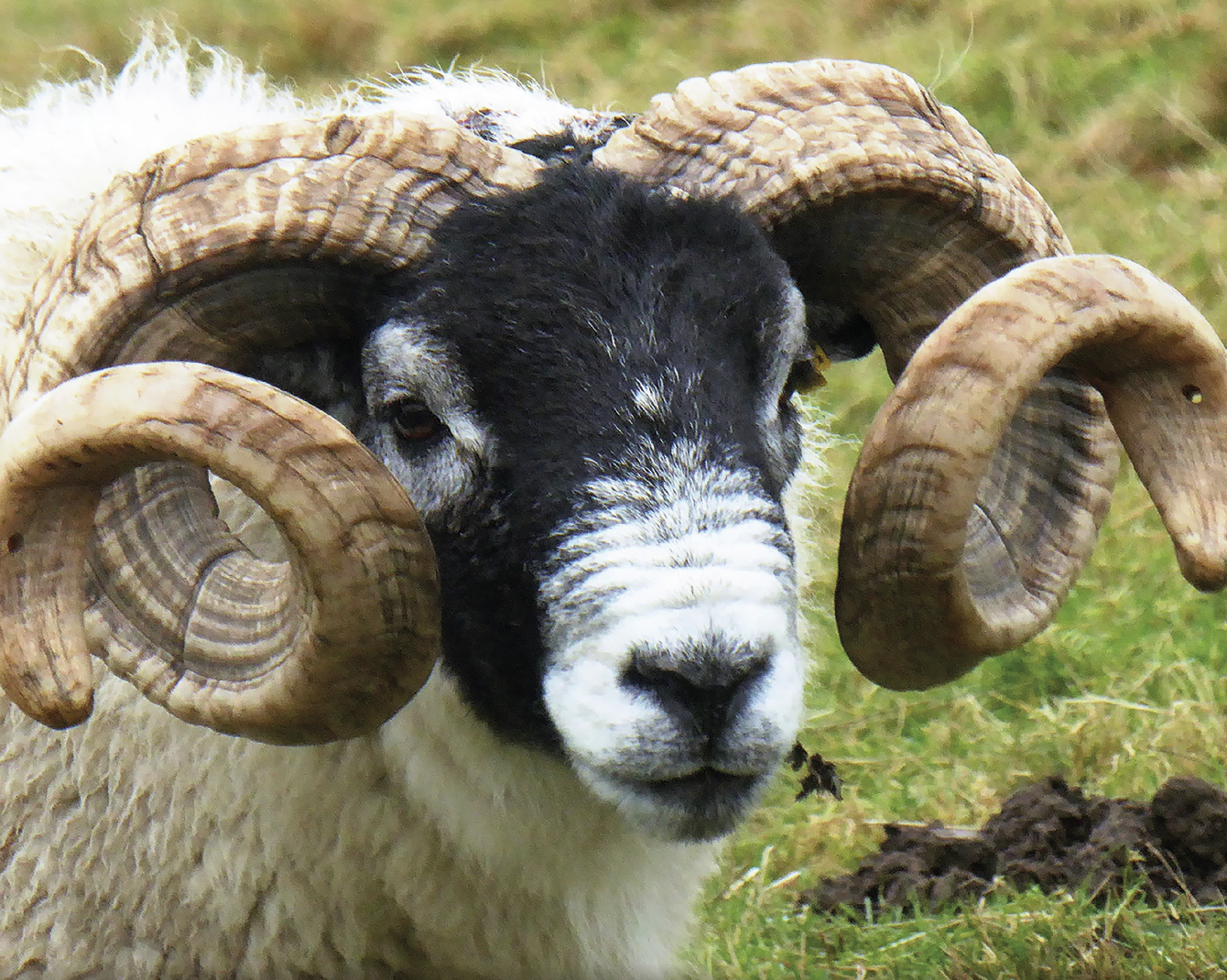
So, sheep can be quite surprising and don’t always present themselves in a gentle and docile way. Like the massive, mean-eyed, well-endowed ram I met on a farm outside Ford, which was clearly warning me not to come into its field.
I didn’t, of course. I’m not a fool. I might like most sheep, but I know a bruiser when I meet one.
I’ve come across other sheep which looked tough enough to be wary of. Often, it’s the horns, which can look more suited to the Serengeti than a field in the Ingram valley, but there are other circumstances when their boldness can be disconcerting. I’ve seen sheep leap onto the top of dry stone walls, for example (a thing I couldn’t do myself), and once I was driving somewhere in the Rothbury area, exploring rural Northumberland with two American friends, when we met a flock of sheep coming down the road towards us in a confident manner. Obviously, I had to stop the car, and my guests were charmed by this picturesque and rather old-fashioned rural scene. “Oh! That is so neat,” they exclaimed – but I noticed neither of them got out of the car to form a closer relationship with the flock.
In the main though, sheep look calm and agreeable, not threatening at all – often spread out across a field or a broader landscape, beautifully white against the green grass. They are usually well spaced – 9 or 10 to the acre, perhaps as many as 20 on an area the size of a football pitch – all quietly and continuously champing away at the short grass, and all for some reason facing in the same direction.
Seeing them like that you might think of them as self-reliant, isolated creatures, but that would be wrong; they are clearly not like that at all – they often form companionable groups under trees or in the shelter of walls and meet up with their chums or relations. The older ones sit quietly resting while keeping an eye on the younger ones. The teenagers get together and pose or take up interesting stances, declaring their independence and maturity as teenagers everywhere do. The lambs romp about in an adorably entertaining way, when not charging around like human toddlers climbing all over their indulgent mothers. They jump on them and burrow into them and sit snugly on their backs, and when they’re hungry, they demand food and get stuck into mum while she stands patiently with a contented look in her eyes.
I hope I don’t sound as if I’m an expert on sheep – I don’t really know anything about them. I suppose I know a bit about their history in our landscape, the economic importance of the export of wool to Europe in the Middle Ages, and the scientific efforts to produce new and faster-growing livestock among Northumbrian farmers in the l8th and 19th centuries, but I’ve written about these things before and this article is just about the pleasures that sheep bring and the richness they generate in our countryside. I’ve never studied them; I just like to stop and lean on walls and watch them.
This is a joy, though I recall one story which revealed how a good knowledge of sheep behaviour can also bring about advantages. I read about it in the newspaper so it must be true. It’s the story of a young, inexperienced police constable somewhere near Penrith, I seem to recall. He was out for a walk when he spotted a sheep grazing in one of those dank, marshy depressions that are so common on the northern moors.
He, being a country boy, knew that sheep generally avoid such moist and acidic places, and he wondered what had made the place acceptable to the sheep. He deduced something was making the grass sweeter, and when they dug up the hollow they found the decaying body of a murder victim, and that led them to the local farmer, who was subsequently found guilty and fed to his own sheep. I made that last bit up of course – sheep eat grass, not farmers – but I think the story’s true and a useful demonstration that it pays so know your sheep and keep an eye on them. You never know what you’ll find.