
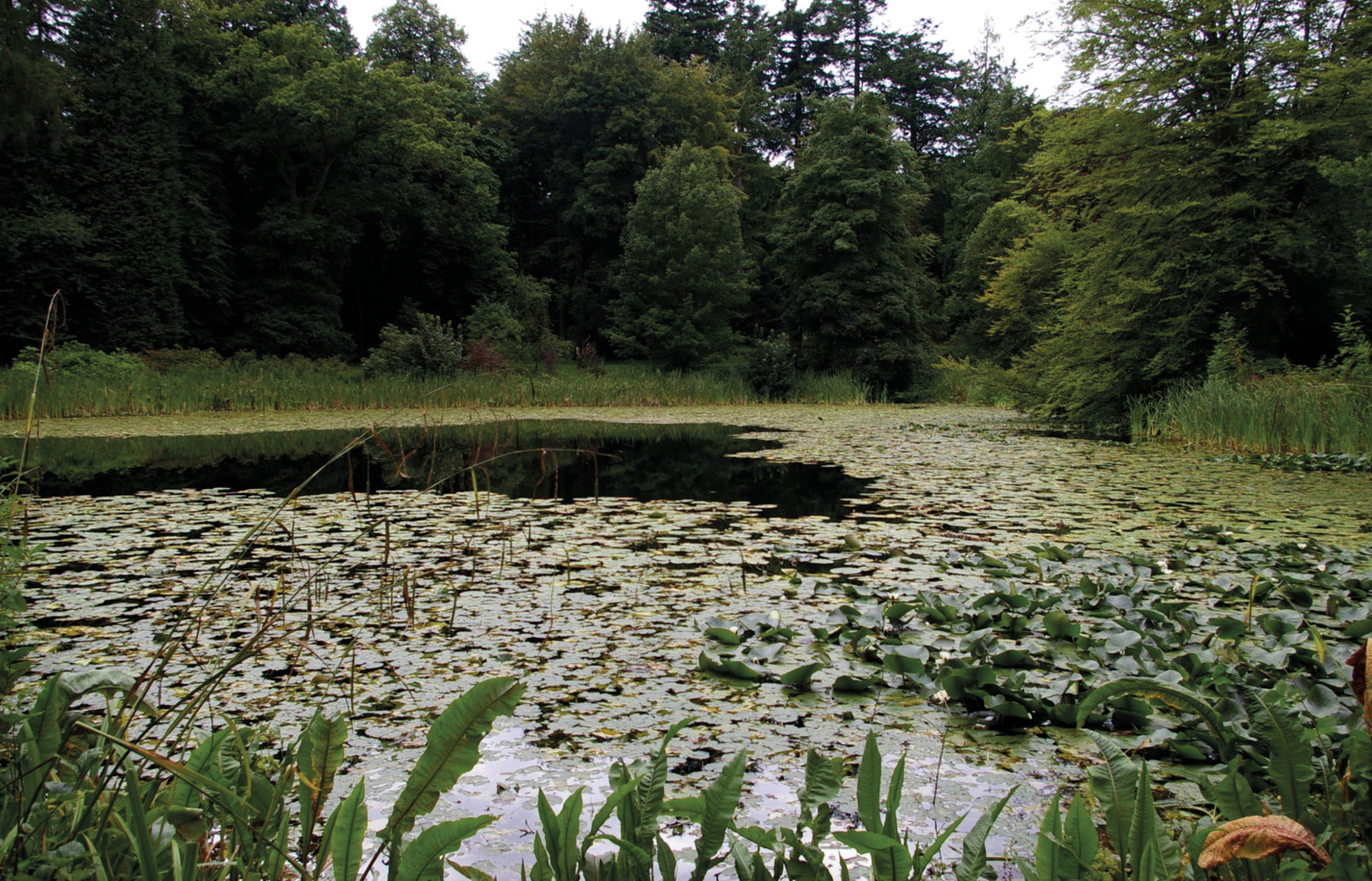
The China Pond at Wallington (photo: Christopher Hilton)
First published in edition 210 of The Northumbrian, February/March 2026
Janet Hardie, granddaughter of Sir Charles Trevelyan, who gave Wallington to the National Trust, explores the fascinating history of the China Pond in the estate’s lovely East Wood
My cousins and I had the privilege of spending many holidays with our grandparents at Wallington. We were an out-doorsy family and all year round we loved exploring the woods, the River Wansbeck, and the six man-made ponds there. Little did I realise when I decided to write this article about the China Pond in the East Wood that I would discover so many surprising stories.
Visitors to the East Wood and beautiful walled garden must cross the road and go through the metal gates with their quirky top sliding catch to get to the pond. It appears that in 1752, Wallington’s owner, Sir Walter Blackett, made a proposal to build a Chinese House – “an elaborate piece of rococo chinoiserie” – near the new pond, as all things Chinese were fashionable. It may have come ready-made from London, but all trace of it disappeared long ago. I am told there is an undated letter in the Alnwick Castle archive from a Mr Poynings at Wallington to the 1st Duchess of Northumberland, which describes the proposal as “a foolish, expensive Chinese Building at the end of a large fishpond.” There are outline sketches of the pond in the house, and a delicate architectural drawing dated 1752.
As the pond matured, it became an attractive part of the estate, and in the early 1900s Caroline Trevelyan, who was an accomplished artist, painted several watercolours still on show at Wallington. I have one painted in 1913 showing the stone arch for the pond’s overflow, which went down into the Garden Pond, and one of the dragon heads which are now on the lawn in front of the house at the foot of the tree.
My brother, Hugh Cheswright, and probably his uncles and great uncles before him, would scramble along the dark, dank stone tunnels by the pond and in the walled garden. Hugh was always adventurous, while I preferred a gentler occupation under the beech trees where I would make moss houses and play by the curved seat. This seat is also of the then-fashionable chinoiserie design, which even extended to garden furniture.
The east path around the pond, called the Druid’s Path by George Otto Trevelyan, passes a huge standing stone of sandstone grit always known as Poind’s Man. George Otto told his daughter-in-law Molly that there were occasional disputes over boundaries in the 1830s, when Sir John Trevelyan owned Wallington. The story goes that Sir John had the stone removed (pinched?) from the remains of a Druid circle on nearby Shaftoe Crags. It may have been one of two stones known as Poind and his Man, the stone at Wallington the lesser of the two and therefore the Man. The owner of the adjacent estate requested its return, but apparently was told that if he wanted this monumentally heavy stone back he was very welcome to come and get it. It has remained at Wallington since.
The pond is surrounded by magnificent trees, including the remains of European larches, Larix decidua. Charles Trevelyan writes in 1957 of his admiration for the planting done by Sir Walter Blackett: “While the planting was in progress in 1738, the Duke of Atholl left behind him in recognition of his entertainment at Wallington a few specimens of the first consignment of larches in this country, which he was conveying to his Perthshire home.” A few were planted. One blew down in 1968 and only one remains, which lost its uppermost branches in Storm Arwen in 2021.
In the 1960s the Scottish Forestry Commission was asked to propagate some of the Atholl larch seeds. The only way to get the cones from the top of the trees was to shoot them down with a shotgun, which Charles and his daughter, Pauline Dower, did. The seeds were duly sent to Scotland and some were returned for planting, but only one survived the drought of 1976. It is now successfully growing at the end of the Portico Walk near the Walled Garden.
I asked Simon Thompson, head gardener at Wallington, about storm Arwen, whose 100mh winds wreaked havoc at the end of 2021. The trees felled by it included two huge oaks, which were uprooted, one by the China Pond and another near the Garden Pond. Simon knew of a creative wood carver named Tommy Craggs and they discussed the idea of making something out of the vast trunks in situ. Simon received sponsorship from Barbour and in a couple of days Tommy had carved a magnificent owl perched on an upright trunk by the Garden Pond.
Then they turned to the China Pond – perhaps a carving evoking the wild weather blowing through the trees? “It all happened organically,” said Simon. First, the face of the wind with breath coming out of its mouth, then cold Jack Frost appeared on one side, and so the carving grew. Tommy worked with his chainsaw for two or three more days and carved the word Elementary along the length of the trunk. Simon decided there would be no noticeboard or interpretation, so that people could make up their own minds about what the carving portrays. It is now a well-loved piece of climbing apparatus for both young and old.
At the northern part of the pond stands a massive redwood tree, Sequoia sempervirens. If you’re a tree-hugger, this is for you. The redwood has very soft, dense bark in complete contrast to other trees, and if you look closely, you can see tiny round holes in the soft bark. These are made by woodpeckers, treecreepers and nuthatches for roosting and nesting. Redwoods are among the tallest trees on the planet, with some reaching more than 350ft high, and this mature specimen is doing well. Simon is undertakng successional planning of redwoods through the woods so future generations will be able to enjoy them.
Close to the roots of the fallen oak is a small building on the edge of the pond. One summer when my brother and I were youngsters, we thought it would be fun to make a den inside it. We broke in and found it quite dry, with a sort of pump contraption in the middle of the floor. I think we managed to make a small fire and collected tins of food for midnight feasts and cousinly gatherings. Our grandmother Molly Trevelyan fairly quickly found out about our mischievous activity and we were hauled into her parlour and severely reprimanded. Why? Because the little hut was the pump house, built in 1900 to be used by fire engines to pump water from the pond if there was ever a fire at Wallington. We had no idea that was its purpose, and I hope were suitably apologetic. Only years later did our mother Patricia admit that she knew what we were up to but did not see any harm in it.
We used to be able to leave the China Pond by the northern path via another set of metal gates not dissimilar to those at the entrance, and these have their own story. In 1935, Charles, Molly and Patricia travelled to Russia and while in Moscow, “came across a pair of wrought-iron gates which led into a small enclosure . . . from which the czars of old watched the execution of criminals in what is now the Red Square.” The gates were beautifully made and ornate – “full of curly-cues” writes Molly.
They took photographs and on their return to Northumberland asked a sculptress friend, Dora Clark, to draw a simplified version, “with much of the unnecessary fulsomeness left out.” The blacksmith at Belsay was asked to make the gates, which were “so heavy we had to build stout strong gate posts to carry their weight.” The finishing touch to the plain pillars were two pyramid stone caps. My grandparents named them the Moscow Gates.
Exploring the history of the China Pond has been an unusual mixture of history, geology and nature laced with childish memories and nostalgia. I love the fact that the history about the making of the pond in the 18th century is available in archival documents. Also the sense that the monolithic stone will still be standing there in decades to come, quietly keeping its own council, and that the giant redwood will continue to grow for many decades, its soft bark providing a safe home for tiny birds. The beautiful watercolours of the pond and its surroundings by a Trevelyan ancestor in the 20th century capture the essence of
the place, and the wrought iron gates and pump house also have their own stories to tell.