
First published in edition 211 of The Northumbrian, April/May 2026
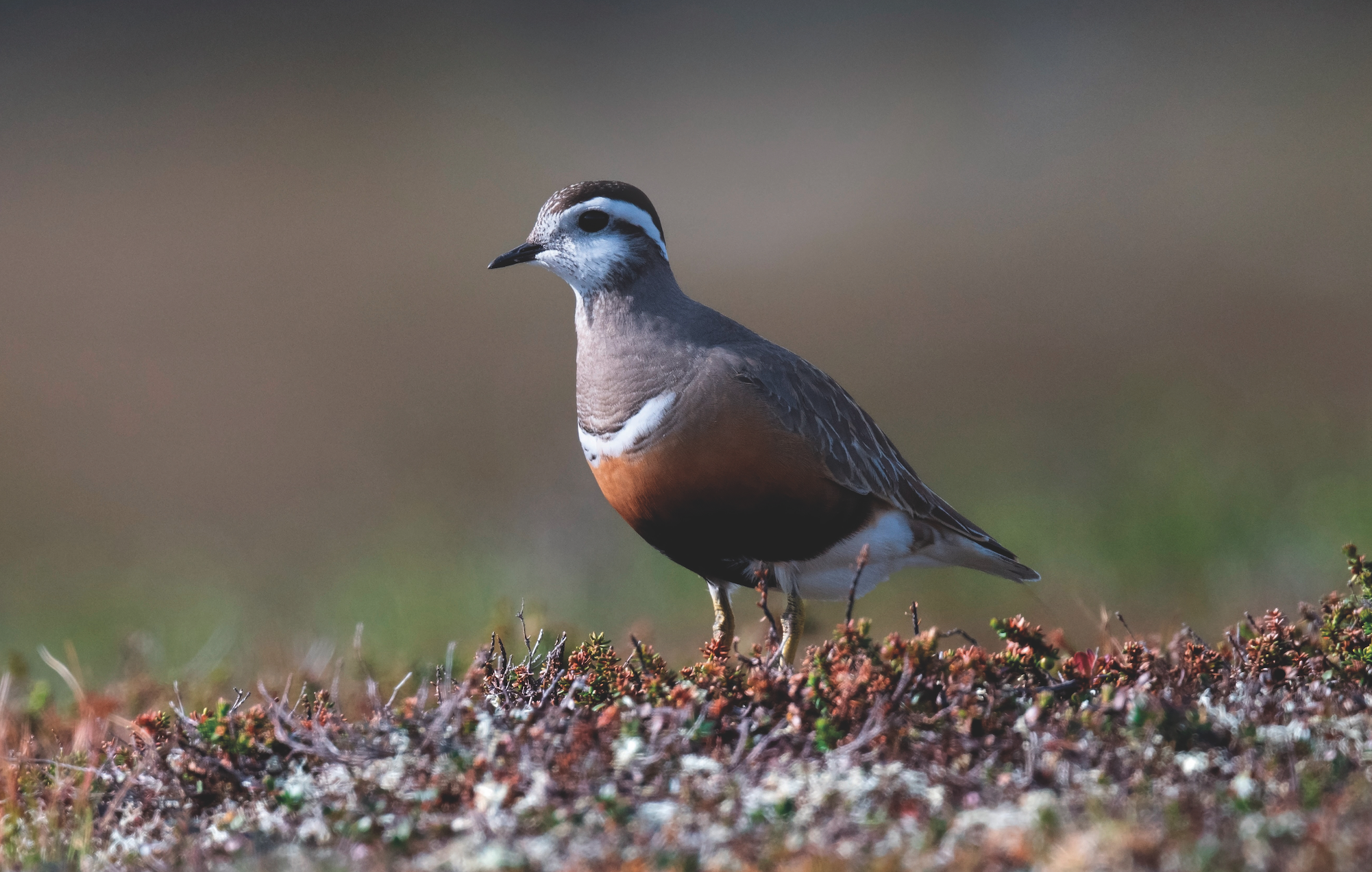
Ian Kerr traces the fortunes of the rare and remarkably tame dotterel, from its perilous past as a Tudor delicacy to today’s spring pilgrims on Cheviot, where hardy birders climb in hope of glimpsing this mountain migrant
Every spring, a few hardy, dedicated birdwatchers slog their way more than 2,500ft up to the flattened, boggy summit of Cheviot in search of one of our most fascinating migrant birds.
The brightly coloured dotterel is not only beautiful. It also turns the usual male and female roles of the bird world on their heads, as can be seen on their mountain-top breeding grounds in some of the toughest places in Europe and Asia.
The dotterel is also unusually tame and approachable – one of the reasons, sadly, that it is now rare in Britain. Down the centuries, when dotterels were much more common, they were trapped in large numbers for food, being regarded as a great culinary delicacy from the Elizabethan and Tudor periods until the early decades of the 20th century.
Their bright feathers were also in great demand for fishing flies – hunting for this market putting even more pressure on the population. Their tameness and lack of caution led to them being regarded as stupid and easily duped, thus the very word ‘dotterel’ came to be used as a term of mocking abuse for anyone regarded as naive or easily led.
These centuries of unrelenting pressure mean that today the dotterel is a rare spring migrant in Northumberland, with just a few fairly regularly turning up on the highest areas of the hills. Hence the efforts of those keen birders tackling Cheviot and other local summits.
For anyone who has made that climb – and I’ve done it a few times in the distant past – it’s a great, if strenuous, day out, though I’ve always regarded the plateau of Cheviot as a bit of a disappointment, being a believer that mountains should really have proper, pointy peaks.
In addition, such efforts aren’t guaranteed to be successful or even necessary, as a few migrant dotterels also turn up on low ground and settle on ploughed fields and pastures – which is a bit galling for those who’ve made that strenuous Cheviot ascent.
In the past, when the population was much higher, the dotterel favoured regular stopping-off spots, mainly in the southern counties, for migrating birds. That’s where the bird trappers of the day concentrated their efforts, setting nets to catch the unwary visitors and sell them for their meat and feathers.
Victorian naturalists wrote of the dotterel as a regular visitor, with parties occurring in many areas, including such unlikely spots to us today as Newcastle Town Moor. It was also claimed that a few pairs bred occasionally in The Cheviots.
In 1932 George Bolam wrote of continued trapping and shooting for food and feathers, blaming these practices for their continued decline. Numbers then rose in the second half of the century following the end of trapping and shooting, with legal protection for the birds and a recovery of the small population breeding on the highest plateaus of Cairngorms and Grampian ranges in Scotland.
These days, the rarity and beauty of the dotterel make it a sought-after species for spring birdwatching as they pass through the region moving northwards from wintering areas, mainly in the bare mountains and desert edges of North Africa.
There are now no local areas, apart from the top of Cheviot, which are regularly used. This makes finding dotterels a matter of either sheer luck or of painstaking scanning of likely looking tilled fields and pastures with short grass of the kind favoured by other short-billed waders, including golden plover and lapwing.
Most sightings away from the Cheviots have involved lone birds in fields close to the coast, though I can recall seeing groups of more than a dozen on ploughed land at Berwick Hill near Ponteland, and a similar group in the west of the county near Hallington. Last May, a party of nine spent more than a week on a tilled field at Beal, regularly feeding just yards from the busy road to Holy Island.
Typically, these parties spend a few days resting and feeding before moving on, though I recall back in the spring of 1994 watching two birds which remained in pastures on Holy Island from April until June, gradually fading out of their breeding plumage as the weeks passed.
Most of the birds seen locally in spring are en route to breeding sites on the highest Scottish mountains where the breeding population has been recently estimated to be anything between 300 and 600 individuals. The location of these high altitude mountain tops make it very difficult to survey these breeding attempts, hence the great uncertainty about numbers.
Other dotterels occurring locally move much further north to similar upland plateaus in Scandinavia, and Arctic Russia eastwards to Siberia. A few also breed in the Alps.
All these places have one thing in common – a tough, arctic climate that seems to suit these remarkable birds in addition to little competition for their vital insect and invertebrate food from other species. Having said that, a few pairs still nest just over our county border in Cumbria, where there are breeding records from the late 18th century until the early 1990s. None were then recorded as attempting to breed until 2015. Since then there have been five confirmed nesting attempts at five different high altitude sites in the North Pennines and other Cumbrian fells.
These attempts at the extreme southern end of their breeding range have coincided with a period of reduced sheep stocking on the highest fells, resulting in a slow recovery of the short-growing Arctic and Alpine shrubs which are scattered across otherwise bleak and stony landscapes. Dotterel nests, merely scrapes in the ground, are generally on flat areas of stone, moss and these stunted plants and shrubs – the only vegetation tough enough to withstand the extreme conditions.
Very unusually for the bird world, the females have the brightest plumage and once they’ve mated and laid eggs they leave it to the males to hatch and raise the young which, like all waders’ chicks, are capable of running and hiding and feeding themselves as soon as their plumage dries after hatching.
The females seem to then lead a bachelor girl life, often moving on to find new partners and repeat the process. The only other British breeding wader which follows this role reversal is the red-necked phalarope, which is even rarer, with only a handful of nesting attempts in Britain annually.
Whenever I’ve written about rare birds I generally get a few people asking me where they can find these elusive creatures. The answer as far as dotterels are concerned is that they can turn up just about anywhere on tilled ground or short pastures. That is unless, of course, you want to try your luck by slogging up Cheviot – but even then there’s certainly no guarantee of success.