
First published in edition 211 of The Northumbrian, April/May 2026
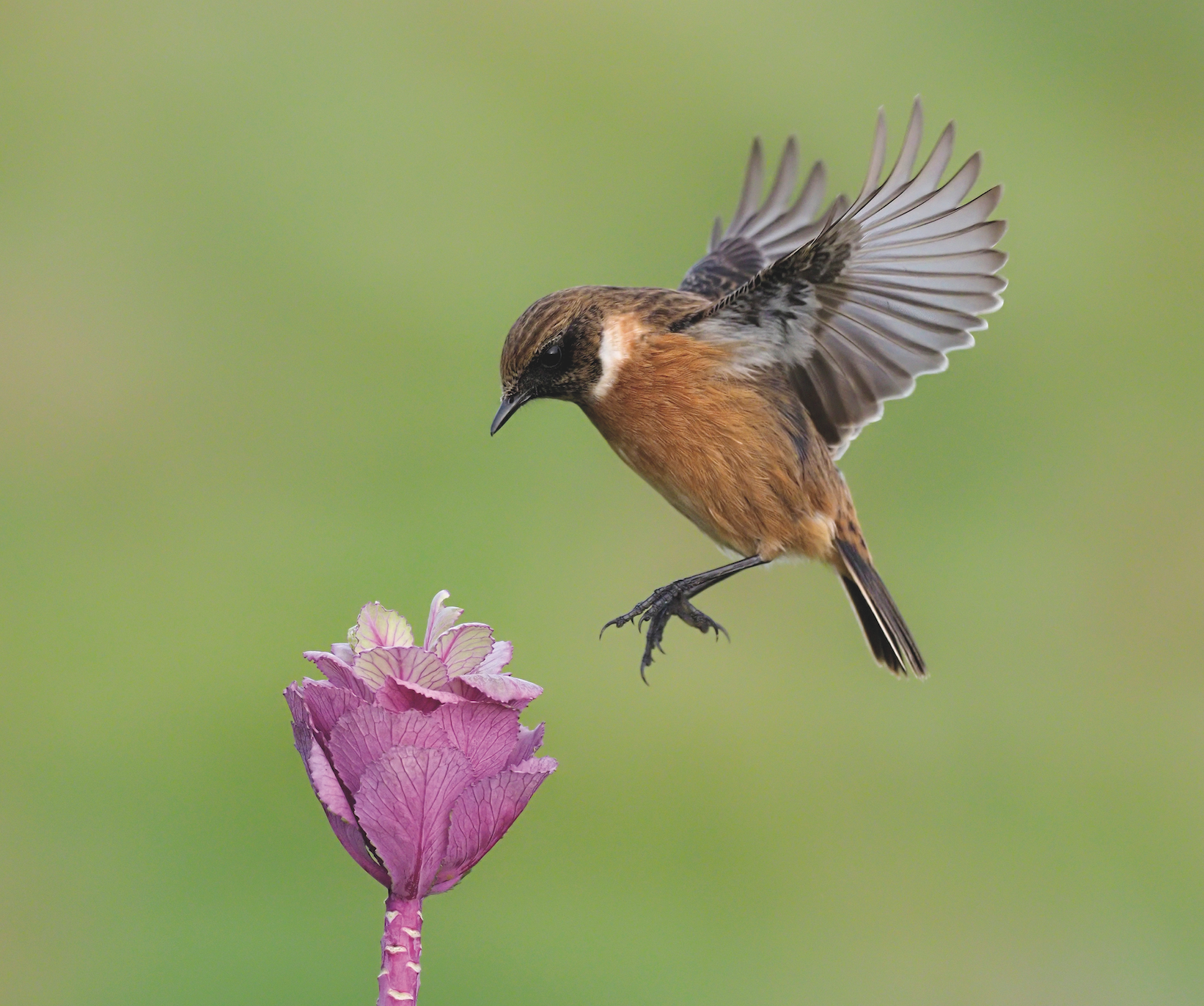
Across dunes, moorland and ancient paths, Northumberland Wildlife Trust chief executive Mike Pratt finds a constant companion in the stonechat – a small bird whose vivid colours and sharp call bring him closer to the living landscape
Sometimes it’s the little things we notice around us in the countryside which bring us closest to the land; things like simple encounters with birds and other wildlife.
As a birder and naturalist, it’s not good to have favourites. How can you pick out one species of anything above all else when each is an integral part of the serendipitous magic of the natural world? But it is human nature to have preferences, and I have a special place in my heart for the stonechat. It’s a humble choice, I know. I love soaring eagles too, owls are a close second, I love seabirds and waders, and in any moment the bird I’m looking at is all that matters.
But stonechats have a special resonance for me. Sometimes it feels as if they pop up wherever I go; from a recent retreat in the mountains above Malaga, Spain, to all along this Northumbrian coast from Berwick to the Humber. They seem to help to mark my way; joyful little totems linking me to nature and lifting my spirit.
From the Bamburgh dunes to Benshaw Moor, Lindisfarne links to Annstead Dunes, the hill forts at Lordenshaws and Yeavering, and the banks of the Till and the Tyne, I seem to come across them everywhere, particularly on ancient sites, for which they seem to have a penchant.
It’s their appearance – the male’s sunrise flushed chest and black cowl, white neck ring and wing flash – and the way they balance on the end of sticks and grasses, like enamelled bird badges waving in the breeze. And their distinctive call, that ‘chit, chat’, like two stones knocking together, is a mindful cut through to nowness. I love the way they seem to suddenly appear, with their artful fly catching and displays.
I’m lucky to have them as neighbours, sometimes in the garden or on the coastal gorse, nesting in the same thorn every year. Last summer their fledglings bathed in our garden pond. I’ve several times watched one completely abstract itself, almost turning inside out as it undertakes a thorough preening in the sunshine.
All down the east coast, it seems, stonechats appear, their territories set wherever their favoured habitat occurs. This is generally rough scrub, grass and gorseland, and dunes. Inland, they favour the edge of moors, where they compete with their cousin, the much less abundant summer visiting whinchat.
The little estuaries between Warkworth and Craster each seem to hold at least one pair. They are often encountered on the foreshore edge or even in semi-industrial settings, balancing on wire, old machinery and broken fences. They seem to like those metal and rock-filled gabion baskets on coastal defences, which are good hunting sites for insect prey. Everywhere they go they seem to embody and add colour and dynamism to their surroundings.
Recently I was walking on Hadrian’s Wall Path near the Temple of Mithras, idly picking up the odd shard of possibly Roman pottery from fresh molehills, when I heard the stonechat refrain close by. A pair were in the boggy vallum, that linear ‘moat’ built as a defence against Scottish incursions 1,600 years ago, now long abandoned and often scrubbed over with bracken, bushes and reeds. It is ideal stonechat habitat.
Unaware of either the history of the site or of me, the pair carried on with their bonding rituals, coming gradually closer, moving from stem to stem, the male flying up and parachuting down impressively, the female pretending to ignore him. Until suddenly they were side by side, staring at each other. Bobbing like two lollipops on adjacent fronds, they mated briefly, then with a chit and a chat zoomed off in opposite directions, starting the whole game again.
They move around outside the nesting season, though they have several broods most years. Encountering a family group is often rewarding; the young surprisingly confiding, the adults coming close and warning you away, opening their throats to reveal another sienna blast of colour, either as a warning to intruders or an invitation to their young to feed on mashed-up insects.
Out of season, their seemingly blissful coupledom breaks down and the young find their own territories. They may be joined by Scandinavian birds and rare subspecies, and then in early pre-breeding times they act a bit like the notoriously polyamorous dunnock, and you can see maybe three males to one female. She has the pick of the bunch, though I have an inkling that some pair for life, as far as is possible at least.
One characteristic I find endearing is how they create secret nests near or on the ground, often under a bush approached by a grass tunnel, rather like the skylark, to put predators off their trail. Their hard to trace nests are the perfect distillation of everything found locally at micro scale – grasses and leaves, bits of string and even plastic, curls of fox or hare fur or down, all around a cosy cup construction.
As a child I recall seeing them the first time on a big sand dune we called Blue Mountain due to its mass of flowering vipers bugloss in June. I have always looked for them in the years since, and they continue to surprise me.
The great thing is, in most if not all haunts they are still there. They are adaptable generalists within their somewhat vulnerable edgeland habitat, willing to settle now and then for a bit of semi-urban manmade untidiness or field headland. Thus, they have thrived tenuously where other species have not, which means they can still be encountered relatively regularly, though of course these days never taken for granted.
They are a sign of hope that not everything is in immediate and irreplaceable decline; still present as a distant silhouetted dot on a scrubby horizon, or as a colourful burst balanced on a stick or fence. These distinctive characters are woven into the warp and weft of the land, their chits and chats charged with wild beauty that ground us in any moment they might appear.
Mike’s books of prose and poetry about the natural world are available via Northumberland Wildlife Trust at
www.nwt.org.uk and at Mike’s website:
www.livingmindfullywild.com