
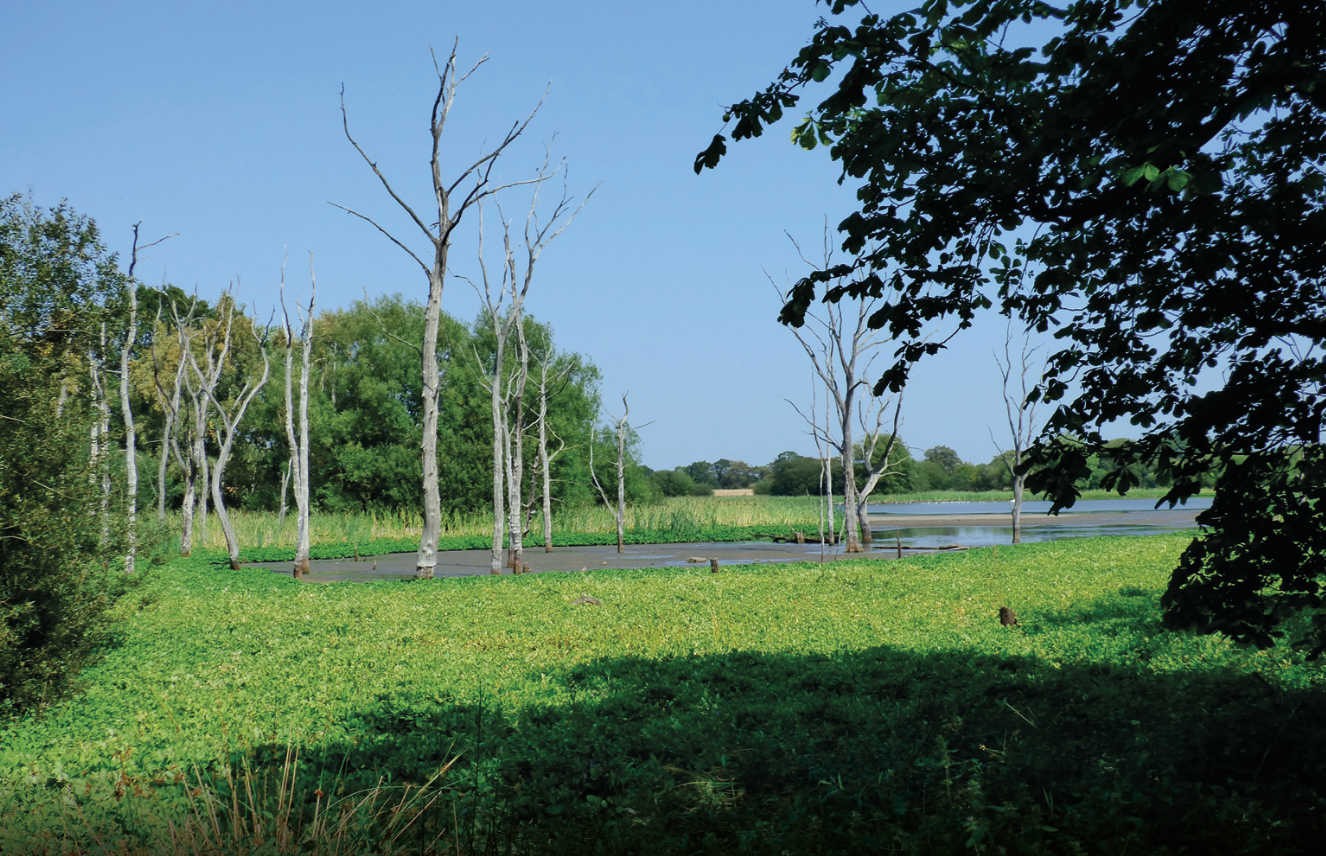
Arcot West Pond
First published in edition 212 of The Northumbrian, June/July 2026
Anthony Toole traces the area around Arcot Pond across the seasons, as rare migrants, winter thrushes, summer wildflowers and shifting waters create an extraordinary theatre of wildlife
My first visit to Arcot Pond was on a cool March day a few years ago, in response to the reported sighting of a rare water bird. A red-necked grebe, one of perhaps 50 that might appear in Britain in the year, had flown in, probably from eastern Europe, and hung about there for a short while before moving off elsewhere. It was just beginning to come into its summer plumage and I managed to capture a couple of passable images of the visitor before leaving it in peace. It was gone in a few days, and as far as I am aware, has not returned.
Lying a little over ½ mile southwest of Cramlington, Arcot Hall is reached by a pleasant drive through a tree tunnel along a minor road just north of and parallel to the A19. It was given its name by Robert Storey, who bought the land in 1791 with wealth he had acquired in India as a young physician to the Nawab (prince) of Arcot.
He sold the land to George Shum, who built Arcot Hall in 1802. Coal was mined there during the 1930s and 1940s. British Coal rented the estate to Benton Park Golf Club in 1946 after the club’s land had been compulsorily purchased by the council for housebuilding. The name was changed to its present Arcot Hall Golf Club in 1958, and the club finally acquired ownership of the estate in 1996.
Covering 68 hectares, Arcot Hall Grassland and Ponds is boundaried north and west by the golf course. Its southern limit is the minor road, while to the east is a straight footpath through tall hedges punctuated by mature oak, Scots pine, ash and beech trees. In summer, the full bloom of the hedgerow shrubs, hawthorn, bramble, elder, burnet rose and honeysuckle attract many bees and butterflies. Through occasional gaps in the dense growth one can catch glimpses, across a field or two, of the houses at the edge of Cramlington.
Though it does not have the status of a nature reserve, the unkempt area is classed as a Site of Special Scientific Interest. It is thought to contain perhaps the largest area of species-rich grassland in the North East, and is a mosaic of wetland, woodland and heath habitats that are now becoming rare because of agricultural development. Many of the plant species, and the invertebrates they attract, are scarce in Northumberland.
When I visited in high summer, the grass was thriving, as were the flowers – dyer’s greenweed, vetch, tormentil, knapweed, buttercups, herb robert, germander speedwell and the occasional spotted orchid. The large area of bramble to the south of the main pond promised an autumn harvest of blackberries. Growing from the wet margins of the pond were yellow flag iris, branched bur-reed, bittersweet, forget-me-not and water mint. The pond itself was populated by several lapwing, several hundred black-headed gulls, and a mute swan. Swallows swooped over the water and blue damselflies hovered and bred near the edges.
Following the footpath brought me past a pond extension where herons perched on the skeletal branches of dead trees. Beyond a stile, the track came within a few metres of the road, passing a long-fallen beech, out of the roots of which grew a mass of brambles. The track then became a woodland walk, which opened onto scrubby growth of bramble, hawthorn and gorse. Flowers here included sneezewort and scabious. More grassland followed, through which the path curved past the east shore of the main pond and back to the entrance on the minor road.
As the long, dry summer approached its end, the grass became brown and straggly while the flowers died off. Though the hawthorns were laden with berries, the lack of summer rain appeared to have affected the earlier promise of a bramble bounty. Most of the blackberries had failed to ripen, while those that did were small and seemed reluctant to be picked, staining the fingers rather than dropping into the palm.
The pond was little more than half full, with cracked mudflats reaching out from the shores. The muddy central areas, however, attracted a new gathering of waders. In addition to the lapwings were 15 black-tailed godwits and a solitary ruff. Only about 59 or 60 of these godwits breed in the UK and spend the winters in Africa. The larger numbers that winter here return to Iceland and northern Europe for breeding.
Autumn rains filled the pond, leaving little in the way of exposed mud or shallows, so that dabbling ducks like mallard and teal flew in to replace the waders. Smaller numbers of wigeon and colourful, broad-beaked shovellers were probably the vanguard of winter visiting flocks, while a few moorhens foraged in the margins.
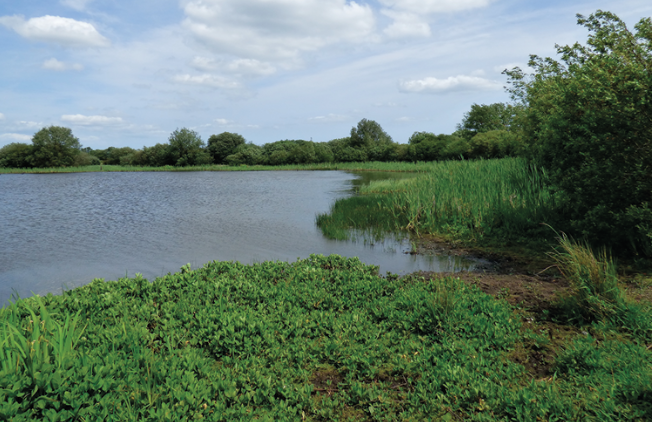
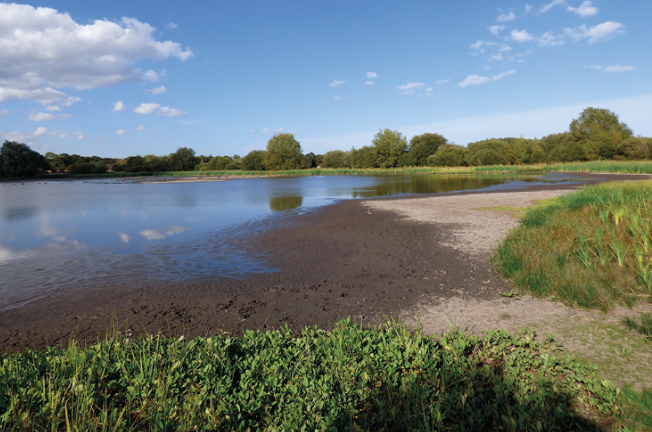
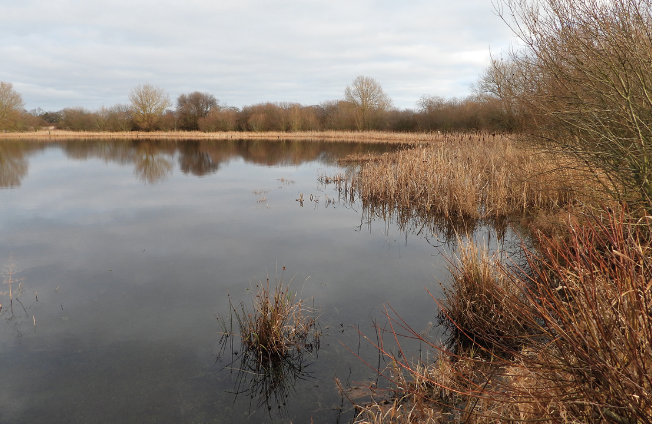
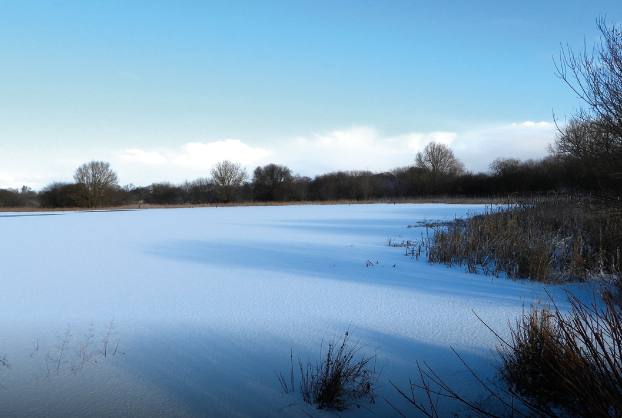
South Shore in spring, summer, autumn and winter
The weather approaching the turn of the year was mild but damp. As I parked the car by the entrance, a jay settled briefly in the nearby hedgerow. Only small gatherings of teal and mallard paddled across the pond, accompanied this time by a pair of gadwall. Though the promised abundance of blackberries had not materialised, the hawthorns were laden. A flock of around two dozen birds rose from the adjacent grassland, their loose formation and rapid flight suggesting that they might be Scandinavian thrushes, winter visitors, rather than starlings. Indeed, when they settled in the bushes and began to gorge on the berries, I was able to pick out a few redwing, though as is sometimes the case, their numbers may have been augmented by a scattering of fieldfares.
The third day of the new year brought the winter’s only fall of snow. Though the shower was brief, it covered the frozen pond to a depth of a couple of inches. Two thin strips of open water remained in the centre, occupied by a small number of mallard. Ignoring the open water but clinging to its edges were perhaps as many as 50 teal. Redwings still commandeered the hawthorns, and a kestrel surveyed the withered scrubland from a perch on one of the tallest trees.
Through the end of January and most of February, persistent rain sogged the grassland, puddled the footpaths, and filled the pond to capacity. The Scandinavian thrushes had cleared most of the berries from the hawthorns and the brambles had shrunk to a tangle of withered sticks. The teal, smallest of the dabbling ducks, remained in large numbers, mostly gathered into groups spread along the reeds of the north shore.
A dozen mallards were already separating into pairs in anticipation of their spring breeding. A solitary goldeneye held the centre of the pond, while a couple of male shovellers gave splashes of colour to the eastern reedbeds.
The first springlike days came in early March, with snowdrops catching the dappled sunshine of a hedgerow and catkins weighing down hazel branches. A robin staked his territorial claim from the top of a hawthorn and a pair of red grouse cackled up from the grassland. Only the shovellers and a flock of nine pochard colonised the pond.
A month later, the hawthorn was green, and though the blackthorn was still leafless, it was white with blossom. Along the sodden southern shore of the pond, a row of willows, careless of their wet feet, were laden with catkins. Small numbers but a variety of waterfowl, shovellers, coot, mallards, tufted ducks, mute swans and gadwall paddled across the pond in pairs. Spring was here.
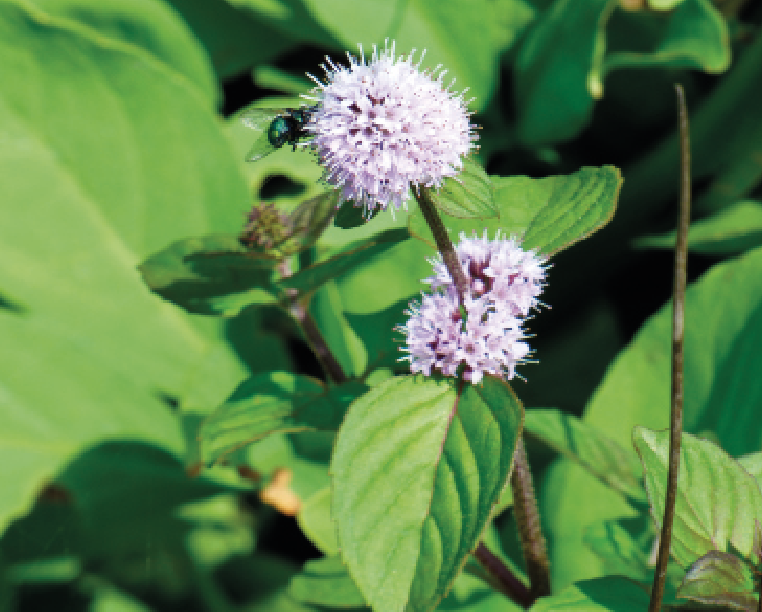
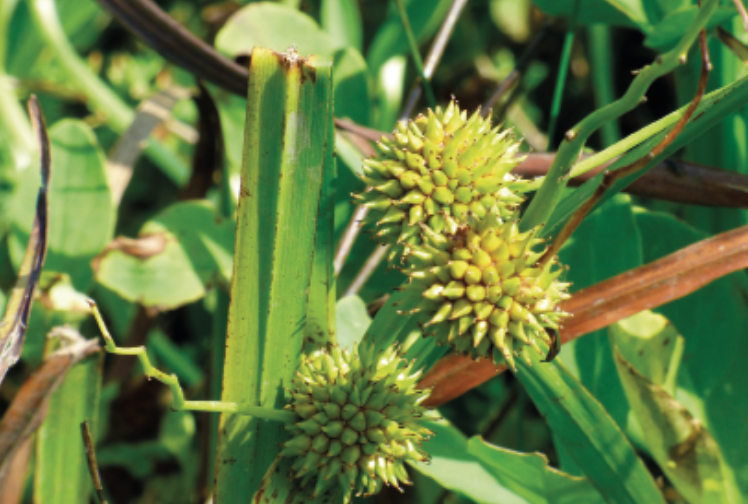
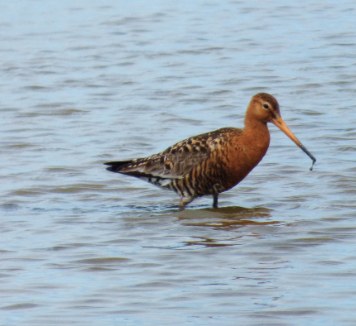
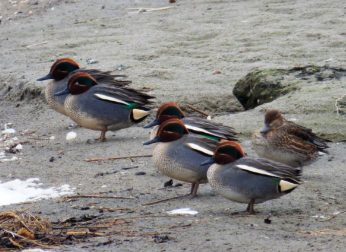
Water mint; Branched bur-reed; A black-tailed godwit; Teal gather by the water