
Let us prey...
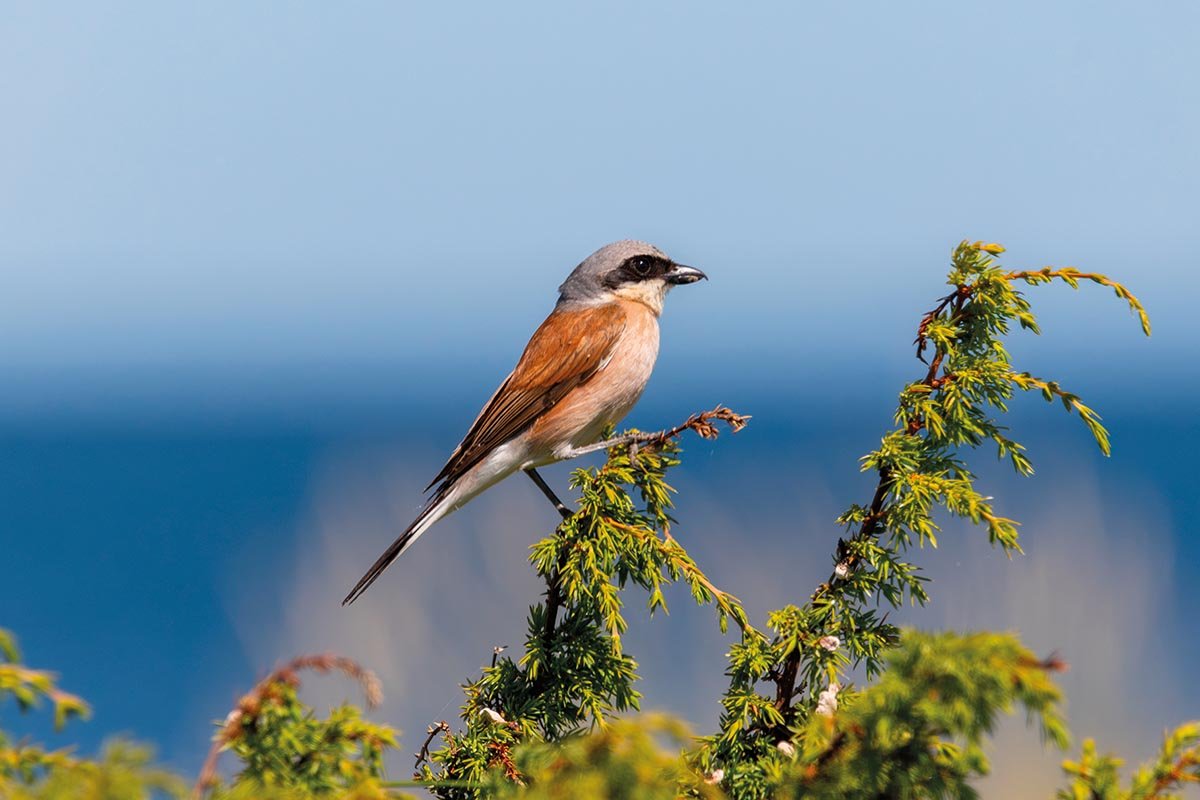
First published in edition 205 of The Northumbrian, Apr/May 2025
Ian Kerr profiles that most diminutive bird of prey, the red-backed shrike – a rare visitor to our shores which has birdwatches glued to the skies in hope of its arrival in spring
Each spring, as the days lengthen and temperatures begin to rise, few people pay more attention to local weather forecasts than birdwatchers planning an outing on the coast.
They’re looking for periods of easterly and warm south-easterly winds which can trigger the arrival of rare and uncommon birds. These are migrants which don’t normally occur in Britain, but those winds can blow them off-course as they move up continental coasts towards breeding grounds in Scandinavia, the Baltic States, Russia and other parts of northern Europe, many of them beyond the Arctic Circle.
These weather conditions can provide the exciting arrival of a species which everyone wants to find – one of our most striking and colourful visitors, the red-backed shrike. It is both rare and beautiful, and looks its best in spring. A male shrike makes a splendid sight, particularly as they often boldly sit high on the uppermost branches of bushes and frequently use wire fences, overhead cables and power lines as look-out perches.
They’re slightly smaller than our familiar starling, but much more colourful. Males have reddish-brown backs (hence their name), pale breasts and bellies tinged with pink, white cheeks, and a neat pale grey head. They also have a striking piratical black eye mask. Their tails are black and grey with white flashes which show up when they’re in flight. Females have a less striking brown back, barring on their breasts and bellies, and a much less extensive and prominent mask.
Despite their small stature, shrikes have sharp, hooked beaks and are really miniature birds of prey. Although largely surviving on insects, they’re capable of killing other small birds including chicks taken from nests, small mammals such as mice, and given half the chance, small lizards, snakes and other reptiles.
When food is plentiful, they have a rather gruesome habit of storing their surplus by impaling it on thorns or barbed wire. This has provided them with the old country name of ‘butcher birds’. Their Latin name is Lanius collurio, the Lanius part deriving from the Latin verb lanio, which means “I tear or rend in pieces.”
These days, red-backed shrikes are rare migrants confined largely to coastal areas and then only occurring when weather conditions dictate. Things were very different in the past when they were widespread, breeding across southern England and most of Wales. Their range gradually contracted, however, and by the 1970s only 100 or so pairs were confined to south east England. After that they faded out as a British breeding species with only the very occasional pair now nesting, usually under heavy protection.
The reason for their demise could include our warmer and wetter summers and the increased use of pesticides, which has reduced their main large insect food. Locally, well north of their old breeding range, it appears that they were always few and far between. The Rev’d John Wallis, vicar of Simonburn on the North Tyne, wrote in 1719 that they were found “in upland areas with thickets,” which is an observation repeated by other naturalists during the 1800s. However, by 1912, George Bolam of Berwick, an extremely astute and careful chronicler of Northumberland birdlife, wrote that they were a rare casual visitor. But he did add, rather tantalisingly, that they still occasionally bred.
He cited a probable shrike nest near Longframlington in 1890 and another at Belsay in 1901. Similarly, a pair was present during the breeding season at Tarset on the North Tyne at times between 1938 and 1941 – a period when they were still breeding widely further south. Others, found during 1970s summers at Wideopen and Backworth, when numbers were on their steep downward spiral in southern England, raised suspicions of nesting, but nothing was proved.
Today, these birds, which winter in tropical Africa, have an extremely wide breeding range stretching from northern Spain eastwards to Turkey and Central Asia. They cover most of the continent northwards to southern Scandinavia, the Baltic states and eastwards far into Central Europe and Russia.
The birds which turn up locally are presumed to be from the fairly close Scandinavian and Baltic breeding populations. Most springs, two or three red-backed shrikes are spotted, their rarity always making them a big attraction for those fortunate enough to see them. There have also been occasions in those easterly and south-easterly airflows when influxes have occurred. Last spring was one such occasion, with record numbers occurring right down the east coast from the northern isles of Scotland to the Wash. In Northumberland, Holy Island, as so often because of its position thrusting out into the North Sea, was the epicentre, with at least nine birds – five superb males and four females – arriving in a single day.
Single males were also found southwards at High Newton and Cambois, and females were seen at Cocklawburn, the Farne Islands, Beadnell Bay, Newton Pool, Amble, Snab Point near Cresswell, Newbiggin and Tynemouth. The picture was much the same along the entire east coast, with well over 100 birds found and perhaps many others escaping detection.
As might be expected, the biggest concentrations in this period of warm south-easterly weather were found on small islands in northern Scotland. The real hotspots were Fair Isle, with a staggering 32 shrikes, followed by North Ronaldsay with 18. It’s no coincidence that both islands have well-manned bird observatories and ringing stations, which means plenty of eager folks on hand to get out and find them. They must have considered it their lucky day, perhaps a chance in a lifetime, to see so many of these wonderful birds.
Of course, there’s no guarantee that such an influx will occur again. But at this crucial time of year, all eyes are on those weather maps – here’s hoping!