
Out of the woods
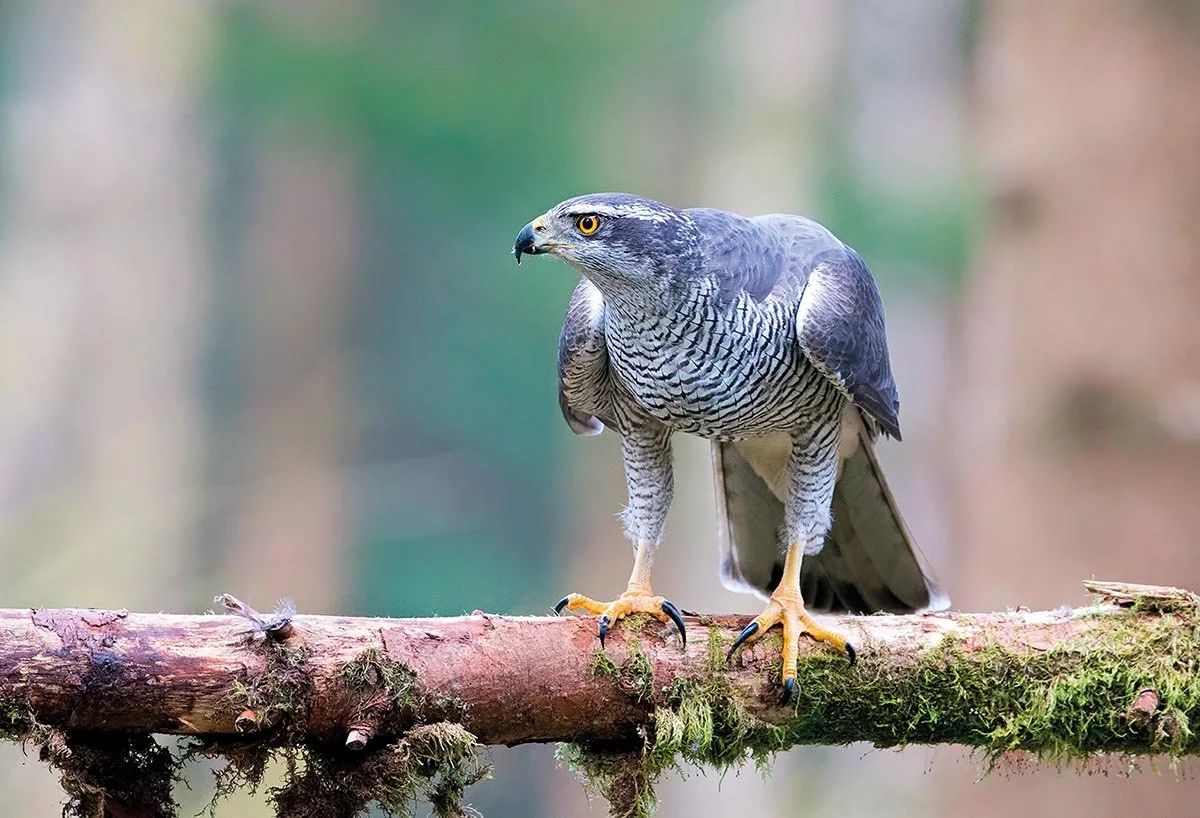
A goshawk (photo: Chas Moonie)
First published in edition 206 of The Northumbrian, June/July 2025
Northumberland’s forests have long been a refuge for one of Britain’s most mysterious and intriguing species. Author and naturalist Conor Mark Jameson has been under its spell for some time . . .
The northern goshawk (Astur gentilis, to give it its official title) can cast a spell on you. I know, because it happened to me. I was so fascinated I ended up writing a book about it, and my search for it: a journey into what we now call re-wilding.
My interest in the goshawk has been lifelong, and in some ways I feel as though I have lived my life in parallel with the species. I spent my childhood in Scotland, at a time when the goshawk was returning to Britain’s remoter forests. Kielder Forest, in Northumberland, is central to the story.
My parents retired and moved from near Glasgow to the peace and quiet of the rural landscape of the Scotland/England border. Visiting them usually involved travelling from my home in Cambridgeshire, up the A1 and across the Cheviot Hills from Newcastle. The journey would bring me through Kielder and its stands of mature conifers in a patchwork stretched across the rolling slopes. Every time I passed, northbound and southbound, I would be on the alert for a glimpse of goshawk. I would always stop and have a recce – looking, listening.
Goshawks were extinct in Britain for nearly a century from the late Victorian era. They came back in a suitably furtive fashion – not in a blaze of publicity in a high-profile partnership between organisations, landowners and sponsors, as might happen now, but by escaping or being deliberately set free by owners. The birds usually came from Finland – big, pale northern hawks.
Kielder was an obvious place to free them, as it resembles those Scandinavian forests. The goshawks established a breeding population from the early 1970s, said to be around 20 pairs. They became known as the ‘phantom of the forest’ and we were told that they couldn’t live anywhere else, being allergic to humanity.
In all those years and all those passing visits at Kielder I never had a sniff of one. They’re like that. Their ability to go undetected is legendary – a little bit like witchcraft, considering their size and sheer presence when encountered up close (captive birds, needless to say). I liked this about them – I was just happy to know they were there.
Then one day, when I least expected it, on my journey south I found a goshawk. But it was in a glass case, in a junk shop, in a town, glaring at me with its shiny glass eyes. Even in that condition it “struck fire from my mind”, as TH White put it when describing the idea of ‘reverting to a feral state’ with a trained goshawk. I couldn’t shake the image of that glare: accusatory, compelling. I then met a German conservationist who found a live goshawk not far from where I lived. Not in a forest, but at a gravel pit. When I queried what he claimed, he looked at me and calmly reported that he knew a goshawk when he saw one, as he saw them all the time. In Berlin.
It’s ten years since I wrote my love letter to the species, Looking for the Goshawk. I wanted to understand why the species remained so rare and elusive, while other birds of prey were recovering, helped by conservation. I was living down south in those years, where accepted records of goshawks were almost unknown. I promptly went to Berlin and saw a wild goshawk close-up in a public park. This young female was eating a hooded crow and looked just like the one I’d once found in a junk shop (if only it had come vibrantly to life). Berlin has 100 pairs of goshawks. The birds find sanctuary in city parks, gardens and cemeteries.
In lieu of goshawks, much closer to home I found myself searching for TH White, the only person who wrote a book about the lost raptor (as I think of it) in the 20th century (The Goshawk, 1951). Tim, as he was known to his friends, is also largely forgotten, but remembered by some as the author of fantastic tales based on the legends of King Arthur – a setting where magic is an everyday thing and goshawks have a place.
A troubled soul, White retreated from society in the years leading up to World War II. He gave up his job teaching English at a prestigious school, took a cottage in the woods and a goshawk from Germany that he would seek to tame. The hawk escaped.
I went to those woods half in hope of finding a goshawk like the one he lost, and then in slightly more hope of finding his cottage, if it still stood. I might have failed, but I was found in the wintry fields by a local family who took me into their trust. After some soul-searching, I met an elderly lady who had known Tim White from childhood and now lived in that cottage. She spoke of him with such affection, even 70 years on. He was a damaged man, and deserves some restoration, too.
We have now entered the era of re-wilding – restoring ecosystem functions on a landscape scale to meet the needs of the natural systems that sustain all life forms, ourselves included. The goshawk is an important component of these systems. And there are signs that it is finally getting clear again. Despite some continued persecution, it seems to be out of the woods such as Kielder, as we continue to repair the ecosystems on which everything ultimately depends.
Conor Mark Jameson is author of Looking For the Goshawk, published by Bloomsbury