
Lords of the flies
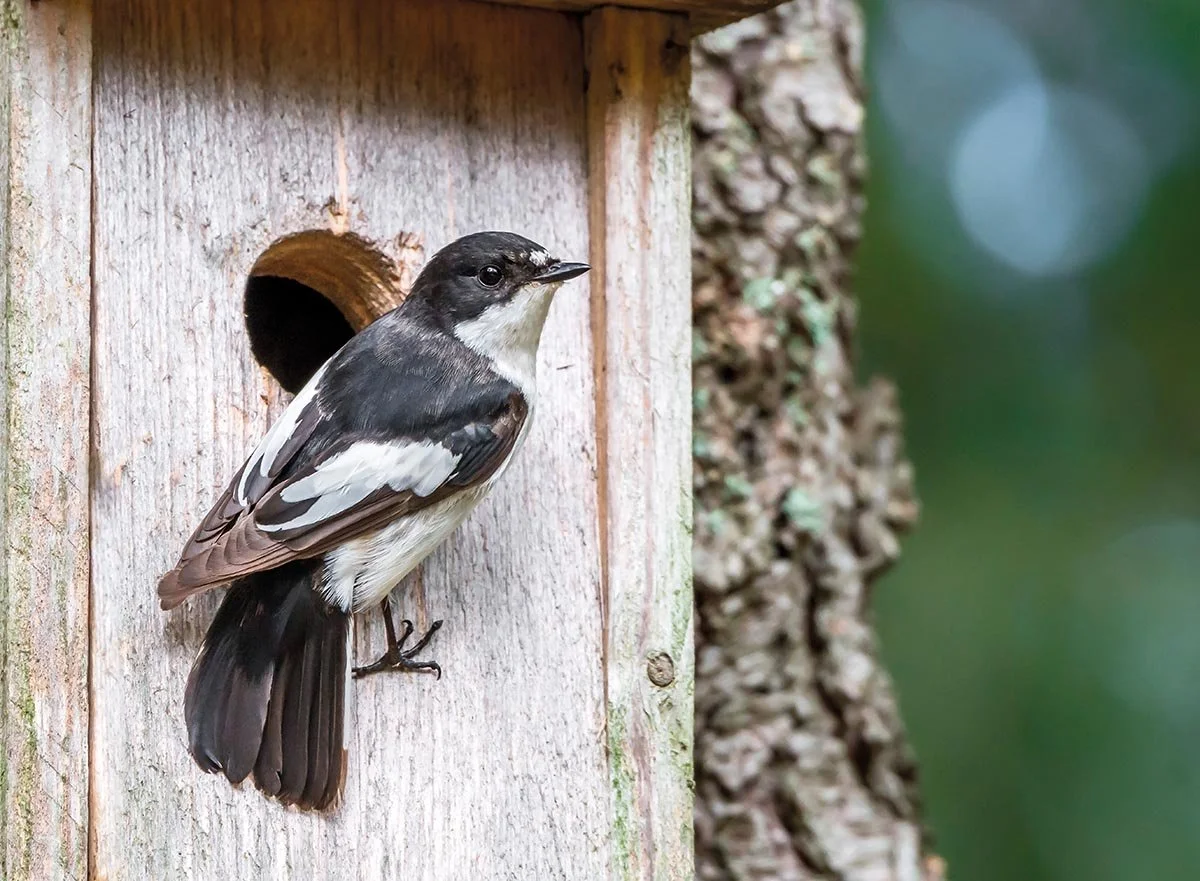
A pied flycatcher, and below left, a spotted flycatcher
First published in edition 206 of The Northumbrian, June/July 2025
Ian Kerr profiles the spotted and the pied flycatcher, king and queen of the insects they hunt in aerobatic style
Some of our most attractive summer birds have names which fully describe their appearance and lifestyle. Take spotted and pied flycatchers – they fly out, often very acrobatically, from regular perches to take passing insects. Spotted flycatchers are brown and, unsurprisingly, spotted, while male pied flycatchers are black and white and their females brown and white. As their names indicate, both survive on flies, which they skilfully chase; darting and weaving to take them in the air to feed themselves or their chicks.
Both are strictly summer visitors to Britain and Europe, while in autumn they migrate to winter in the humid zones of West Africa on the other side of the Sahara Desert – one of the world’s greatest migration challenges to small birds. There the similarity ends, however, as each have very different nesting strategies and breeding ranges.
Pied flycatchers are cavity nesters, seeking out small safe holes in trees, particularly in oak woodland and similar sites rich in insects, to build nests and raise young. They also take readily to nest boxes, and this has enabled many thousands of them to be ringed and studied. This marked preference for mature oak and similar deciduous woodland results in a restricted, basically westerly range in Britain, which is home to most of this habitat. Strongholds are Wales, the Lake District, and parts of north-west Scotland. Elsewhere, including Northumberland, their breeding populations are patchy. We have plentiful woodland, but most is commercial conifer, short of the old and rich native woodlands the bird favours.
We do, however, have pied flycatchers in pockets where this woodland, which once covered much of Britain, survives. This includes the fine woodlands of the Derwent Gorge, which contains good stands of oak, and similar areas around Dipton, the North Tyne, and a few others. In most of these sites pied flycatchers are attracted by boxes.
Conservation organisations have a traffic light system for bird populations – green for stable, amber for species where there’s concern, and, as you’ll have guessed, red for those in danger. Pied flycatchers, with a national population of around 23,000 pairs, are doing reasonably well across Britain, though there have been some decreases. This led to them being switched from green to amber in 2009, where they have remained since.
Spotted flycatchers are not confined to oak and other native woodland, so they have a much wider breeding range covering most of Britain apart from the western and northern isles of Scotland. As well as woodland including conifer forests, they nest in a range of sites, content to breed in gardens, parks, churchyards and similar urban and suburban sites. At one time, there were several pairs regularly nesting in Jesmond Dene in Newcastle.
They build their nests in a range of places, including ivy and other climbers, and crevices in trees and buildings. They’ll also use open-fronted nest boxes. In conifer forests I’ve found favoured sites among the earth and roots of trees brought down by gales. This kind of destruction, so widespread after Storm Arwen, also provides sheltered, sunny clearings in forests, which are ideal feeding areas. Sadly, however, our spotted flycatcher is in real trouble. Its population across Europe has plummeted by some 90% since the 1960s – by far the greatest crash of any migrant which winters in Africa. It has been on the red list of greatest conservation concern since 1996, when the decline became apparent mainly thanks to work of volunteers. During the same period, most other migrants which winter in Africa, including swallows, house and sand martins, swifts, cuckoos and several species of warbler, have shown decline but at nothing like the devastating scale of the spotted flycatcher.
Its breeding range has contracted slightly, yet there are far fewer birds than in the past. Nationally, the breeding population is down to around 30,000 pairs, which sounds a lot but not when it is thinly spread across Britain.
The reasons for this catastrophic decline are uncertain. It’s easy to blame deteriorating conditions in West African wintering areas, but that can’t be the full story as other birds wintering in the same areas haven’t shown anything like this decline. Nesting success here seems to have altered little, but research shows fewer birds surviving their first year. That could indicate problems with food soon after they fledge or while on migration, as well as conditions in Africa. Perhaps the decline is a combination of all three.
More efficient farming and the use of insecticides means there is less of their vital insect food. You may notice this, if only from the windscreen of your car in summer. The days are long gone of clearing the glass of accumulated bodies after a journey through the countryside, and this could indicate that young, inexperienced birds are unable to find enough food after they fledge.
Pied flycatchers don’t seem to have the same problem of early mortality. Perhaps this is because the mature woodlands where they spend the early days of their lives are not so affected by the presence of chemicals and still have healthy insect populations. Whatever the cause, the spotted flycatcher is in trouble, its population in freefall. This is clear during the migration season in the place where I do most of my birding these days. On Holy Island, pied flycatchers making their way southwards in early autumn are still a reasonably common sight. But last autumn I saw only one spotted flycatcher. While that is in no way scientific, it’s an indication of what is happening to them.
Other migrant species wintering in Africa which have suffered big population declines have made a recovery. Sand martins, for example, have bounced back, if not to their previous levels. Here’s hoping that, against all the odds, spotted flycatchers can do the same.