
Rocks of ages
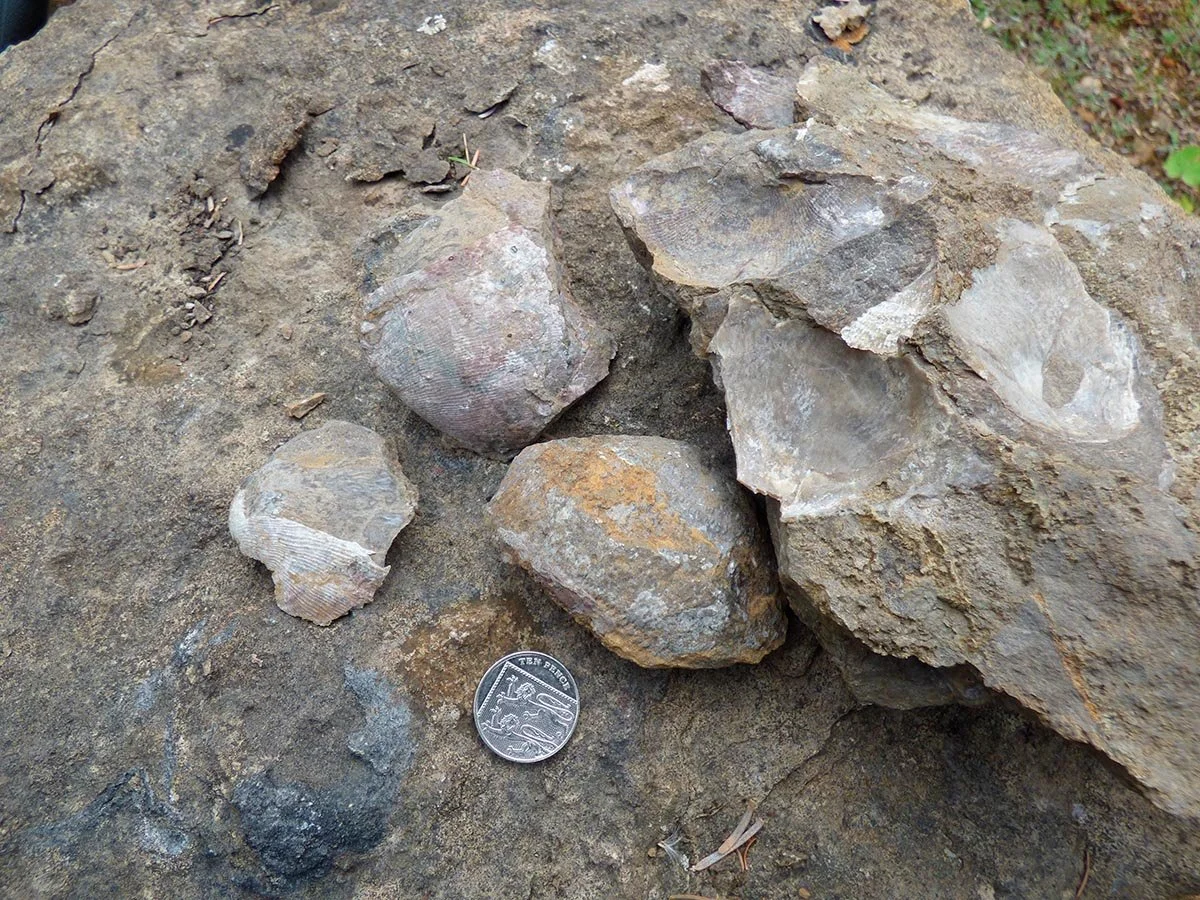
Gigantoproductus fossils
First published in edition 205 of The Northumbrian, Apr/May 2025
Anthony Toole relives a childhood obsession with geology when he takes his grandson fossil hunting in the beautiful rugged landscape of Greenlee Lough, just north of Hadrian’s Wall near Housesteads
I have always been fascinated by geology. During my early teenage years, I created my own mini-museum from pieces of kidney haematite, crystals of quartz, and fossils of sea creatures gathered from the many pit heaps and limestone quarries that lay scattered around my West Cumbrian home town.
This interest was boosted by a passion for mountaineering that has been a dominant influence on my later life. When the book Northumberland Rocks by Ian Jackson was published by Northern Heritage and Northumberland Wildlife Trust in 2021, I eagerly bought a copy and was thrilled by the stunning images of the 50 rocky places illustrated in the book.
Most of the geological sites featured were familiar to me, though some were not. Which is why I found myself with my grandson Aidan setting off from the small permissive car park beside Gibbs Hill Farm to the north of The Sill. Our planned destination was Green Carts Quarry, which was to be found (the book said with some difficulty) in a clearing near the southern end of Wark Forest.
The continuation of the rough-surfaced road took us round to the north of Gibbs Hill, then rose steadily to the edge of the forest and a first view of Greenlee Lough. Contrary to what had been a fairly good weather forecast, a thin drizzle blew in from the west. However, we decided to trust the forecast and carried on to be rewarded by a clearing of the rain over the next 20 minutes.
After a mile, the road, which had been re-surfaced with rubble, passed through the first of several gates and followed a wall that enclosed a relatively young deciduous woodland. An open field fed a small herd of black cattle, while a wood to the south temporarily blocked our view of the lough.
A glacial lake, relic of the last Ice Age, Greenlee Lough is the largest natural lake in Northumberland. Its rare combination of flower-rich reedbeds, woodland and wetland have earned it the status of Site of Special Scientific Interest (SSI). As a National Nature Reserve, it is almost unique in having a surface area of 80% water, and as such it attracts many species of water birds. These include ospreys that often spend days or even weeks here prior to their annual migrations from their nesting sites at Kielder to their winter sojourns in Africa. The reserve is jointly managed by Northumberland Wildlife Trust and the National Park Authority. Indeed, as we approached Greenlee Farm, a National Park van drove past us from the farmyard.
The track led downhill past a forest of tall conifers, many of which had been felled, and on for a half mile to the buildings of West Stonefold. A further half mile brought us to East Stonefold, which, like the other farms and despite the distance from the nearest main road, looked to be in continual or frequent occupation. Until here, our route had traced the southern edge of Wark Forest. A short distance beyond East Stonefold, we joined the Pennine Way, which swung round to the north and took us into the forest.
My Ordnance Survey map told us that we should follow the third of the many forest roads that led to the west from the main trail. However, on reaching what should have been the start of this track, we found it blocked by fallen trees and completely hidden.
Aidan consulted Google Maps on his mobile and confirmed the presence of the track. We struggled past the fallen trees and across very uneven ground to find it. It proved to be overgrown but became much easier to follow as we progressed. It was clear that this road had not been used by forest vehicles for many years. Stagnant pools to the side of the track were stained a vivid orange by tannins that had leaked out of the trees. After half-a-mile, the track swung to the left, then back right and into the broad clearing in which lay Green Carts Quarry.
The clearing was filled entirely with piles of rubble, with none of the rock faces that are usually associated with a quarry. The rock was of limestone, calcium carbonate, that had been deposited from a shallow, tropical sea some 335 million years ago during the carboniferous geological period. We searched amid the rocks for several minutes before we spotted any fossils and then we began to find them in abundance. Many were of corals, but the most noticeable were of brachiopods, twin-shelled creatures similar in appearance to today’s bivalve molluscs such as mussels.
They evolved around 550 million years ago, eventually comprising 30,000 different species. Fewer than 400 species survive today, all of them in marine environments and mostly in colder seas. The brachiopods in my childhood collection measured about 3cm in width. The Green Carts specimens were up to three times that size and belonged to a species known as Gigantoproductus.
We explored the quarry for the better part of an hour, discovering many more fossils which we left for others to find. We then followed an exit track that led west to join another main thoroughfare. This curved round to the south, then east along the edge of the still standing conifers.
We passed within a short distance of Greenlee and the Stonefold farms, but were prevented from crossing to them by a tall deer fence and an expanse of rough ground left by a felled section of forest. The track re-joined the Pennine Way path just where it entered the forest. From there, we re-traced our route back to Gibbs Hill.
The book that inspired our trip had warned us that finding Green Carts Quarry was a challenge. Indeed, the walk, including our stay at the quarry, though not much longer than 6 miles, had taken us as many hours. Nevertheless, we felt that we had visited one of the most secret places in Northumberland, and one which few other people would be likely to visit in any year.
And by splitting open some of the rocks, we had found the imprints of creatures that had been hiding here for us to discover, since long before our most distant human ancestors walked the Earth.