
Two swallows do at last this summer make
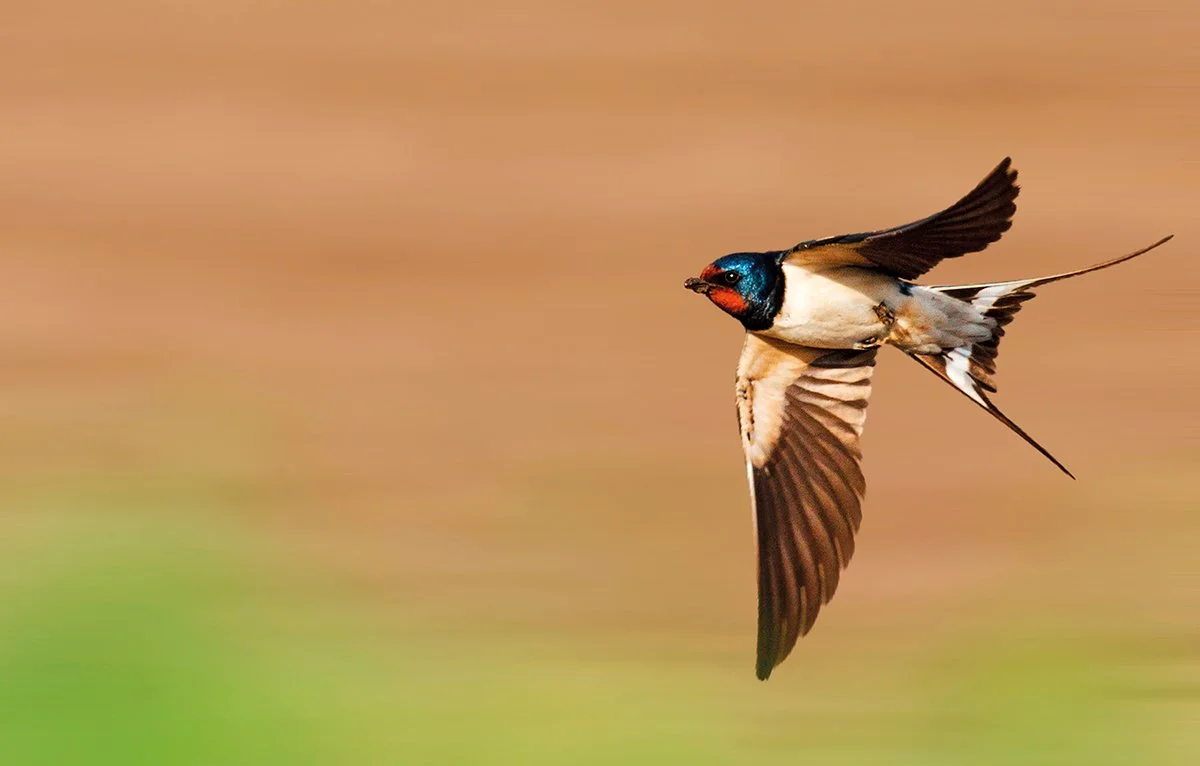
A swallow in flight
First published in edition 207 of The Northumbrian, Aug/Sept 2025
Ian Kerr is delighted, after three decades trying to attract summer swallows to his coalhouse, to have a pair at last set up home and rear young
That old adage about one swallow not making a summer may be true as far as the weather’s concerned, but one pair has certainly helped to make mine very memorable.
To explain, I must go back to the dark winter of 1992 when my wife Hazel and I threw caution to the winds and blew all our savings on a mortgage deposit on a run-down and unloved cottage which had lain empty on Holy Island for four years. With happy memories of spring and autumn family holidays in local cottages and occasional cosy weekends at two island pubs, it had become a burning ambition to have a place of our own in a spot we’d both grown to love – me because Holy Island is such a wonderful place for bird-watching, and Hazel as a lover of history, the coast and countryside.
Taking possession on a freezing Boxing Day of a property which had long been uninhabited and unheated, and seeing the damp and amount of work needed, we briefly wondered what we’d done. However, by spring we had the place warm, carpeted and redecorated. We put our own stamp on the cottage to the delight of our family and, particularly, two small granddaughters who loved to watch rabbits, then so numerous on the island that they appeared on the back lawn early each morning.
Now we come to those swallows, birds which most folk would agree are so much a delight of the summer scene. That first spring Hazel said she dreamt about roses around the doors and swallows nesting in the coalhouse. The roses were simple enough, yellow for the front door and red at the back and involving nothing more than a quick visit to the garden centre at Berwick. As things turned out, however, the swallows were to prove a much more difficult proposition.
I carefully cut an entry hatch at the top of the coalhouse door and put up a nesting shelf a foot long and three inches wide on the back corner. We then sat back and waited, and, as it turned out, waited, and waited, and waited. That first summer we watched with great anticipation as a pair of swallows came and had a look. They would swoop down and perch at the hatch, heads craning inside to look around. They mustn’t have been too impressed with my handiwork, however, because they soon departed, obviously looking for a better des-res.
And so it went on summer, after summer, after summer. Birds would prospect for a day or two and then settle in other sites, some yards away in neighbours’ porches, but never at our cottage.
Over time the old coalhouse became redundant when a new heating system was installed, and it became storage for garden tools, paint pots, brushes, buckets, odds and ends of timber, and anything else we didn’t have room for inside.
Blackbirds appreciated my hatch and on a couple of occasions nested inside, one year on a rung on my stepladders hanging on the wall. At least, I suppose, that was an excuse to avoid the chore of cleaning the windows for a few weeks.
But still the swallows stayed away, despite Holy Island having a large and very healthy breeding population. They regularly nest everywhere around the village – the old upturned boats and fishing sheds at the harbour, in stables, farm buildings, garages, garden sheds and the porch of St Mary’s Church, where the shrill calls of hungry young have enlivened many a summer service.
I recall one year when swallows nested in a corner of the church porch. The vicar at the time, who was also a Franciscan monk, waited until the young had fledged before taking his brush and shovel to sweep up what they’d left behind and, believing that the nest was no longer needed, cleared that away too.
What he didn’t realise was that swallows often rear second and occasionally even third broods. Sure enough, the swallows returned, found their nest gone and promptly set about building another. Unfortunately, this time the nest was right over the main entrance to the church. It meant that church-goers and hundreds of visiting tourists were continually ducking and diving to escape the inevitable stuff being squirted down.
I remember telling the vicar: “That’s literally a message from Above for a Franciscan.” Fortunately, he had a sense of humour.
I also remember islanders in their seventies and eighties telling me that swallows had been nesting in an alleyway, the Long Passage, in Marygate, one of the main streets, since they were children. They still are this summer, which means the site has been in continual use for well over a century. Away from the village, other pairs use the old castle limekilns, the bird hide at the Lough, the refuge box on the island causeway, and war-time concrete bunkers in the mainland dunes. For a couple of years one pair even nested on the low boulder clay banks near Emmanuel Head, the only known natural, as opposed to man-made, breeding site in Northumberland. But still they ignored our coalhouse. That is until this rather momentous summer when swallows have nested at last on that ledge I put up 32 years ago. They have got used to me being in the back garden and popping in and out of the place to get things as long as I move slowly and quietly. I’m delighted to say they have fledged their chicks and I’m now hoping they’ll be back next year.
That breeding swallows return to regular sites has been proved time and again by ringing. For example, one bird I ringed as part of brood in an island garage was found dead only a couple of hundred yards away five years later. That meant that on four occasions it had flown to wintering grounds in South Africa and had presumably been faithfully returning to the village of its birth. After its final return in un-seasonally cold April weather it had at last succumbed, presumably unable to get enough insect food after its arduous return journey of some 10,000 miles.
Sadly, we said farewell to Hazel in the island churchyard in 2022, so she never saw the ambition realised of our own breeding swallows. But when I told an old friend about the birds her reply was instant: “Hazel would have loved it.”
She certainly would, and if she’s looking down on us – as I’m sure she is – I know she’ll be absolutely thrilled.