
Riders on the storm
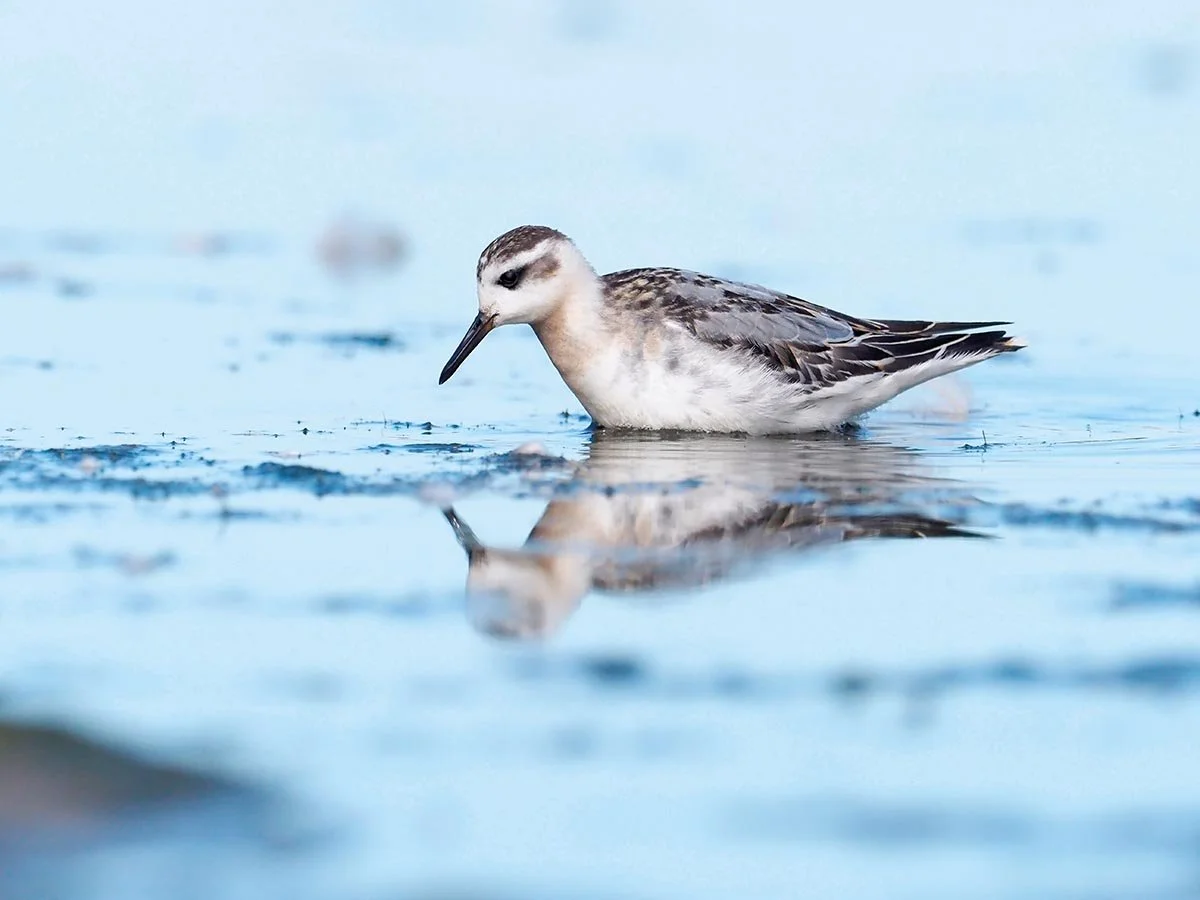
A grey phalarope enjoying calm waters, and below left, an individual in its red plumage
First published in edition 208 of The Northumbrian, Oct/Nov 2025
Ian Kerr salutes the brave grey phalarope, which is occasionally blown to our coast by gales and storms, which it fights with courage and agility
When autumn and winter storms whip up the North Sea with howling winds, huge waves, deep troughs and flying spume, one small bird can appear almost miraculously in the midst of the frenzy of water. Tiny and vulnerable on crashing seas, grey phalaropes seek out meagre shelter from the worst of the fury in bays, inlets and harbours protected by piers and breakwaters until the storm passes. On rare occasions, some appear inland, literally blasted there by fierce winds.
Just 8 inches long and slightly built, these members of the worldwide wader family are rare visitors to our coasts in the worst weather of autumn and winter, having been driven into the North Sea from their normal wintering areas far out in the Atlantic by the sheer force of the winds. They usually linger only until conditions abate and they can return westwards to their normal feeding haunts.
We refer to them in Britain and Europe as grey phalaropes, while in their high Arctic breeding areas stretching from Svalbard to Iceland, Greenland, northern Canada and Alaska, they are known as red phalaropes. That’s because people there are lucky enough to see them in their glorious brick red summer plumage, which is very rarely seen away from those bleak northern breeding areas.
The usual breeding roles are reversed in grey phalaropes. The females have the brighter plumage and the males take most of the responsibility for incubating eggs and guarding vulnerable young. Like other waders, the young can run, feed and hide within hours of hatching – a vital adaptation for many ground-nesting birds at great peril of being taken by predators. The male responsibility lasts until the young are safely on the wing.
The role reversal also applies to its closest relative, the red-necked phalarope, an extremely rare breeder in Britain, and Wilson’s phalarope, a North American species. Wilson’s phalaropes are the rarest of the lot for us, but occasional sightings have been made on Holy Island, Budle Bay, Grindon Lough and ponds on or near the coast at Low Newton, Cresswell and Newham.
By the time we see grey phalaropes in autumn and winter, adults of both sexes have moulted into pale uniform grey and white winter plumage, their heads marked by a dark crown and eye patches. Young birds are similar, with brown and black mottling on their wings.
Birds breeding in Svalbard, Iceland, and eastern Greenland move south down the Atlantic in autumn, while some of their North American counterparts go south into the Pacific. They swim as lightly as corks up and down the sides of waves and troughs, coping with anything but the worst of conditions. They often spin on the surface as they feed on tiny shrimps and other marine creatures, the spinning motion appearing to be a means of stirring up and bringing food to the surface.
Nearly all sightings of these remarkable birds are along the coast, but on those few occasions when they appear inland, they are largely tame and fearless of humans. If only they knew what we can be like, they wouldn’t be nearly so trusting. I recall a memorable experience when one appeared at the Big Waters nature reserve near Wideopen in 1988. It spent several days resting and feeding a few feet from the bank where people had gathered to watch. At one stage it wandered out of the water, clambered over a photographer’s hands, then hopped over the boots of a nearby fisherman. Other occasional inland sightings occur on lakes and ponds, waterways and rivers including the Tyne. A July sighting on the small Harbottle Lough above the Upper Coquet valley provided, I think, the only county record of a bird in full red breeding plumage, while there have been occasional spring sightings of birds in partial red markings.
Apart from the Big Waters individual, the birds I’ve encountered have all been on the coast during or immediately after gales. These included one spinning and feeding among gulls just off the pier at Seahouses, several off my home patch of Holy Island, and others along the coast, including a group of three on pools at the South Gare at the mouth of the Tees, which is a famous birding spot.
The most remarkable series of local sightings was in October 2023 from Newbiggin Bay in the wake of Storm Jocelyn, which battered the coastline with wind, torrential rain and mountainous seas. It led to a record coastal influx of grey phalaropes, particularly at Newbiggin where the high rock breakwater provided a little shelter from the weather. I was with friends outside the Maritime Centre when three grey phalaropes appeared intermittently on the crests and in the heaving troughs just inside the breakwater. Despite the shelter, they were easily lost to sight, to then quickly reappear riding over the wave tops. Seeing three together in my home county was a great experience, but even better was to come. The following day the three had been joined by seven more, the total rising later to 12, by far the largest group ever recorded in Northumberland. By the following day, the storm had abated, and as quickly as they’d appeared the birds departed, leaving just one to linger for a few hours before it too disappeared.
During the same period, five were spotted at Whitley Bay and at Howick, three off Seahouses, two at Hauxley, and singles at Druridge Bay, Howick, Newton, and Budle Bay. All quickly vanished back out to sea as soon as the wind dropped and conditions began to calm. These remarkable little birds really are the orphans of the storm.