
Midnight whispers
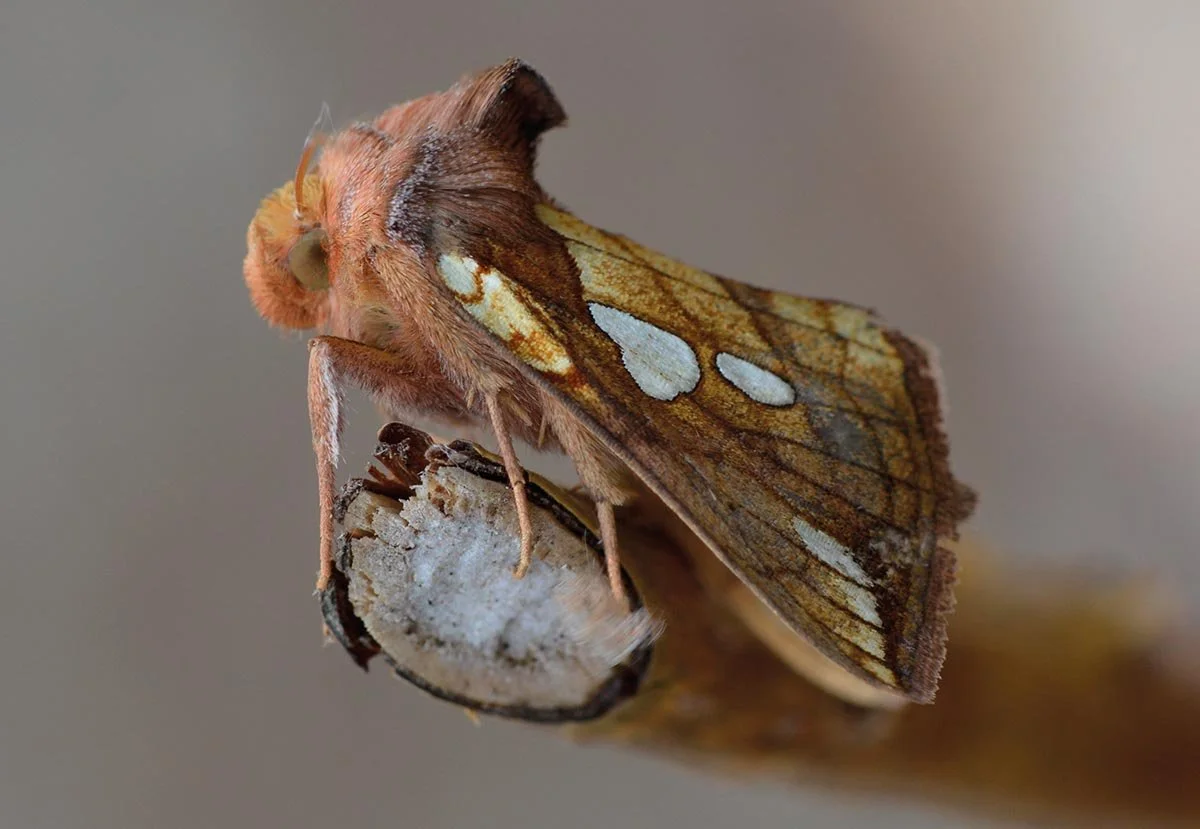
The attractive markings of Lempke’s gold spot (Photos by Susie White)
First published in edition 209 of The Northumbrian, Dec 2025/Jan 2026
Susie White explores the mysterious world of moths, their delicate beauty, exquisite diversity, indispensable place in our gardens, and the wonder to be found in discovering them at first light
It began with the chance discovery of an angle shades moth, a species that often rests by day on walls or fences. I was in the old walled garden at Chesters where I worked and was completely blown away by the cryptic markings of this extraordinary insect. I took a photograph and searched books to identify it, this being before online searches and apps. It was so otherworldly and beautiful with its brown and peach-coloured triangles and scalloped wing edges. This was the start of my fascination with moths.
Because many fly at night, it’s often not appreciated how wonderful moths are; how varied in size, colouring, pattern and shape. Yet they are much more numerous than butterflies. There are around 2,500 species of moths in the UK compared to 59 species of butterflies. When planting gardens for pollinators, butterflies get the most attention simply because they’re more visible. But in making a wildlife garden we need to consider much more than bees and butterflies; beetles, flies, hover flies, wasps, lacewings and moths are all valuable pollinating insects and part of the food chain.
I get frustrated by badly researched press articles showing images of harmless garden moths alongside stories about clothes moths. This doesn’t help to counter negative perceptions and a YouGov poll for the charity Butterfly Conservation revealed that 64% of people associated moths with eating clothes and 17% thought moths ugly! Yet there are only two common species of clothes moths that do damage.
Butterfly Conservation has done much to change perceptions. Moth trapping is increasingly popular and is quite often featured on BBC Two’s Gardeners’ World. I began studying moths thanks to the North Pennines National Landscape (then the AONB) which offered a free weekend course in moth recording. This was run by Dave Grundy, an expert instrumental in 2007 in launching the Garden Moth Scheme – a volunteer-led national project to collect and standardise data.
Once a week for 36 weeks of the year people across the UK and Ireland monitor the moths in their gardens and there are now well over 1m records. The same trap in the same location builds a picture of how moths are doing. This has opened my eyes to their splendour and diversity. It is of course thrilling to find a rare moth, and I’ve had quite a few less common species such as eyed hawk-moth, sprawler, and grey shoulder-knot. Some become part of the familiar routine of my garden, a reassuring part of the annual cycle. Just like the opening of the first hawthorn flowers, the first brimstone moth, acid yellow with chestnut markings, is an event.
There is huge variety in size, from the diminutive Chinese character that mimics a bird dropping, to the emperor moth of heather moorland. These fast-flying, restless moths are attracted to a small phial of pheromone that I take to the moors in spring and hang on a stick a few feet from the ground. Within minutes there’s a fluttering of male emperor moths, their feathered antennae able to pick up the scent that mimics female pheromones from almost 2 miles away. Dramatically patterned and as big as a peacock butterfly, this moth is a gorgeous orange brown and has large eye spot markings.
The larger moths are understandably impressive and great for showing to children. I set the moth trap the night before my grandchildren visit on a warm summer day when I expect there to be some of the most spectacular species. There’s the pink and green of elephant hawk-moths and the sculpted grey wings of poplar hawk-moths, both of which will not move from your finger. Because of their chunky, weighty bodies, it takes some minutes of wing vibration to pump them up ready for flying, so they are reluctant to leave. To see the delight on a child’s face is so rewarding.
It’s with a description of that magic moment, shared with my grandchildren, of seeing what is in the moth trap, that I open my new book. Entitled The Gardener and The Moth, it is one in a series published by Saraband called In The Moment. I felt other books about planting for moths and butterflies missed details of the food plants needed for caterpillars. Many insects will visit a range of garden flowers that provide nectar to feed from, but it’s essential to have larval food plants if you want them to grow and thrive in your garden.
After describing their life cycles, anatomy, mimicry and disguises, I write about how to lure moths using light traps as well as growing the right plants, from trees and shrubs to perennials and alpines. There’s an illustrated guide to host plants; colourful species that make the garden attractive for us and for insects. Filling our garden with these is the best way of ensuring that moths and butterflies can complete their life cycles. Though the chunky yellow and black caterpillars of the mullein moth will filigree the leaves of mullein, most work away unseen. Native grasses are food for the pretty antler moth, map-winged swift, and lunar yellow underwing. Golden hop, excellent for covering an arch or fence, hosts caterpillars of comma butterflies as well as pale tussock and buttoned snout moths.
The fields around my house are a habitat for meadow brown and ringlet butterflies by day and ghost moths at dusk. This is when the male ghost moth engages in a courtship display called lekking, swaying and hovering in an elaborate dance. Their pure white wings are eerie in the gloaming. The females, though, are honey-coloured with orange markings – an example of sexual dimorphism.
One of the most striking moths is the garden tiger, which has dramatic black and white patterning and when disturbed flashes orange-red underwings. Its spectacularly hairy caterpillars are known as woolly bears. Then there’s large emerald, a beautiful shade of green and a wingspan like that of a small tortoiseshell butterfly. And burnished brass, its wings glinting metallically as you turn it against the light. Gold spot, gold spangle, cinnabar and silver Y offer a gamut of colours and shapes. One of the most elaborate is merveille du jour, an autumn flying species that mimics lichens with its complex patterning of jade green and black. It is indeed a “wonder of the day”.
Although spring and summer bring the largest number of moths on the wing, some fly in winter. The December moth is well insulated with a furry body, a head that looks like it’s wearing a Cossack hat, and wings cloaked in charcoal grey and russet. One year I trapped moths over the winter to see what was present in the garden, even setting the trap out in the snow, and was surprised to find some still around. But it is those early summer mornings with the grandchildren excited to see what we discover that are the most special.
We are lucky to have Tom Tams as Northumberland County Moth Recorder, responsible for collating moth records and submitting them to organisations such as Butterfly Conservation. The North East region includes County Durham where Tim Barker is the County Moth Recorder. The website
www.northumberlandmoths.org.uk is excellent, while another useful tool is the What’s Flying Tonight app. Mike Cook, coordinator for the Garden Moth Scheme North East, prepares fascinating graphs and reports on how different species are doing. Local Facebook groups provide excellent backup so there is plenty of support if you’re interested in starting with this fascinating subject.
My book has just been published and it was wonderful to have the opportunity to write about something that gives me so much joy. I illustrated it with drawings of the plants in my garden as well as some of the moths and butterflies that I have found. And the dedication . . . that is to my grandchildren and happy mornings spent looking at moths.
Susie White is a gardener and naturalist and writes a regular Country Diary for The Guardian. Author of Second Nature: The Story of a Naturalist’s Garden, her latest book The Gardener and the Moth: Planting for Moths and Butterflies, is out now, published by Saraband