
Where the wild things grow
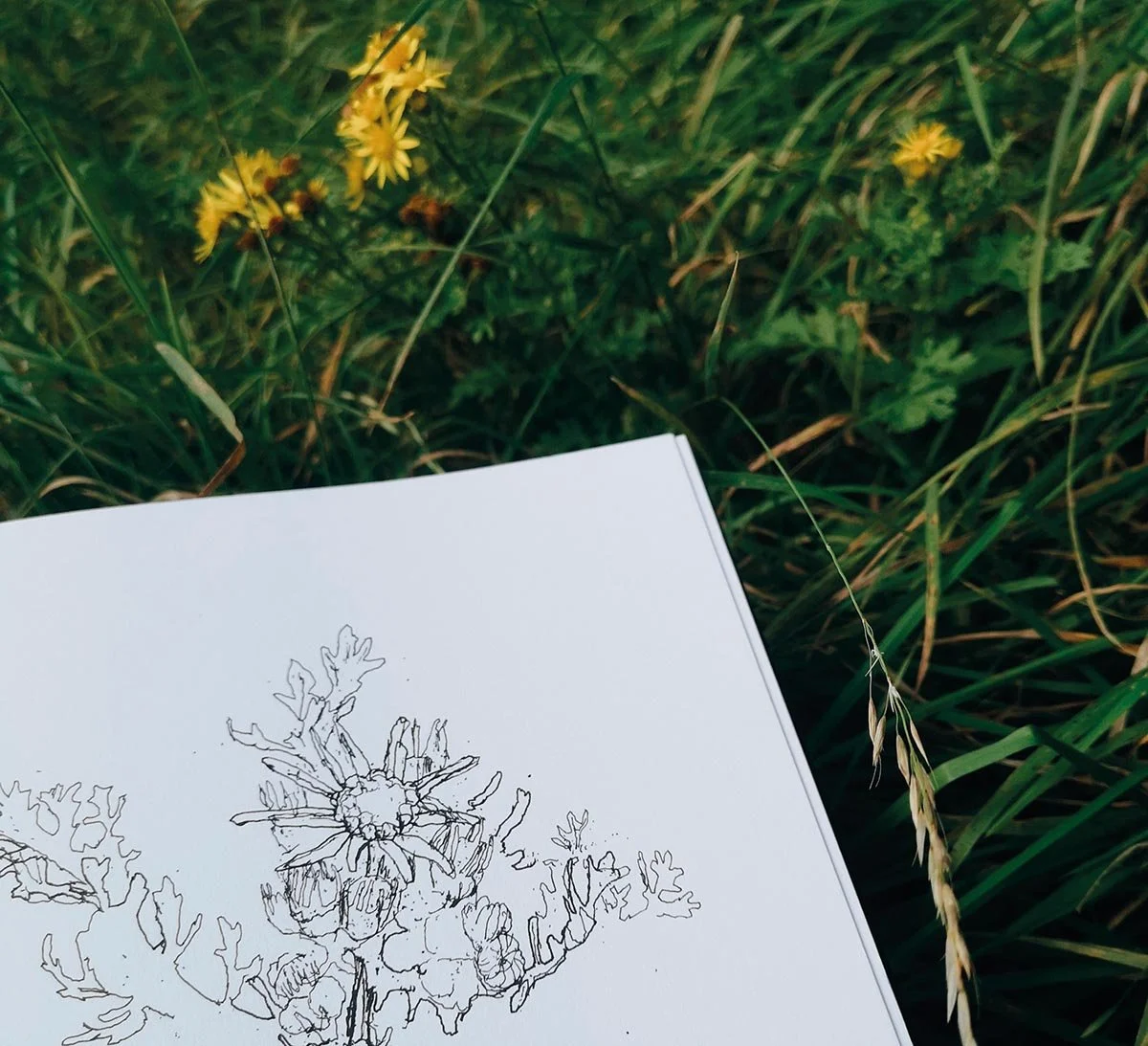
A drawing of ragwort by Anna (Photos by Susie White)
First published in edition 208 of The Northumbrian, Oct/Nov 2025
Susie White meets Berwick-based artist Anna Chapman Parker, whose new book captures a year spent drawing the weeds that grow in cracks and pavement edges, revealing a quiet beauty usually overlooked
I’ve always been fascinated by the way plants can survive in the most unlikely settings, so when I read Anna Chapman Parker’s book Understorey I felt an immediate connection. Anna is an artist and writer, her book an exploration of the weeds of her hometown of Berwick-upon-Tweed. Over the course of a year, she made drawings of plants she noticed in road verges, around lampposts, at the base of walls, along cracks in tarmac.
Anna lives near the town centre in a house tucked away in a secluded garden with her musician husband and two children. We agree to meet and walk around Berwick, looking at pavement interlopers, following some of the routes she writes about in her book. From the railway station we quickly leave the noise of announcements, trains and traffic to take a path towards the River Tweed.
A few steps from the station we notice spontaneous flowerings, rounded froths of feverfew, white along the path’s edge. This is the start of Castle Vale, a linear park that traces a narrow dene down to the river. Anna is explaining how the park is maintained sustainably when we meet parks rejuvenation officer Kate Dixon, who is spraying weeds in the paving around a decorative pool. This is not glyphosate, but industrial vinegar, and the pool is now planted informally with a loose combination of flowering rush, purple loosestrife and other native plants. It’s a contrast to the town centre, where there’s brown and dying foliage, weedkiller suppressing ebullient life. “Some councils are adopting a no-weedkiller approach,” Anna says, “but with signs to explain that it’s not neglect, rather it’s for life and for insects.”
In her book, Anna sets out to answer the question of what constitutes a weed, to learn about these often-overlooked plants. At the bottom of the dene we reach the Tweed and walk slowly, delighted by all the wildings we spot: nipplewort, red valerian, stonecrop, knapweed, wild garlic and a Berwick speciality, a freshly white ivy-leaved toadflax. This non-native naturalised plant is more compact than the familiar species that trails its purple flowers amongst cracks in stonework.
In 2019 Anna started drawing the wild plants that survive in edge lands and abandoned places. To begin with, she was grabbing a moment while out walking with young children, later on feeling her way into making it a book. A year’s worth of looking at these often-neglected plants, Understorey is subtitled A Year Among Weeds. She learnt a lot through research, discovering new names such as the different types of chickweeds.
“I always have a sketchbook with me”, she says. “I try to spend more time looking at the plant than at the paper.” In her thoughtfully written book, she explores how we make drawings. “The point is not to produce a good drawing, only to be there and look.” In that moment of concentration, everything else falls away, “all obligations and anxieties, of work, of parenthood, of domestic life – I’m worrying only at the triangular problem between plant, eye and paper.”
As we walk and talk we find that we share many favourite plants: herb Robert with its ferny red-tinged leaves, bristly stemmed comfrey, knapweed and its soft thistly flower heads, medicinal yarrow with its white platform of flowers for insects. We find we have the same interests in art and literature, references that she draws on in her book such as John Berger’s Ways of Seeing, the sublime Wilton Diptych in the National Gallery, the revelatory photographs by Karl Blossfeldt in the 1920s – all ways that artists, poets and pioneers in photography have depicted wild plants throughout history.
She weaves the many uses for plants into her diary of the year. That William Turner, ‘the father of English botany’, who was born in Morpeth, described how English bluebells were used to make glue for books. She picks garlic mustard, also known affectionately as Jack-by-the-hedge, to make pesto. She is wary of hemlock, the poisonous plant that killed Socrates. She notices the wasps clustering on a sowthistle by the station platform.
As we wander along the shoreline, dense thickets of ivy cascade down the cliff face, a bounty of flowers and berries for insects and birds. A comma butterfly settles on mallow and we watch a cormorant fishing close by. Grasses swish and sway around piles of driftwood, habitat for small mammals, insects and birds, and the Royal Border Bridge, opened in 1850 by Queen Victoria, sweeps gracefully across the river.
It was while walking this path in winter, as well as the streets of the town among shops and car parks, that Anna began really looking at the plants that grow along edges and in abandoned places. Plants brought in by seed on the wind, infiltrating cracks with creeping stems or arriving through the droppings of birds or dogs, and even by human spit. She wondered about the divisions we make between weeds and wildflowers, garden plants and weeds as she started studying and recording them in her delicate ink drawings.
These are sprinkled throughout the book, and their looseness and broken lines are energetic in the variety of ways they occupy the paper, from sprinkled sprigs of daisies to completely covering the surface with a network of creeping buttercup or the complex lines of a grassy bank. Here is someone who has not self-consciously tried to make an illustration, but has been completely absorbed in the act of looking and understanding what expresses the uniqueness of each plant.
“You have to keep remembering that you don’t know,” she writes. “Each leaf edge, each seed tip, each section of a stalk is different from your store of preconceptions. If you want to draw this flower or leaf and not the one before, you need to keep forgetting its identity.” We need to empty our minds to draw, to see what is there.
Understorey begins with a list of the plants Anna found in the town together with their botanical names, the length of the list a reminder of how many flowers often slip below our notice. This is a celebratory book that draws us in and makes us pay more attention to our surroundings. At a time when it’s too easy to snap a picture on a mobile phone, it’s an encouragement to look freshly at weeds, wherever we are.
The book is published by Duckworth Books and is available in hardback as well as in paperback. Anna designed the covers for both and this gives them a feeling of unity, her eye, hand and writing brought together.
I’m looking forward to her next book!
Susie White is a gardener and naturalist and writes a regular Country Diary for The Guardian. Author of Second Nature: The Story of a Naturalist’s Garden, her latest book The Gardener and the Moth: Planting for Moths and Butterflies, will be out on November 6, published by Saraband