
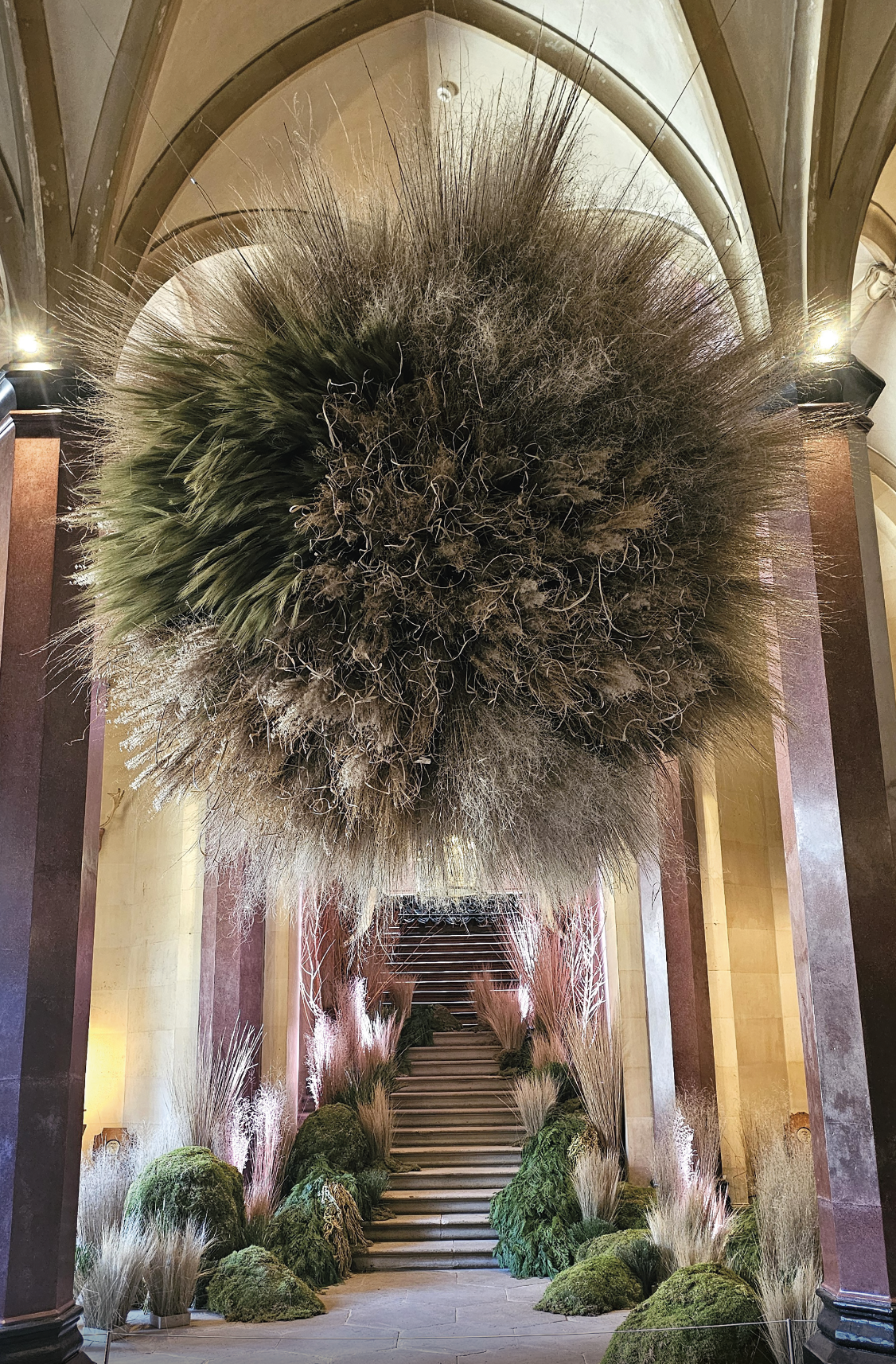
The moon imagined as a huge ball of grasses in the entrance hall (Photos by Susie White)
First published in edition 212 of The Northumbrian, June/July 2026
Susie White explores an extraordinary new floral installation at Raby Castle, supplied and inspired by its gardens
Last year I wrote about the redesign of the 5 acre walled garden at Raby Castle, the work of one of my favourite garden designers, Luciano Giubbilei. Since then, I’ve been back a couple of times to see it settle in, the planting softening and maturing in a beautiful blend of naturalism and formality. The castle stands imposing in its Deer Park, a short walk from the walled garden. Now the two have been linked, with materials from the garden being included in a spectacular display of floral installations within the castle named Castle in Bloom.
The 18th century walled garden was a highly productive space providing food, fruit and flowers for the castle. This was a place for innovation and experimentation. There was pride in being able to grow exotic fruit such as figs and pineapples, and the historic White Ischia Raby fig is 240 years old and still produces fruit in its specially built glasshouse. The famous 200-year-old yew hedges undulate, curve and billow in sculptural patterns.
Blending contemporary design while respecting the past, Luciano Giubbilei has created a new way of looking at plants in the garden. This theme is now carried on in Castle in Bloom, with material from the garden cut over the winter used in extravagant, imaginative displays. This uniting of castle and garden will develop further as the season progresses, with large swathes of annual meadow softening the façade and sheer castle walls.
In my mother’s day, flower arranging was stiff and formal, influenced by famous names such as Constance Spry. My mum would go on courses and arrange flowers in the church. Our house was always filled with vases of flowers cut from the garden. Contemporary floristry has been liberated and can now go anywhere that the imagination takes it. The Castle in Bloom installation shows just what can be done; inspiration for anyone planning an event, joyous in its ideas and artistry.
It takes visitors on a journey around the castle, from its grandest rooms to its kitchens. You enter through a medieval passage, the choice of flowers fitting its history and use as an entrance to the servants’ quarters. Here, Deborah Boston of Periwinkle Bar has draped British flowers over metal hoops that echo the archways in the walled garden. These are plants the servants would be familiar with: hops cascading from the roof, feverfew and yarrow for medicinal use, statice and sea lavender, silver birch, all locally sourced through Flowers from the Farm. Deborah has a flower shop in one of the buildings at the walled garden for the summer.
Moving upstairs, the fireplace in the small drawing room has been filled with exuberant silk flowers designed by Anice Neville. She specialises in historically accurate faux floral arrangements and for the fireplace she took inspiration from The Flower Garden Display’d, a book of hand-coloured wood engravings written in 1730, owned by Katherine Poulett and on display in the castle dining room. Anice named her business Opulence and the Beetle because she hides a little gold beetle within each of her designs as a nod to the Dutch and Flemish Baroque still life masters.
Historically, the castle would have been filled with floral spectaculars and one of these has been recreated in the library, drawn from a photograph from the 1890s in the archives. This high Victorian period was filled with greenery, carefully copied, including a palm, a transformation that helps us to understand how the room felt in those days.
With works by Dutch Masters being displayed in the Ante Library, it’s appropriate that Anice has created a vase as a homage to 17th century Dutch still life paintings. It overflows with irises and fritillaries, tulips from the tulip mania period, symbolic nests and insects, feathers, butterflies and a cricket. For the dining room, Anice has created three arrangements inspired by June, July and August from The Flower Garden Display’d, a combination of exotics and cottage flowers such as lupins, sweet Williams and sunflowers. Just as the Dutch paintings included flowers from different seasons, Anice is able to combine blooms from different flowering periods.
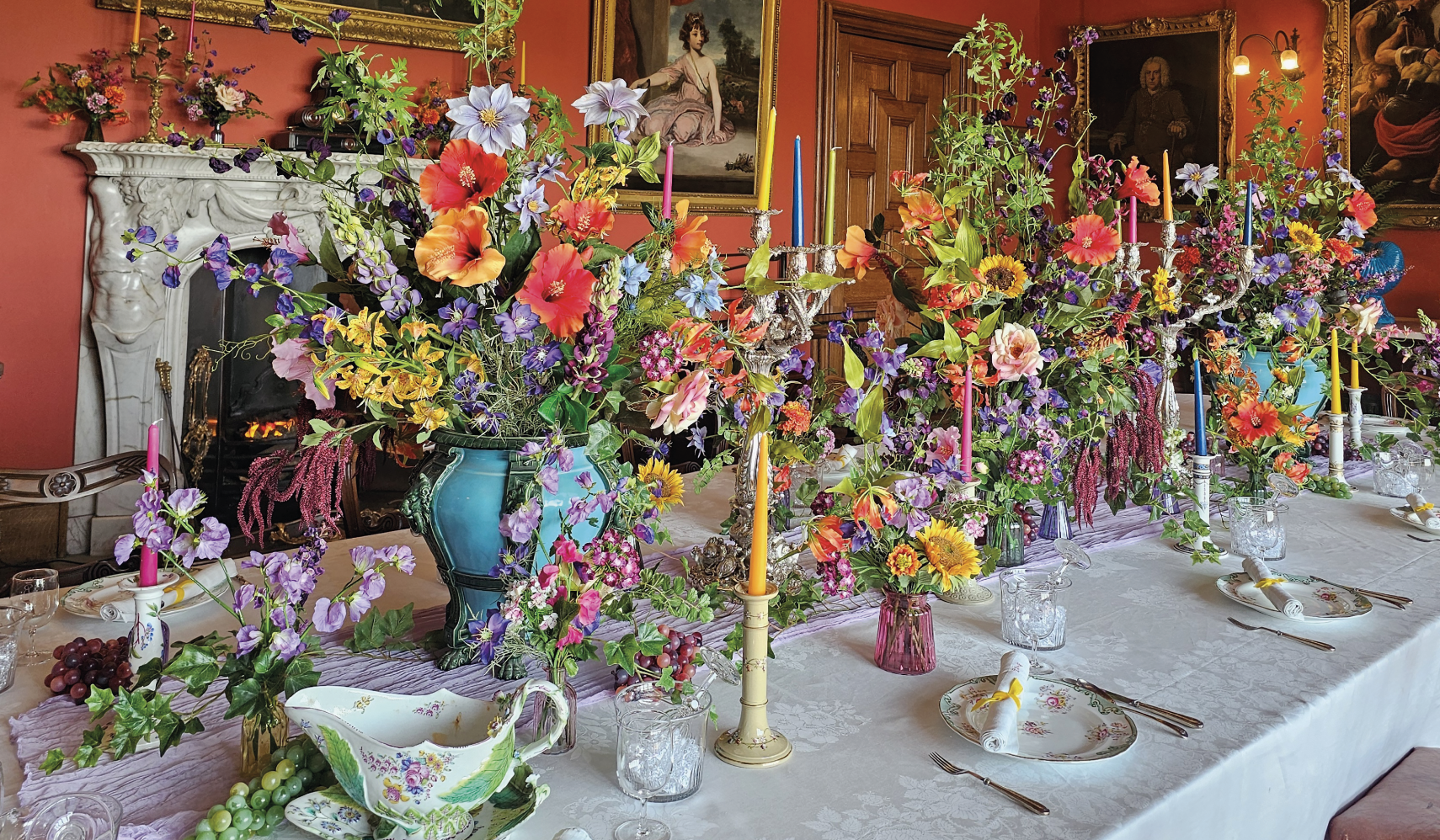
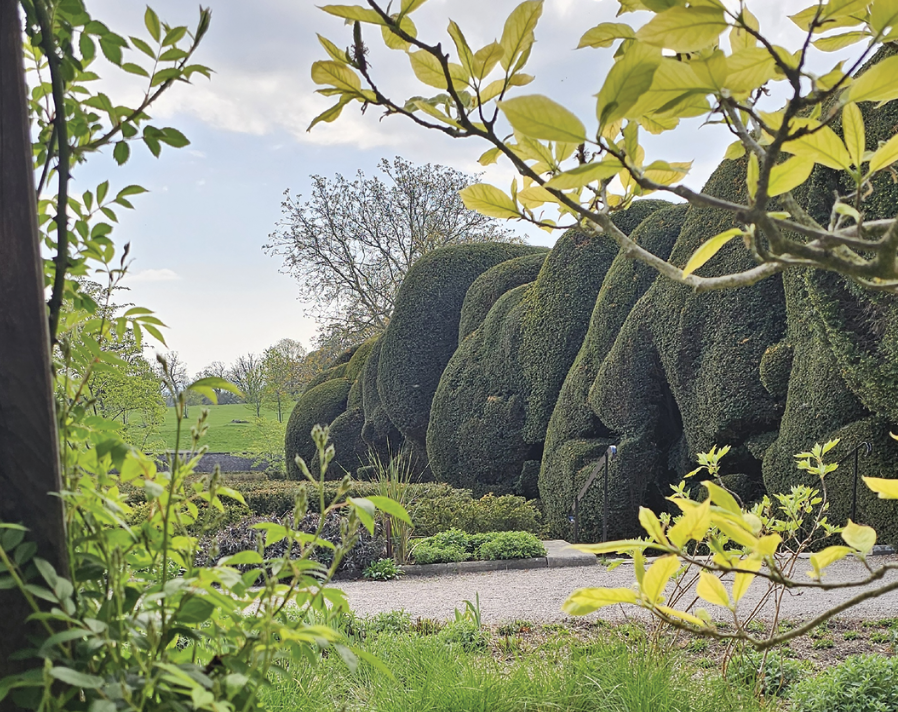
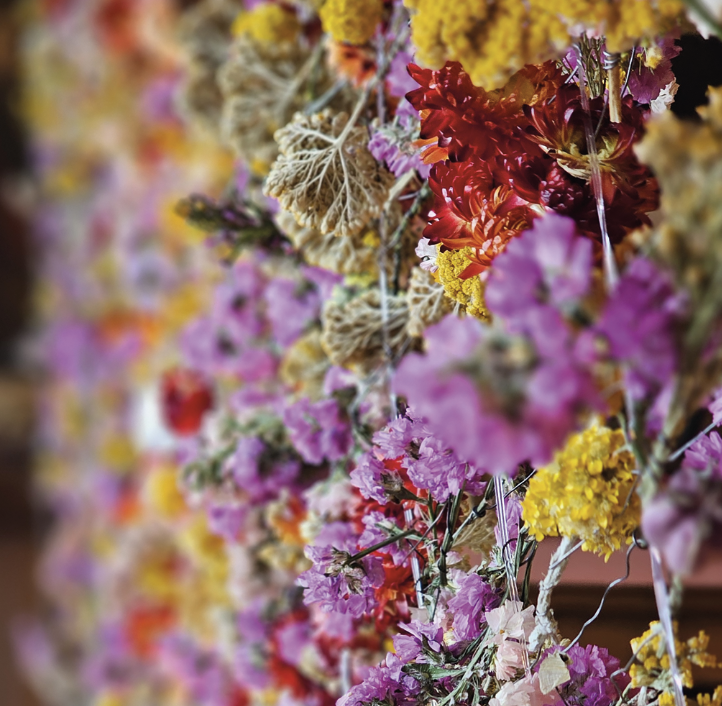
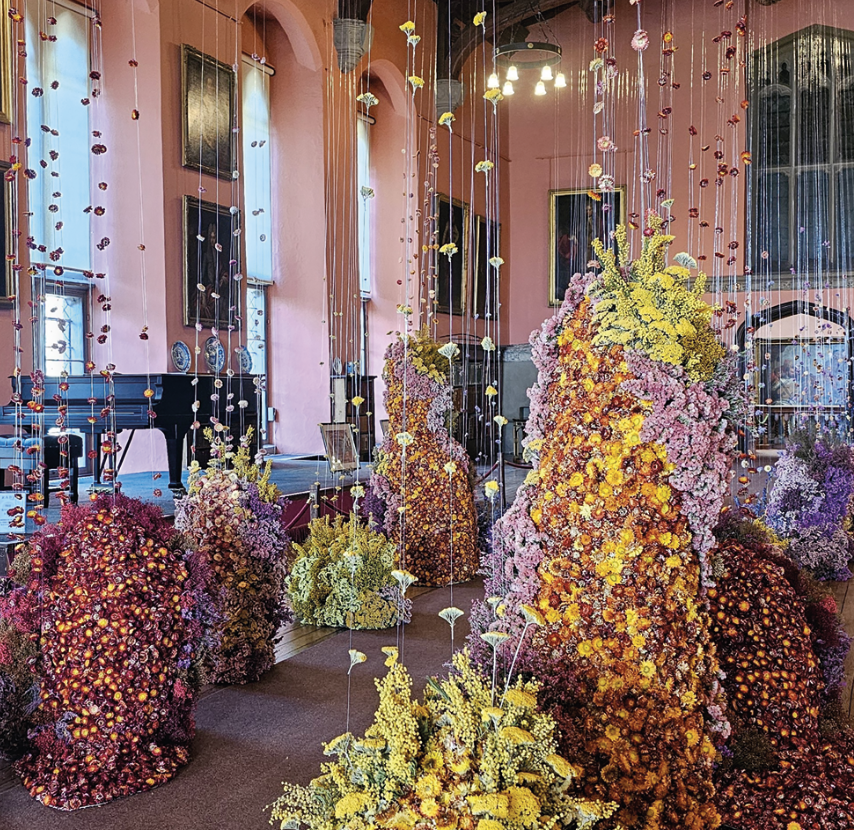
Above: Sumptuous arrangements inspired by the Dutch masters created by Anice Neville; The garden yew hedge and its “otherworldly organic shapes” inspired the display in the entrance hall, top; A detail of the sun portal in the Baron’s Hall, which is pictured at the end of this article; The organically shaped mounds of blooms in Baron’s Hall seem to evaporate upwards
Contrasting with the rich colours and brim-filled vases, the atmosphere changes completely in the castle’s entrance hall. This enormous arched and pillared space is where carriages would enter through huge double doors to the sound of hooves clattering on stone flags. Florist Anna Potter of Swallows and Damsons brings a wild feel to her designs and has built a global reputation for her floral commissions. Suspended above the whole is a giant flower moon, a grassy orb that uses material harvested from the walled garden. If you watch her Instagram feed, you can see the process of creating this incredible effect, for which she fashioned a ball of hay encased in chicken wire into which she pushed bundles of grass stems. Anna says it has been a real joy to create her displays in the castle. All the grasses she has used came from the walled garden and were harvested at the end of winter by assistant head gardener Becky Crowley and the team. Deschampsia ‘Goldtau’ is grown en masse in large square beds, its straw coloration being particularly fine in autumn. The grasses were cut to the ground in bundles to make space for blue camassia bulbs that flower in May. The grass, its seeds shaken on to the beds, was dried on the floor of the castle conservatory.
The deschampsia was mixed with twists of miscanthus into handfuls and wired onto sticks to be pushed into the globe. It took four days to make and needed a cherry picker, brought in through the carriage doors, to suspend it by steel cables from the pillars. Anna felt that the entrance hall was quite dark, grounded and earthy, and she wanted to make use of the more earthy elements in her design, using grasses and hummocks of moss spilling down the staircase. She loves the castle garden yew hedge for what she calls its “otherworldly weird organic shapes” and by echoing this inside, she wants people to look at it differently.
Anna‘s response to the room above, the light filled and colourful Baron’s Hall, was to weave the giant suspended sun you see on this page – a portal against a backdrop of three grand windows. This installation features thousands of strings of dried flowers that swirl away from a central point, decreasing in density as they expand from the centre. Tiny bundles of statice, everlasting flowers such as helichrysum, and golden yarrow were tied onto radiating network of wires to create an effect that is uplifting and joyful.
The centre of the hall is lined by two rows of organic mounds of flowers (pictured left) that appear to evaporate up towards the ceiling. Their bases were also made from hay enclosed in chicken wire which allowed Anna a freedom of shape. The flowers that float upwards are interspersed on wires. This display is made of a multitude of dried flowers, the strange irregular shapes like the accretions of a coral reef, spilling out across the floor, the colours ranging from oranges and reds to soft blues.
The last part of the journey is to the medieval Great Kitchen, built in the 1360s and one of the oldest parts of the castle. A passage is cut into the thickness of the walls encircling the kitchen, partly for defensive purposes and partly to give access to the Baron’s Hall above for serving food. This passage gave access for the gardeners to install sheaves of corn in freestanding bundles high up by the windows. They hung garden herbs on strings against the white walls and hops were garlanded above the range. There’s something calming about their simplicity after the extraordinary journey through the floral wonderland of the other rooms.
With this link, I wandered through the walled garden to see where the grasses for Anna‘s work had been cut, the camassias now coming into bloom, and enjoyed the sinuous curves of the yew hedge in a new light.
Susie White is a garden and nature writer and a Country Diarist for the Guardian. Her latest book has just been published by Saraband, entitled Nature’s Almanac: A Gift for Every Day of the Year
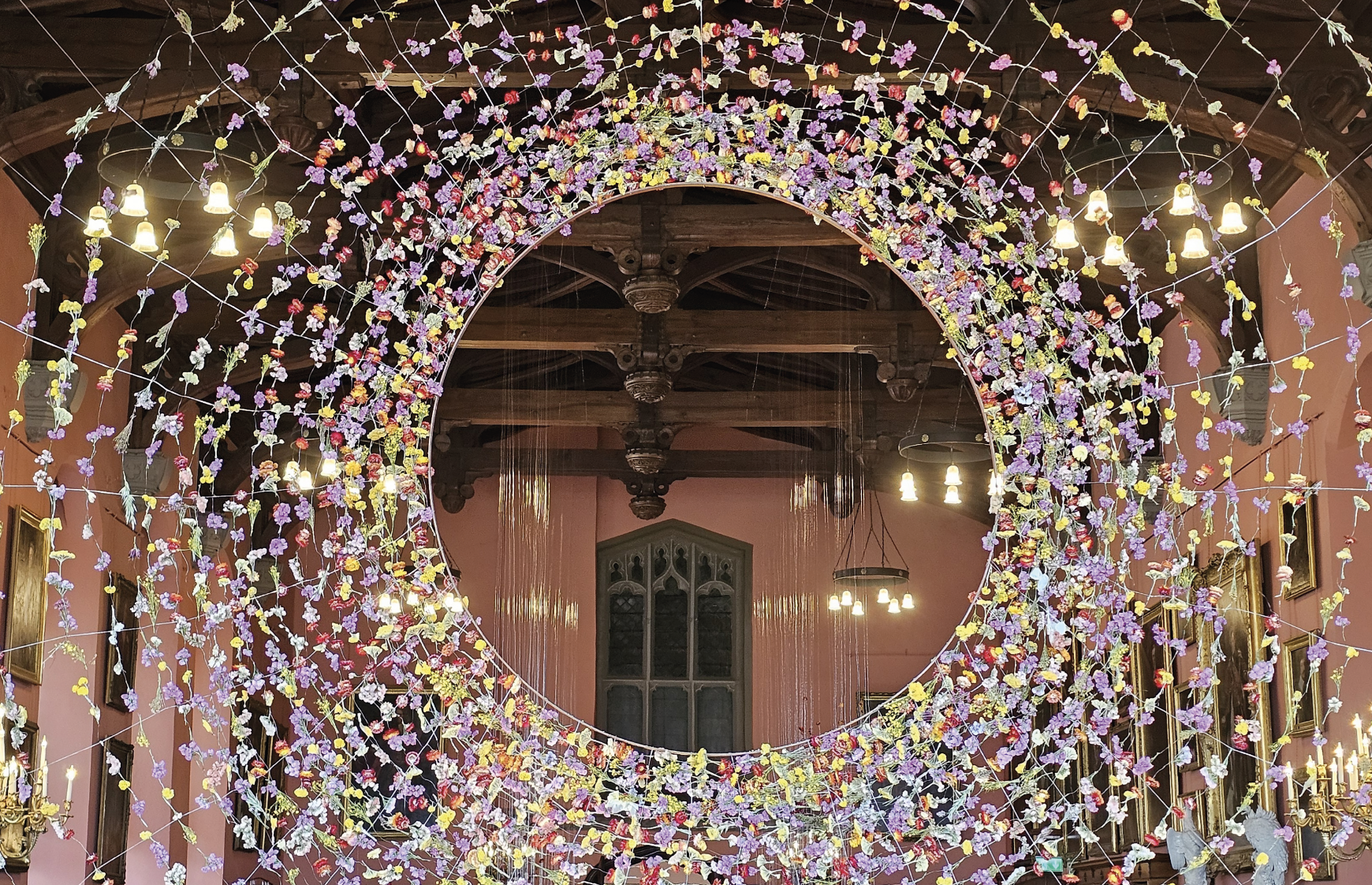
The sun portal in the Baron’s Hall