
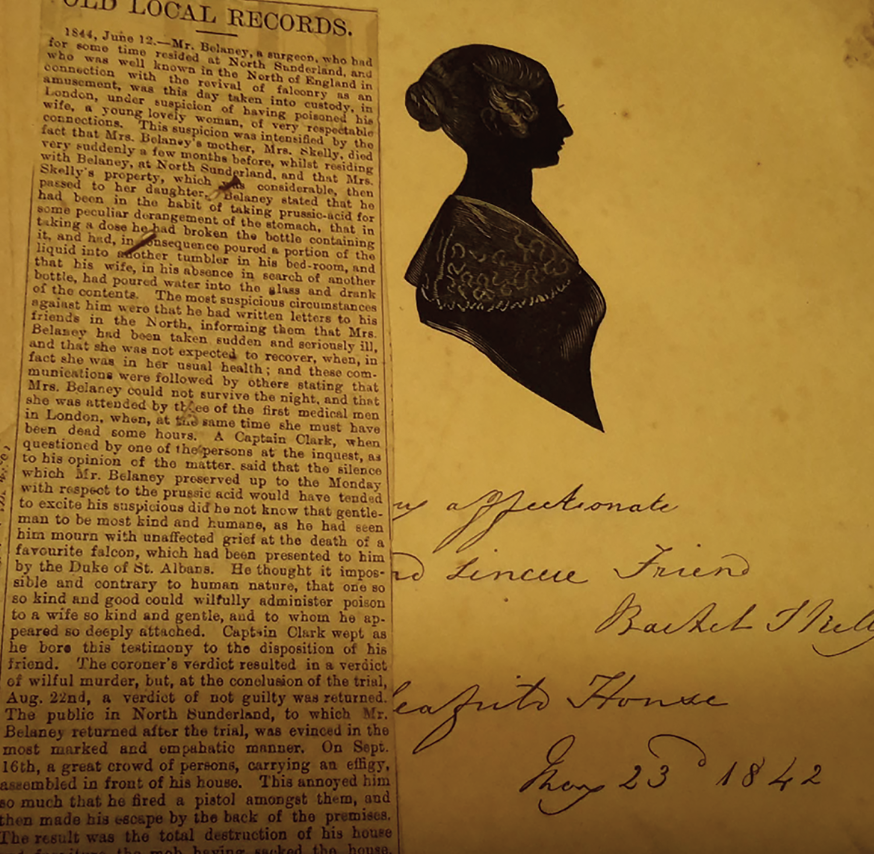
The silhouette and note written by Rachel Skelly two years before her death, and a newspaper clipping detailing the arrest of her husband on suspicion of murder.
The two were discovered, pinned together, among papers found in a family bible in Texas more than 120 years later
First published in edition 210 of The Northumbrian, February/March 2026
She was young, wealthy and admired across the coast of Northumberland. He was a self-styled doctor with a taste for falconry and a bottle of prussic acid by his bedside. Tried for his wife’s murder and found not guilty, James Belany escaped the courtroom, but not the judgement of those who knew Rachel Skelly. Michael Lyons reviews a case that still resists certainty
At an auction in Jasper County, Texas, some 20 years ago, a curious browser inspects a pair of old, leather-bound bibles; one is dated 1793, the other 1878. Struck by the fact that their original owners are both members of a family named Stobbs from North East England and that they are crammed with an assortment of old papers, he decides to buy them. It is to be 10 years before he realises that they yield a dramatic story, for one item is the silhouette of a woman bearing the legend, ‘Your very affectionate and sincere friend, Rachel Skelly, Seafield House, May 23 1842.’ Attached to the image is a newspaper clipping concerning the trial of her alleged killer two years after she wrote that note.
Less of a ‘whodunnit?’ and perhaps more of a ‘did-he-do-it?’, this Northumberland mystery remains unsolved. Before Seahouses became a settlement in its own right, the few properties abutting the sea from which it finally took its name were outliers of North Sunderland. This obscure outpost hit the national headlines in June 1844, when press reports of a coroner’s inquest, quickly followed by an Old Bailey trial in August, featured the sudden death of this same Rachel Skelly, and the indictment of her husband for her ‘wilful murder’. As this alleged crime took place in Stepney, London, it begs the question, why did this woman die in such tragic circumstances so very far from her home?
The accused, ‘Doctor’ James Cockburn Belany, was a man of mysterious background. Before he moved into the North Sunderland area, probably in 1842, his book, A Treatise upon Falconry, had been published in Berwick in 1841. A zealous proponent of hunting with falcons, apparently he travelled everywhere with his favourite bird, Sappho.
Tellingly, he recommends falconry as particularly suited to ladies and seems absorbed by his admiration for the fairer sex, describing women as, “being moulded to every grace and crowned with every charm. . . endowed with all those personal gifts which can adorn society and bless mankind.” He even penned a poem describing them as “the sweetest solace of mankind.”
Rachel Skelly, it seems, was indeed an attractive lass, described in one press report as “of great respectability and extreme beauty. . . her fine figure and personal charm procured for her the appellation of The Rose of the North.” It appears she had “innumerable suitors to her hand” in North Sunderland and beyond, and finally vouchsafed it to the recent incomer, James Belany.
Even before Belany courted Rachel and won her heart, he must have been aware that her widowed mother, also called Rachel, was a woman of considerable means. With extensive interests in local mines, lime works and property, her home, Seafield House, was a large, comfortable dwelling. Indeed, after the couple were married at St Aidan’s Church, Bamburgh on February 23, 1843, Belany moved into the house with his new wife and mother-in-law. Soon he was exercising a significant role and authority in the management of the Skelly businesses.
Despite Belany’s claim to be a doctor, it is unclear as to whether he was a physician, surgeon, apothecary, or indeed any of these. Within just five months of his moving into Seafield House, Widow Skelly fell ill and died on July 1, 1843. George Scott, registrar for the area, called at the house to record the circumstances of her death. In his submission to Belany’s subsequent trial, he told the court that the defendant himself provided him with all the information he required. When asked about the cause of her death, the registrar said: “He stammered a little, or demurred, and said, ‘well, you may put it down as bilious fever’. I did so, and he signed it.”
Rachel Belany inherited all her mother’s properties and businesses, but now it was her husband at the helm. By the time she became pregnant, he was managing all day-to-day operations and the couple had applied to the court to be acknowledged as joint inheritors of the widow’s estate. Sadly, Rachel lost their first child, but by the end of the year she was pregnant again and in May 1844 the pair left for an extended holiday in London and the South, Rachel insisting she was well enough for the arduous 300 mile journey.
Yet by Saturday June 8, just over two weeks after leaving North Sunderland in high spirits for their holiday, Rachel was dead. The suddenness and circumstances of her passing caused doctors to require an inquest which opened two days after her death. The presiding coroner ordered a postmortem to accurately elicit the cause of her death and as a result of the examination, Belany was arrested and remanded in custody charged with poisoning his wife. Formal proceedings against him opened on August 19, 1844.
One of the main prosecution witnesses was Matilda Heppingstall, who owned the Stepney residence where the Belanys took lodgings and was present at Rachel’s deathbed. She testified that once Rachel had recovered from her long journey, she seemed to be in good health, even playing her hostess’s piano and eating a good supper only two nights before the fateful Saturday. Yet on that morning, Matilda and her servant were summoned urgently to Rachel’s bedside by her husband to find her, “lying quite motionless, her eyes were shut and her teeth appeared closed. . . she was foaming a good deal from the mouth.”
The most damning part of the landlady’s testimony was Belany’s apparent woeful resignation as his wife lay dying, his delay in sending for a doctor to attend her, and his failure to administer any remedial treatment himself. He seemed convinced that Rachel was to suffer the same fate as her mother a mere 13 months earlier. Though Matilda pleaded with him to send for a doctor, only when all seemed lost was Mark Garrett, a local physician, summoned.
Garrett’s evidence was equally incriminating. By the time he arrived, Rachel was already dead and he was to complain subsequently about being called far too late. Upon questioning Belany at the scene, he was told that the only ‘medicine’ his wife had taken that morning was a dose of Epsom Salts. Just two days later at the postmortem, doctors found about a pint of fluid in her stomach, strongly impregnated with the odour of prussic acid – the poison hydrogen cyanide.
Belany went on to surprise Dr Garrett by turning up at his home unannounced only hours after the postmortem and admitting to using small doses of prussic acid himself to treat a long-standing stomach ailment. He claimed that the night before his wife’s death, in struggling to remove the stopper of his bottle, he tried to lever it out using a toothbrush but only succeeded in breaking it. He professed to have poured the remnant of the acid into a tumbler, intending to find an alternative vessel. Leaving the tumbler on top of the drawers in the bedroom to go on his search, he became ‘distracted’ for some minutes until he was interrupted by his wife’s screams. He went back to the room only to find her in convulsions, which is when he said he called to Mrs Heppinstall for help. Subsequently, he surmised that Rachel must have imbibed the draught, believing the liquid in the tumbler was water. The remains of the bottle he broke were never found.
Other, circumstantial evidence seems to smack of premeditation. According to Alexander Wilson, the Skellys’ farm steward and a defence witness: “On 21st of May, the night before they left for London, the defendant desired me to give my signature to their Wills. Both had already signed them. In the event of one of them dying first, the survivor was to do with the effects whatever they chose. My name is put to both Wills as witness.”
These wills were made at Belany’s insistence, and upon Rachel’s death he became a wealthy man. Belany wrote to several associates in Northumberland, pleading with them to attend his trial as defence witnesses or to submit written testimonies on his behalf. These all attested his loving relationship with Rachel and his solicitude for her health and welfare.
The inability of the prosecution to prove intent beyond doubt was decisive. There was no rebuttal of the fact that Belany was not present when Rachel imbibed the fatal dose and the jury returned a not guilty verdict. However, the good folk of North Sunderland were in no way inclined to comply with this. Outrage followed when Belany turned up and reoccupied Seafield House. A vengeful mob assembled outside the property throwing stones and wielding firebrands, and its desperate owner used his musket to fire a warning shot. Soon, parts of the building were alight and Belany escaped by a rear exit and fled. He was never again seen in the area, some reports suggesting that he moved to France, living under an assumed name.
One of the Stobbs family who previously owned the two bibles with which this story commences was Mary Stobbs, aunt of the tragic Rachel Skelly. She is known to have disliked and distrusted Belany and gave evidence against him at his trial.
Could the ‘paper trail’ found inside them have been her attempt to perpetuate the sad story of her tragic niece, the beautiful ‘Rose of the North’?