
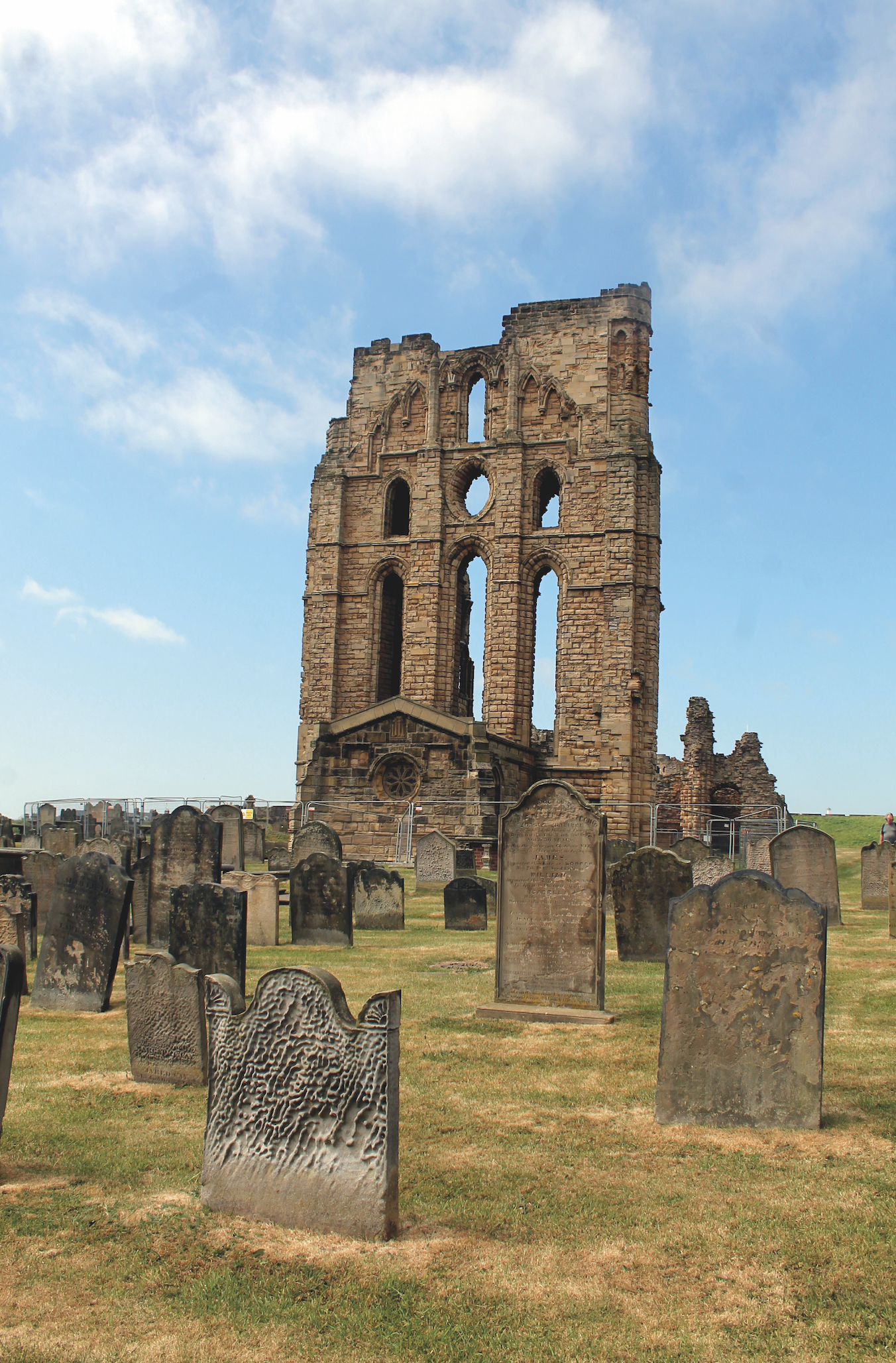
Tynemouth Priory
First published in edition 210 of The Northumbrian, February/March 2026
With its elegant architecture, lovely independent shops and cafés, and rich history, at first glance, Tynemouth is the epitome of coastal gentility. But as Margaret McAllister explains, its civilised modern veneer hides a past shaped by a murderous Christian king, the early northern saints, shipwreck-loving locals, dastardly grave robbers, and a fine reputation for taxidermy
If you’re travelling east from Newcastle or south along the Northumbrian coast, stop at Tynemouth. Really, stop at Tynemouth, or you’ll get wet.
This much-loved little coastal town has numerous stories to tell, beginning with the priory ruins rising up from the cliff. The first priory here was built in the 7th century, so one of the Christian kings of Northumbria – Edwin, Oswald, or Oswiu – must have established it. Oswiu had his kinsman Oswin, King of Deira, murdered in 651, and tradition says that Oswin was buried there. He also became a saint, which is more than we can say for Oswiu.
About 100 years later, the Venerable Bede was living over the river in Jarrow and wrote down a story he’d been told. A party of monks had been sailing down the Tyne on rafts with a cargo of timber, but when they reached Tynemouth the wind was against them. They were in danger of being swept out to sea or wrecked on the notorious Black Midden rocks. The folk of Tynemouth gathered on the headland to watch. Did they help? No. They mistrusted the monks with their new ways of worship, so they threw bricks at them while holding each other up laughing.
One brave young man tried to stop them and asked them to pray for the poor monks. They wouldn’t, so he did. When the wind miraculously turned and brought the monks safely to shore, the locals were impressed and decided not to trouble them anymore. According to tradition the young man was Cuthbert, later the most loved of our northern saints.
After the Viking raids the priory struggled along, but in 1065 a monk named Edmund received a rather useful vision. The glorious figure of St Oswin appeared to him, telling him that his burial place was beneath the church floor. Tostig, Earl of Northumberland, his wife Judith, and the Bishop of Durham took a great interest, and the excavation of the church did indeed reveal the body of a man. A sweet aroma was around it, which was taken as a sign that they had found the saint. Oswin’s shrine was beautifully rebuilt and raised the status of Tynemouth Priory until Big Bad Harry closed the monasteries and had the tomb broken up.
The castle and priory were rebuilt by the Normans, who wanted a well-defended site. King Edward I liked building castles and killing Scotsmen, so he reinforced the priory and castle on his way north to do a spot of bullying. Tynemouth became one of the best defended castles in the north, though not against the locals, as it’s said that when Edward I went there with his second wife Margaret, her herald’s gold and silver trumpet was stolen by the townsmen. (This seems unlikely, however, as King Edward would probably have put off hammering the Scots until he’d hammered Tynemouth).
By this time, the priory was under the authority of St Alban’s Abbey, which used it as a sin bin for troublesome monks. A letter written by a 14th century brother says: “Thick sea frets roll in, wrapping everything in gloom. Dim eyes, hoarse voices, sore throats are the consequences. . . In spring the sea air blights the blossoms of the stunted fruit trees so that you are lucky to find a wizened apple, though it sets your teeth on edge. See to it, brother, that you do not come to this comfortless place.” He also comments that at least they don’t go hungry because there’s always fish. Or fish.
I last visited Tynemouth Priory on a day of typically bracing weather. From the castle gatehouse to the end of the graveyard, the wind off the sea became wilder and colder with every step, but I managed to find the famous Monk Stone. It may originally have been a cross or boundary marker, probably 9th century, but the legend is that it used to bear the inscription, ‘oh horrid dede/to kill a man for a pigges hede’ .
The tale is that a monk of Tynemouth was passing Seaton Delaval Hall when delicious smells from the kitchen reached him. A banquet was being prepared – they wouldn’t miss a roasted pig’s head, would they? He tucked said ‘pigges hede’ under his arm and hurried back to the priory, but Lord Delaval found out and pursued him as far as Tynemouth, where he beat him so severely that the monk later died. Lord Delaval had to do penance and hand over some land to the monastery. The stone was later moved to the priory because a farmer wanted it off his land.
Also in the graveyard is the gravestone of Alexander Rollo, which I remember my father talking about when my sister and I were just dots. When Dad was a boy, there was a poem all schoolboys had to learn – The Burial of Sir John Moore at Corunna by Charles Wolfe. John Moore was a hero of the Peninsular Wars and died holding Corunna against the French. The poem, simple and evocative, reflects on his grieving soldiers laying him in a makeshift grave. “And the man who held the lantern,” Dad would say, “is buried at Tynemouth Priory.”
Corunna was still under heavy fire on the night the defenders buried Sir John. Corporal Alexander Rollo, who held the lantern, put his life at risk to give the gravediggers the light to work by. Happily, he survived the war and returned to live out his life at Tynemouth, sometimes working as a guide at the priory. He died in 1856, aged 82.
Not all rested so peacefully. In the 18th and early 19th centuries, medical students needed practice. Dissection was seen as a disrespectful way to treat a body, but the government decreed that murderers asked for it, so the bodies of hanged killers were given to the surgeons. However, there were never enough dead murderers to go round, leading to a trade in grave robbing by ‘resurrectionists’ who dug up bodies by night and sold them to medical schools.
Newcastle was useful for trafficking corpses to Edinburgh. In 1820 Henry Gillies was charged with stealing a body from Tynemouth Churchyard and eight similar offences were taken into account, but he got away with a year in prison and a fine.
Leaving the cold, windy headland, I called at The Turk’s Head, aka The Stuffed Dog, for a coffee. I wanted to learn about its famous dog, and the staff were very happy to help.
In a glass case, peacefully taxidermied, lies a large collie. In 1873 a Cheviot shepherd was driving his flock through North Shields to the quayside when the noise of the town scared and scattered them. The shepherd and sheepdog became separated, and finally the shepherd went on without the dog. The poor animal became distressed, searching the quay for his master, refusing to leave, or even to eat. Over time he became so emaciated that the locals thought it would be kindest to take him on the ferry and throw him in the Tyne, but he swam to shore and came back on the next boat.
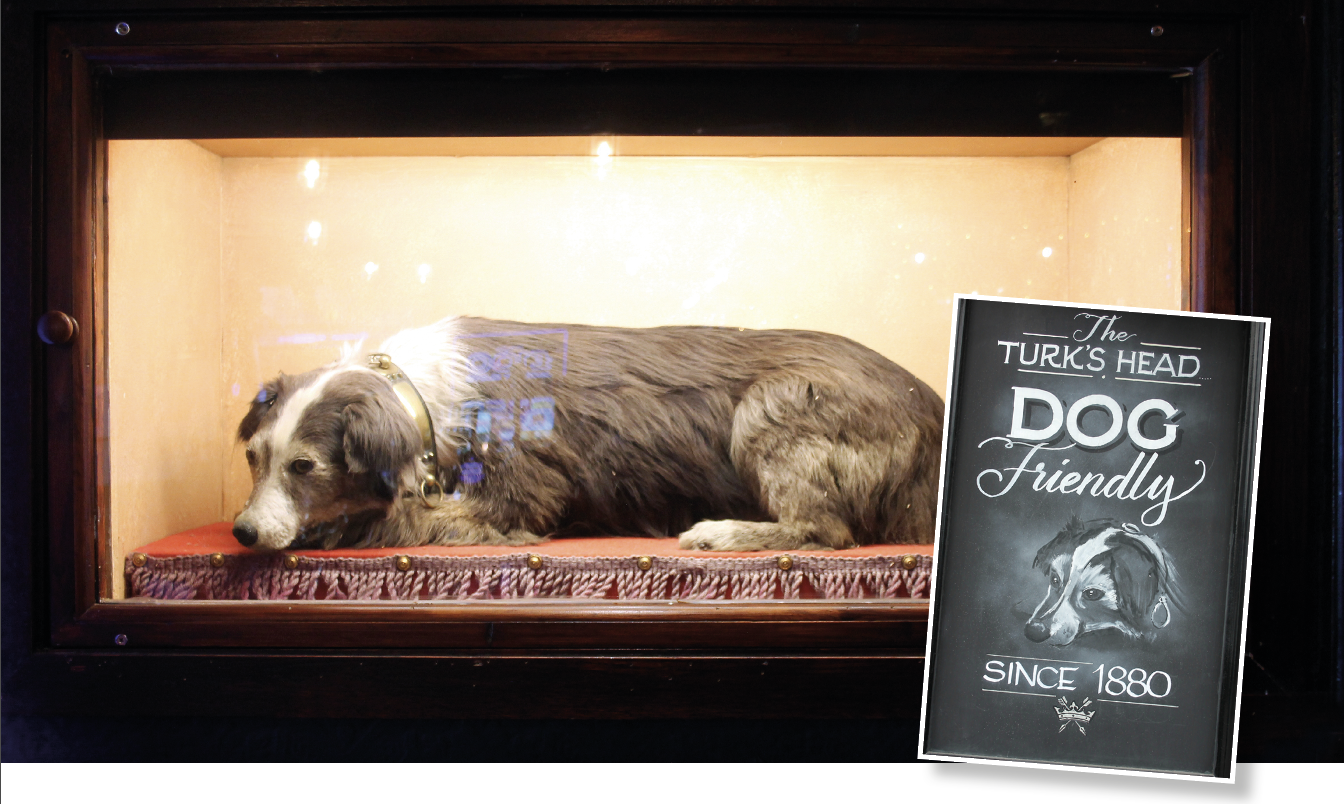
Wandering Willie, whose stuffed remains lie in reverent splendour at The Turk’s Head pub, where Willie also stars on the pub sign
After that he regained his will to live, came under the protection of Ralph Cruickshanks, a ferryman, ate voraciously, and barked to announce the arrival of the ferries. Ralph trained him to herd passengers between the railway stations and the ferry landings. In 1875 the committee of the Jarrow Dog and Poultry Show gave him a collar inscribed: ‘I am still poor Wandering Willie/Many voyages have I been/Dogs like me are not so silly/I am just as good as aught I’ve seen’. He was given a money box around his neck to collect for the orphans of shipwrecked sailors, and finally died of old age in 1880. Go and raise a glass to him.
In the early 1840s everybody had heard of Harriet Martineau, a well-educated young woman who had kicked over convention by becoming a journalist and author. No bonnets and baking for Harriet, she wrote about social causes and political economy, women’s rights, and the abolition of slavery. This fiercely intelligent woman became very ill in her thirties and was advised to go to Tynemouth where the fresh air would be good for her health. An upstairs apartment was arranged for her at 57 Front Street, and her window over the mouth of the Tyne was her view for the next five years.
She was fascinated by the sea and by the lives of the local people, and bought a telescope so she could observe them on the shores. While there she wrote four children’s books, a series of articles, and Life in the Sickroom about how to keep control of one’s life even when confined to bed. Charlotte Brontë visited her, as did Thomas and Jane Carlyle and Elizabeth Barrett Browning. She recovered and went on writing and campaigning until her death in 1876. Tynemouth was good for her.
There isn’t room to tell you about Tynemouth Life Brigade, Collingwood’s Monument, or the famous painters Myles Birket Foster and John Falconar Slater, but pop ‘Penbal’ into a search engine and you’ll find out everything you need to know from Luan Hanratty’s excellent website. Take a trip to Tynemouth and enjoy the lovely shops and places to eat along Front Street. Thanks also to the English Heritage staff at Tynemouth Castle, and the lovely people at The Turks Head. Dog friendly since 1880.