
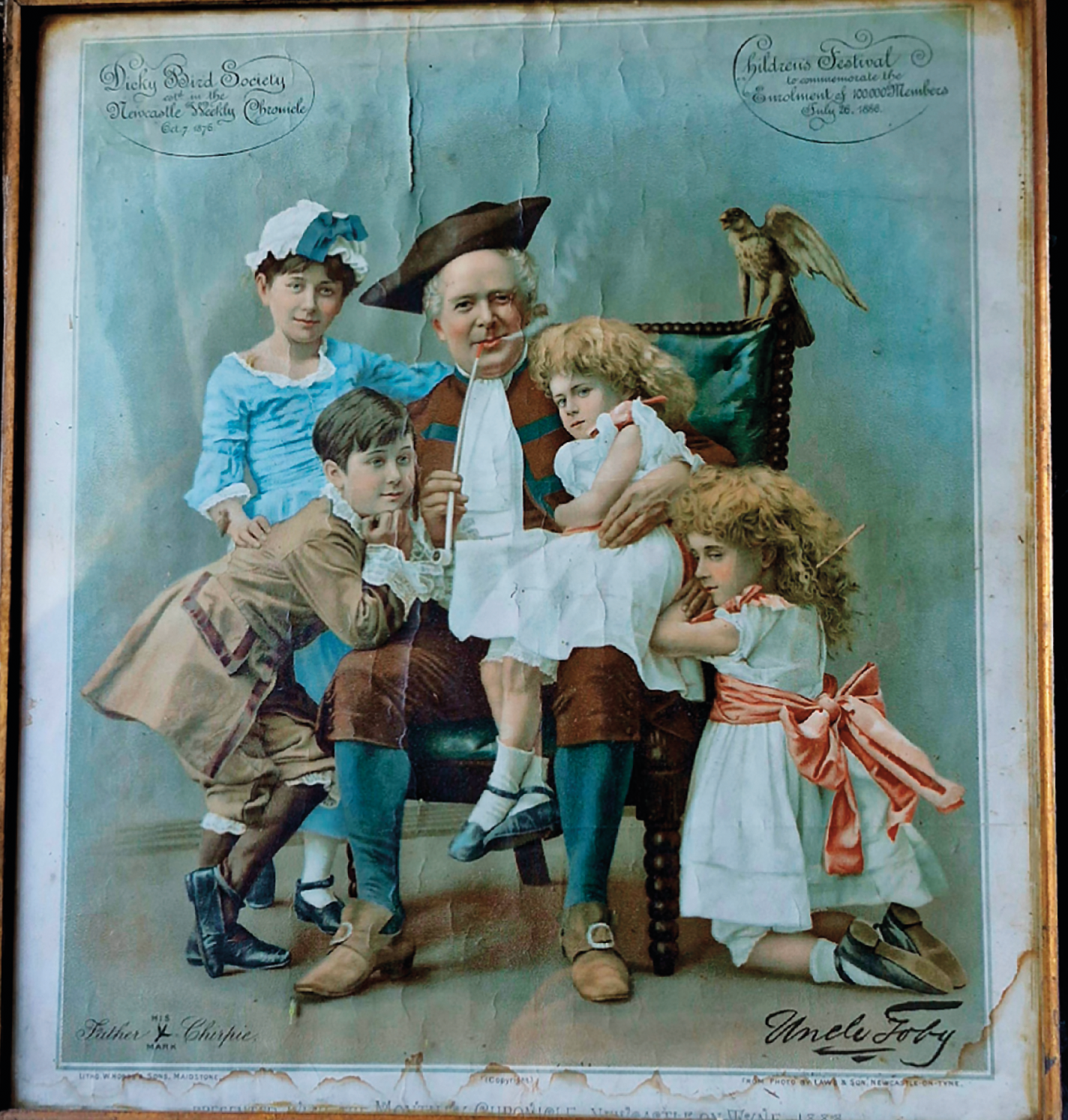
The Chronicle souvenir poster depicting ‘Uncle Toby and his Little Friends’ which Conor Mark Jameson recently picked up for £5 in a junk shop
First published in edition 214 of The Northumbrian, October/November 2026
In the late 1800s the North East was the birthplace of a mass youth movement to protect nature. Now, 150 years since it was founded, Conor Mark Jameson has stumbled on a trace of The Newcastle Weekly Chronicle’s Dicky Bird Society
For most of my conservation career I worked for the Royal Society for the Protection of Birds (RSPB). This is the largest wildlife conservation organisation in Europe, with a membership of 1.2 million and a pedigree stretching back to 1889, when it was founded by two groups of determined women.
But there was an organisation that pre-dated it, and it was born in Newcastle. Its constituency was centred on the North East and the readership of the Newcastle Weekly Chronicle, and it amassed a vast membership, all of them children.
I first came across the Dicky Bird Society while researching the life of the pioneering naturalist and RSPB founding member WH Hudson for my book Finding WH Hudson. Its story lodged in my mind: a remarkable children’s movement for bird protection that had begun in Newcastle years before the organisation that became the RSPB.
Then, recently, I chanced upon the framed 1888 souvenir poster pictured on this page, which I picked up for £5 in a junk shop. It prompted me to look more deeply into the DBS, as it was known, and by happy coincidence, I discovered that it was formed exactly 150 years ago, in October 1876.
This was the age of the newspaper and the Newcastle Weekly Chronicle was shifting half a million copies a week. It was also the tail-end of what climate experts call the Little Ice Age. There’s nothing like a prolonged cold snap to elicit human compassion for birds and other creatures, and even by the standards of the day the year 1876 began in the grip of an unusually cold, long winter. In late February/early March a bitter snowstorm heralded blizzards lasting for up to 50 hours. Average temperatures remained around freezing until the middle of March, then May brought an extraordinarily severe low-pressure system and 60 hours of continuous downpours and flooding.
This was the context in which the DBS came into being and grew into a phenomenon. Interest is likely to have been further boosted when severe weather returned in late December, confirming 1876 as one of the coldest years on record.
Members were told that the DBS was run by a character called Uncle Toby, and child members signed this pledge: “I hereby promise to be kind to all living things, to protect them to the utmost of my power, to feed the birds in the winter time, and never to take or destroy a nest. I also promise to get as many boys and girls as possible to join the Dicky Bird Society.”
Momentum grew. By spring 1877, membership was 1,000, two months later it reached 5,000, and late that year that figure doubled. Support came from the North East and nationally. The London press extolled the society’s aims and virtues, and wider pledges of support arrived from overseas. Similar societies were founded in Norway, Australia, New Zealand, South Africa, even Russia. Dicky Bird fever had gone viral.
Members were asked to draw birds on their envelopes when they wrote to Uncle Toby. Sometimes a drawing alone would suffice for an address, such was the traffic in fan mail to the Chronicle’s offices. Members requested identifying insignia, and were given a yellow ribbon or rosette.
Saving Dicky Birds quickly diversified into a business, and Uncle Toby’s image was applied to all manner of merchandise – some unsurprising, like Uncle Toby’s Birdseed, others less obvious, like his Smoking Mixture. There were sweets, cakes, medals, brooches, even suits. LA Procter’s Glass and China Depot in Northumberland Street was given a licence to supply Uncle Toby crockery, songs were written and sung for the cause, waltzes and galops dedicated, and poems recited
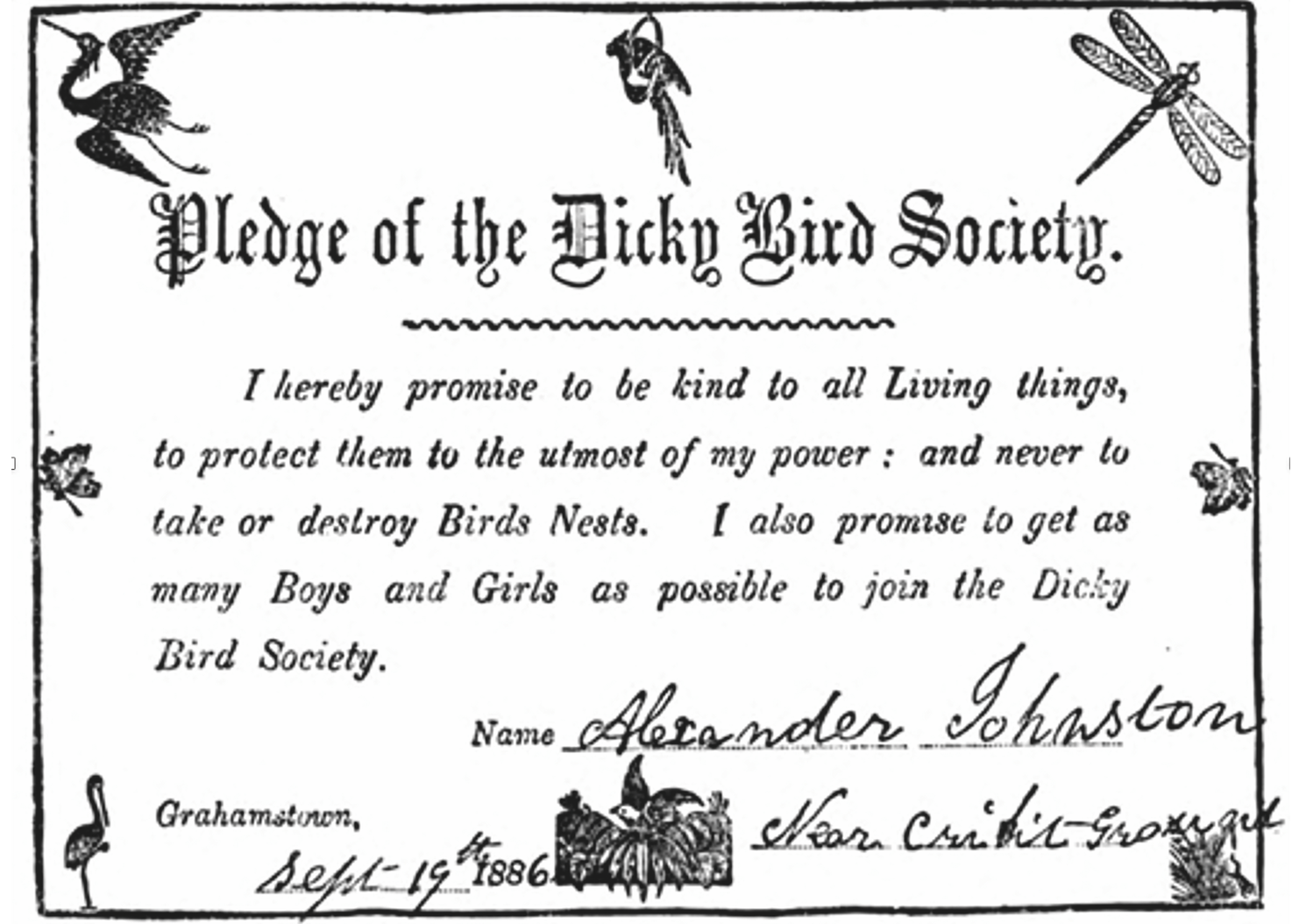
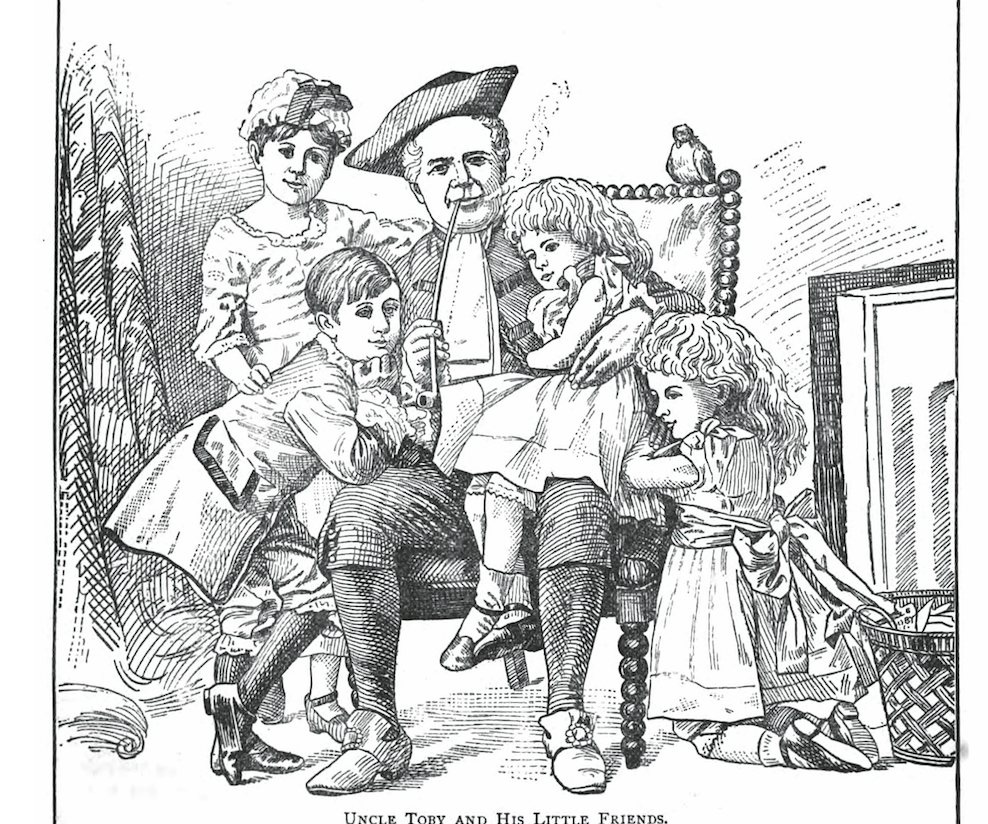
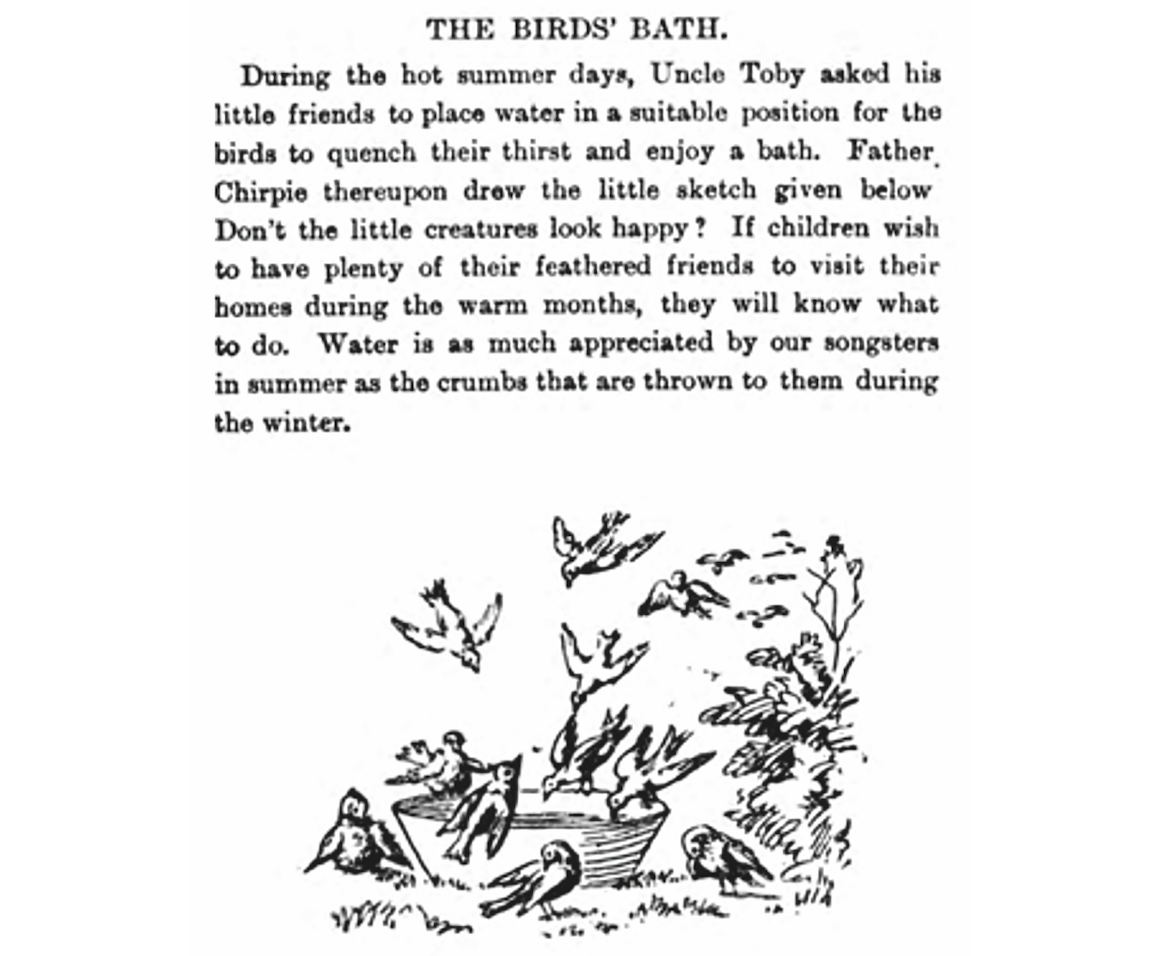
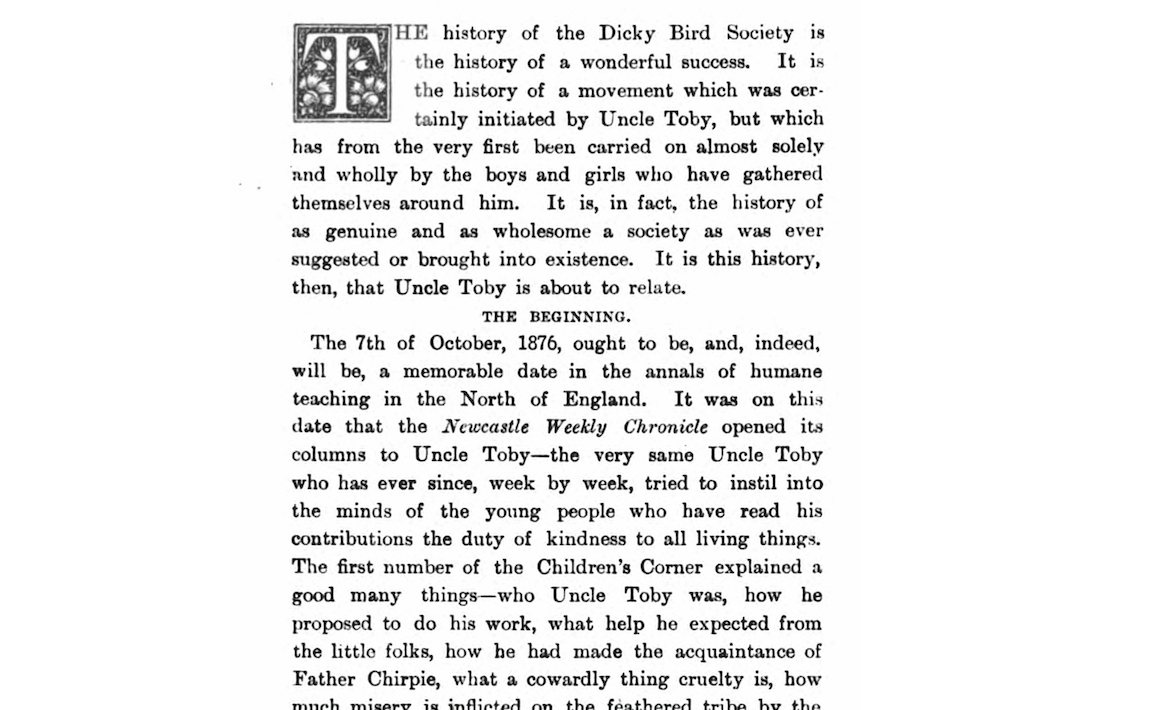
Above: The society pledge, signed by one Alexander Johnston, September 1886; Three extracts from the booklet detailing the history of the society
To mark ten years and its growth to 100,000 members, in July 1886 children gathered at the Town Hall in Newcastle and marched to the Tyne Theatre. The procession was marshalled by Colonel Blenkinsop Coulson, champion of animal welfare. So popular was the event, despite steady rainfall, that it was repeated three days later. In total 8,000 children took part, and “this vast assembly of little folks, coming from all parts of the north of England, was gathered and dispersed without a single accident of any kind.”
The Chronicle produced a 12-colour souvenir poster given away free with the paper. Depicting ‘Uncle Toby and his Little Friends’, it is a surviving copy of this that I recently found. “One of the very best things of its kind I ever saw,” wrote an authority on chromo-lithograph technology at the time.
It was then decided that the society would “confer on active and diligent members the rank and title of captain or companions – boys to be captains and girls to be companions – of the Dicky Bird Society.” When they wrote to the Chronicle they proudly placed the letters CDBS after their names.
There were dozens of imitators, including a group in Cheshire that trod too close to the DBS model and had to be reined in (a quiet word was had, it seems).Meanwhile, a branch in Tasmania followed due procedure and was effectively a prototype franchise operation.
The journalist behind Uncle Toby was the editor, activist and reformer William Edwin Adams. His original dream had been to create a society with 5,000 members. If each member could feed just ten birds with crumbs, he calculated, they would be helping 50,000 birds. The movement he started continued to grow and claimed an astonishing 411,644 members worldwide by 1940, when the disruptions of World War II precipitated the end of the Weekly Chronicle and its extraordinary club.
Adams chose the pen-name Uncle Toby after a character in Laurence Sterne’s comic novel The Life and Opinions of Tristram Shandy, Gentleman. Uncle Toby literally wouldn’t hurt a fly, catching insects that entered the house to free them. Sterne’s novel recounts the ill-starred life of Tristram Shandy, Uncle Toby playing a leading role in his capers. A retired army captain who sustained a groin injury during the Nine Years War, Toby likes to conduct military re-enactments with his servant, Corporal Trim, on a bowling green outside his home. A key subplot involves his neighbour, Widow Wadman, who has designs on him and is keen to determine exactly where he sustained his war wound.
Back at the Chronicle, Adams’s Uncle Toby had more practical matters to deal with. As well as being published in the paper, the names of society members were entered in The Big Book – “certainly the biggest book ever seen in the North of England, or probably anywhere . . .” wrote Uncle Toby.
Chronicle staff had to painstakingly enter all these names, and some of the letters and documents generated by the movement. A souvenir booklet (pictured above) was published in 1891 which you can read on the Bodleian Library website. It records the Big Book as being more than 2½ft long, 2ft broad and 1ft thick, and “when it has to be removed, two men are required to lift it.” Handsomely bound in red and gold, it was put on show to the public, “where it naturally excited a great amount of interest,” and later went on tour.
Within 12 years, by January 1888 the Dicky Bird Society boasted 140,000 members. Its influence must have been noted by others and a year later groups of women were gathering in drawing rooms in Manchester and London to form what we know today as the RSPB.
Chronicle editor William Edwin Adams could take great satisfaction in the impact of the society. “Boys are no longer the little savages that many of them were before we commenced our operations,” he reflected. “Uncle Toby’s vigorous and successful propaganda has been the means of making the world a sweeter and lovelier place for all that inhabit it.”
It was during my research into WH Hudson that I first encountered the Dicky Bird Society, so perhaps it is fitting to return to him here. Its efforts were certainly appreciated by the pioneering naturalist and RSPB founding member. When the RSPB Council offered to hold an annual Hudson Lecture in his memory, in recognition of his immense contribution, he said no. “Lecturing to grownups is a waste of time,” he told them. “Children are the future. Put my money there.”
Today the RSPB has a youth membership of around 200,000. Almost 150 years after Uncle Toby first encouraged children to feed and protect their local birds, that belief in engaging the next generation feels as important as ever.
Conor Mark Jameson is an author, naturalist and conservationist whose books include Finding W. H. Hudson: The Writer Who Came to Britain to Save the Birds, Looking for the Goshawk, and Silent Spring Revisited
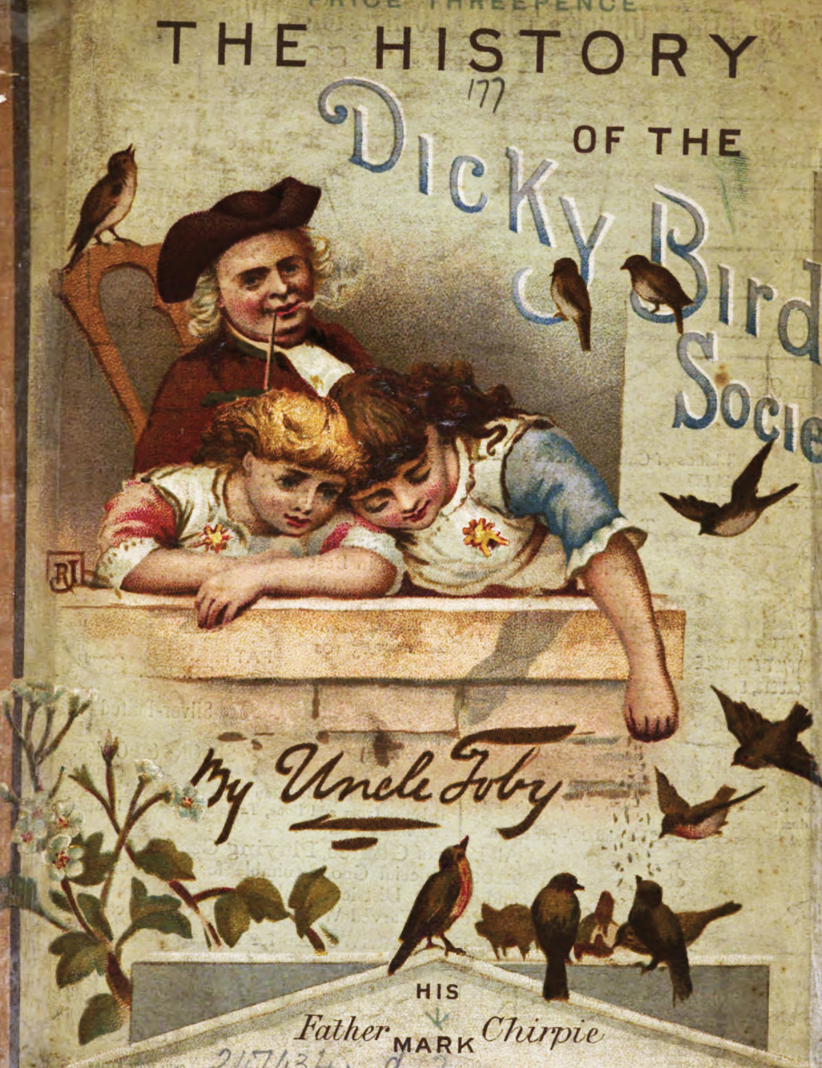
The History of the Dicky Bird Society published in 1891 can be read online at the Bodleian Library, Oxford, here: www.tinyurl.com/386vurz3