
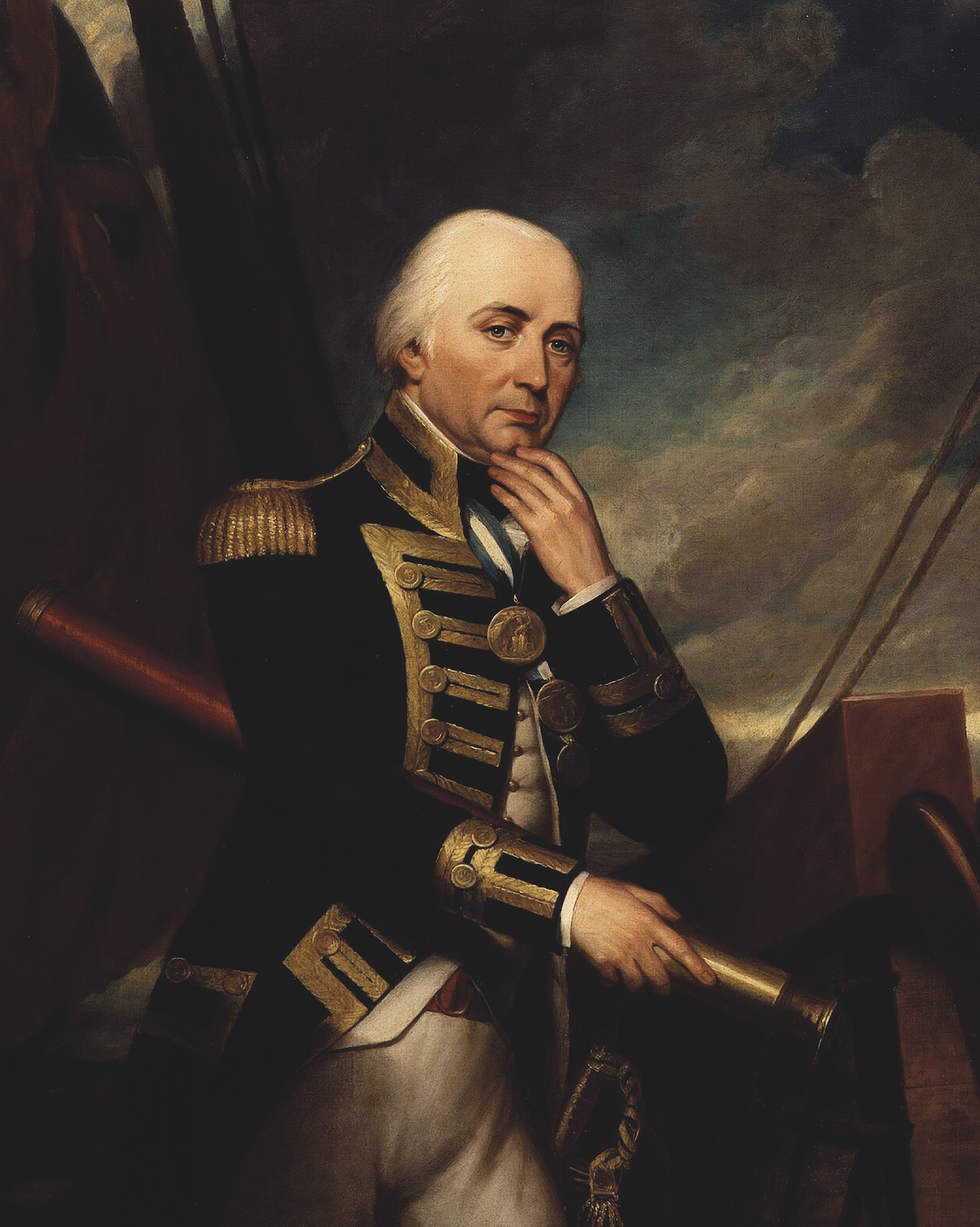
Portrait by Henry Howard, 1828
First published in edition 213 of The Northumbrian, August/September 2026
Stephen Roberts looks at the life of Vice-Admiral Cuthbert Collingwood, 1st Baron Collingwood, naval hero (1748-1810) and Horatio Nelson’s second in command at the Battle of Trafalgar
“See how that noble fellow Collingwood takes his ship into action!” declared Lord Nelson as Cuthbert Collingwood, leading his division aboard HMS Royal Sovereign, bore boldly down on the rear of the Franco-Spanish line at Trafalgar, becoming the first British ship to engage the enemy, and all, according to tradition, while calmly eating an apple.
Although history often casts Collingwood in the shadow of Nelson, his achievements deserve recognition in their own right. A distinguished naval commander, he combined professional excellence with humanity, earning the respect of those who served under him. Beyond his naval career, he was a devoted family man, an astute strategist and a skilled diplomat. His letters reveal a man of intelligence, warmth and gentle humour.
Born in Newcastle in 1748, he was the son of a merchant, Cuthbert Collingwood, and his wife, Milcah. He was born in a house on The Side, which still leads steeply down to the River Tyne, then one of Britain’s busiest waterways. A forest of masts crowded the quays as ships arrived and departed carrying coal and goods across the country and beyond. It was a maritime world that may well have inspired his ambitions at sea.
One of 11 children, he was among the seven who survived to adulthood. They included his younger brother Wilfred, who would also go on to pursue a naval career. The Collingwoods were a long-established Northumberland family. Cuthbert’s great-grandfather was executed for his support of the Stuart cause in the late 17th century, however, and in the years that followed the boy’s immediate forebears, including his father, had been deprived of the family estate, Eslington Park near Alnwick.
Cuthbert attended Newcastle’s Royal Grammar School, where he later recalled a surfeit of corporal punishment (though no longer, we might add . . .). As a naval commander, he was notably reluctant to resort to flogging, preferring to earn the loyalty of his men through fairness, discipline and example. Such was their affection for him that many of his sailors came to know him simply as “Cuddie”.
Aged 12, he entered the Royal Navy as a volunteer aboard HMS Shannon, commanded by his uncle, Capt Richard Braithwaite. When Braithwaite was later appointed to HMS Gibraltar, Collingwood followed him, gaining valuable early experience serving in home waters, the Mediterranean and the Atlantic.
By 1766, at the age of 18, Collingwood had attained the rank of midshipman. After several years serving in home waters, he was posted to the North American Station in 1774. There he witnessed the outbreak of the American War of Independence and saw action during the Siege of Boston, including the Battle of Bunker Hill in 1775, where he led a naval brigade ashore.
Promoted to lieutenant, Collingwood’s career became increasingly intertwined with that of Horatio Nelson, the pair both advancing through the ranks. Having fought against the American revolutionaries, Collingwood was then engaged in Britain’s struggle against Revolutionary France. Throughout the Revolutionary Wars, he served with distinction in a succession of commands, earning a fine reputation. Returning home in 1786, he spent several years ashore and in 1791 married Sarah Blackett; a union that would last until his death nearly 20 years later. Their home was Collingwood House in Morpeth.
The naval victories in which Collingwood participated were many, including Lord Howe’s victory off Brest, the so-called Glorious First of June (1794); Lord Jervis’s triumph off Cape St Vincent in 1797, following which Collingwood was promoted rear-admiral in 1799; and of course Trafalgar in 1805, forever destined to be a bittersweet victory for Collingwood and the nation because of Nelson’s death at the moment of triumph. By then a vice-admiral, Collingwood was second-in-command at Trafalgar and assumed command of the fleet upon Nelson’s demise. His rewards were a pension, elevation to the peerage as 1st Baron Collingwood, and command of the Mediterranean Fleet.
At Trafalgar, Nelson is remembered for the signal, “England expects that every man will do his duty”, though the message he initially proposed to John Pasco, officer in charge of flag signals, was the less memorable: “Nelson confides that every man will do his duty.” Either way, it was arguably outdone by Collingwood’s own pre-battle exhortation: “Now, gentlemen, let us do something today which the world may talk of hereafter.” These are perhaps his most famous words, spine-tingling ones to boot, and they are typical of a man whose letters reveal a deep sense of duty, humanity and resolve. He was not always enamoured of Nelson’s flair for signalling. According to a possibly apocryphal story, Nelson’s famous proclamation elicited the dry response: “I wish Nelson would stop signalling. We all know what we have to do.”
At Trafalgar, Collingwood’s flagship, HMS Royal Sovereign, bore the brunt of a fierce engagement with the Spanish Santa Ana, sustaining heavy damage to her masts and rigging. With Nelson mortally wounded and Collingwood assuming command of the fleet, HMS Euryalus took the battered flagship in tow. By the battle’s end, Royal Sovereign suffered 141 casualties, killed and wounded, while Collingwood escaped with a splinter wound to the leg.
After the battle, it fell to him to send the famous dispatch announcing both the victory and the death of his friend Nelson. In it, he expressed his grief, writing: “My heart is rent with the most poignant grief for the death of a friend, to whom, by many years intimacy . . . I was bound by the strongest ties of affection.”
Collingwood remained in post despite increasingly poor health, spending several years in the Mediterranean commanding British fleets off Spain and Sicily. Although these years lacked the drama of Trafalgar, they were vital to British naval supremacy during the Napoleonic Wars. He died aboard ship in the Mediterranean in March 1810, aged 61, and his body was brought home for burial in St Paul’s Cathedral, where he lies beside Nelson.
After years of requesting relief from his duties, Collingwood had finally been granted leave to retire, and died just as arrangements were being made for his return to England. He never reached the home he longed to see again, nor enjoyed the peaceful retirement he had earned, tending his beloved Northumbrian garden.
His own correspondence and biographies portray an admiral who served his country with exceptional distinction and remarkably few missteps. Steady, dependable and widely respected, he was described by Nelson as an “amiable good man” in contrast to officers who were merely “geese”. Intelligent and erudite, his sense of duty led to a personal self-denial, and some historians have argued that his meticulous attention to detail and reluctance to delegate made high command more burdensome for him than for Nelson.
He is commemorated widely, including by one of the four houses of Newcastle’s Royal Grammar School, while the Collingwood Society has a global membership and hosts numerous lectures and events in his memory. Meanwhile, the Collingwood Monument overlooking the Tyne at Tynemouth and the memorial to him in Newcastle Cathedral both endure.
CHRONOLOGY
1748 Cuthbert Collingwood born within sight of the River Tyne in The Side, Newcastle (September 26).
1759 Collingwood briefly attends Newcastle’s Royal Grammar School.
1761 He first goes to sea, aged 12, aboard HMS Shannon.
1774 Collingwood moves to the North American station where he sees action in the Revolutionary War.
1786 He returns to England.
1791 He marries Sarah Blackett, daughter of Newcastle’s mayor, at St Nicholas’ Cathedral.
1794 Collingwood takes part in the Glorious First of June victory under Lord Howe.
1797 Takes major part in the victory at the Battle of Cape St. Vincent, coming to Nelson’s aid at a critical point.
1805 Battle of Trafalgar. Collingwood completes the victory after Nelson’s death.
1810 Death of Vice-Admiral Cuthbert Collingwood, Mediterranean Sea (March 7).