Borrowed stories and the landscape of a life
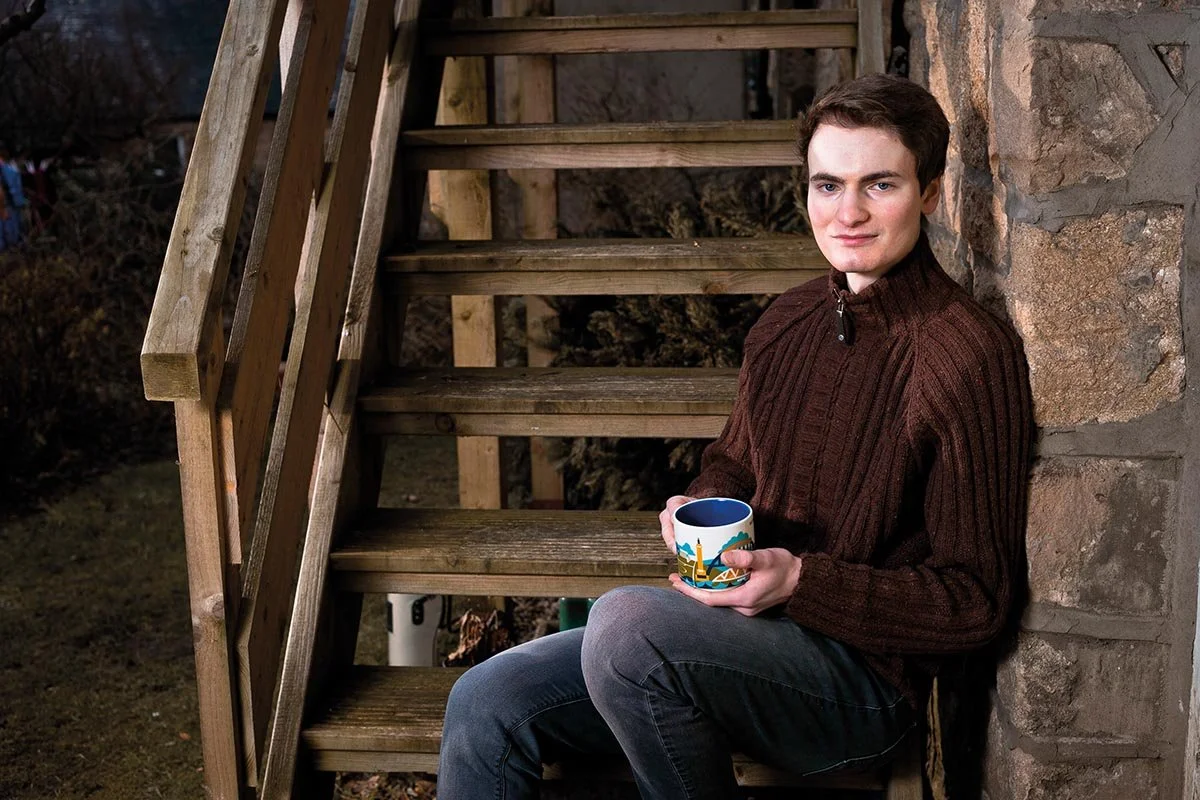
Ewan Bowlby
First published in edition 208 of The Northumbrian, Oct/Nov 2025
Chris Bowlby reflects on the life of his son Ewan. He died aged 27, and left a remarkable legacy in his posthumously published book, Borrowed Stories: Facing Cancer with Culture
I love the landscape around the A68 road that crosses much of Northumberland, the drama of the undulations on the old Roman route, the views that can vary between spectacular sunlit distant hills to beautiful drifting mist or tempestuous clouds. And it is a road and a journey now full of special memories for me, as I shared it often with my elder son Ewan when he was studying at St Andrews University and we travelled to and from our home in Hexham.
Those journeys, sometimes in the company of my wife Jane and our other son Alfie, were an opportunity to talk: about everything from the most trivial to the most profound, the highly personal to the state of the world, the amusing to the deeply worrying. And it was the continuation for us of a conversation that had taken on a special richness and intensity since Ewan’s diagnosis as a teenager with a brain tumour. He, and we his family, lived for a decade with that condition; the constant ups and downs as he had major surgery and treatments, including chemotherapy after the tumour turned cancerous. Yet he continued to live life with extraordinary fullness until just before his death aged 27.
You might have expected Ewan during that decade to have done everything to try to forget what he was facing, and in many ways our conversations as we travelled and at home reflected just that need to focus on all the rest of the life he was enjoying. We spoke about everything, from his love of cooking and food, choral music and chess, to walking the hills in Northumberland and Scotland, playing sport and supporting, defiantly, Newcastle United. But when it came to hearing about his academic research we knew that he had chosen to confront directly, with great courage and honesty, what he was experiencing, as the implications of his illness sank in. This research had, for him, the most personal roots and motivation. He wanted to develop ideas on how all those facing such challenges, and all those close to them, could best be helped.
Ewan believed that culture very broadly defined – everything from Dante’s poetry and the novels of Dostoevsky and George Eliot to modern TV dramas such as Breaking Bad and Cold Feet – could help people to face the kind of fundamental ‘spiritual’ or existential questions that arise when they are diagnosed with a life-threatening condition. Clinical language describes the illness itself (though sometimes in baffling jargon). But modern medicine, Ewan believed, had less and less ability to address these most human concerns. Limited by its strictly scientific vocabulary, it “spoke uniformly with neither time nor patience for narrative, poetry or paradox.”
Among his insights were the way cancer treatment affects patients’ sense of time, how sentimentality can offer valuable emotional experiences for those in need of respite or release, and how even humour, appropriately used, can introduce patients to the therapeutic effects of levity and laughter. These insights did not just come from Ewan’s academic research, but also from regular sessions with fellow cancer patients at a Maggie’s Centre in Dundee, and with members of the Northumberland Cancer Support Group, with whom he held online sessions during Covid lockdowns.
“Powerful, passionate storytelling would begin,” he recalled. “In these moments, I felt that I was witnessing something remarkable, almost sacred.” Ewan’s interests in theology and culture had also been shaped by an unusual mix of family influences. One of his grandfathers was Ronnie Bowlby, former Anglican Bishop of Newcastle. The other was the poet Tony Harrison, long-term resident of Newcastle, whose National Theatre version of the medieval Mystery Plays was the first piece of drama to captivate his young grandson.
Ewan was awarded a PhD by St Andrews shortly before he died, but he had always wanted his research to be made available beyond the academic world, to reach as wide a readership as possible, embracing patients and their loved ones as well as those who care for them professionally. He developed a programme of cultural materials and an introductory guide which we are hoping to make widely available to Maggie’s Centres and other places in contact with cancer patients. He had also been working on a more ‘popular’ book, which included autobiographical chapters. They explain how his own experiences had shaped his idea that people can use stories from culture and elsewhere to learn to understand how their own story may be changing.
“This book,” he wrote, “is about how I overcame crippling anxiety and incoherency so that I could tell others about my cancer. It also allows me to offer my own story as something that others could borrow from.” Ewan hoped that, “telling this story will help other patients in need of encouragement or inspiration to remain open to a range of stories. I believe that when it comes to interpreting and responding to disease, we are surrounded by rich resources. We do not have to look far to find a vast range of imaginative perspectives on our mortality.”
When he knew he would not have time to finish this book he asked me to complete it, with the help of family members, in the spirit of all our conversations over the duration of his illness. It has now been published under the title Borrowed Stories. Former Archbishop of Canterbury Rowan Williams, who knew Ewan, has written a foreword, describing the book as “a profoundly and persistently generous book in which the writer makes sense of what is happening by making a gift of his experience to those who might have to share it or something similar.”
Broadcaster Edward Stourton commented after reading it: “There is plenty of writing available about ‘coping’ with cancer; this book explores the way life lived in the shadow of mortality can be enhanced and transformed by culture – both high and popular. The search throws up moments of true revelation.”
Seeing the book published, furthering Ewan’s legacy, has helped us all in continuing to live with our grief. Reminders of his life and presence are constantly around us in the places he knew best, including many in the North East of England. There is the memory of some of his earliest efforts at fell-walking, falling as a toddler into a huge muddy puddle near Hadrian’s Wall and needing emergency new trousers. Or the many trips we enjoyed with him to Tyneside and the Northumberland coast in high summer or bracing winter. And those journeys along the A68 now bring back memories too of travelling to the family celebration of his wedding to a fellow St Andrews student Karlee the summer before he died, and then bringing them back to our hometown of Hexham, where he spent his final months.
Even during that period Ewan remained determined to do as much as he could, completing the Great North Run in an impressive time. I remember being so proud and awestruck as he strode through the great throng of runners who represent such a wonderful collective North Eastern defiance of all the challenges life can throw at the region’s people.
And Hexham now has its own special memories for us of Ewan. Some, of course, are deeply painful as we recall how the illness took hold in its final stages, although we were helped by a superb local palliative care team. At Hexham Abbey we held a thanksgiving service for him, to which hundreds came who had known him from all the rich life he had lived in his 27 years. He is buried in the town’s beautiful woodland cemetery, near to places in which he loved to walk and think.
“I imagine rich, fulfilling futures flowing out of my ending,” Ewan wrote when he knew he had little time left. It was a characteristically positive and generous thought, heartfelt despite everything he had endured. We will always feel huge sadness at his absence. But there are consolations, including gratitude for all the life we were able to live alongside him, the endlessly enjoyable and valuable conversations we had with him, and the chance now to use his legacy to help as many as possible who face life’s most fundamental challenges.
Ewan Bowlby’s book Borrowed Stories: Facing Cancer with Culture – from Breaking Bad to The Divine Comedy is published by Darton, Longman and Todd, priced £19.99, in bookshops now. The fiction guide Ewan developed for Maggie’s Centres is available at: https://theoartistry.org/files/2021/04/Maggies-Fiction-Library-Guide.pdf