
The time traveller’s life
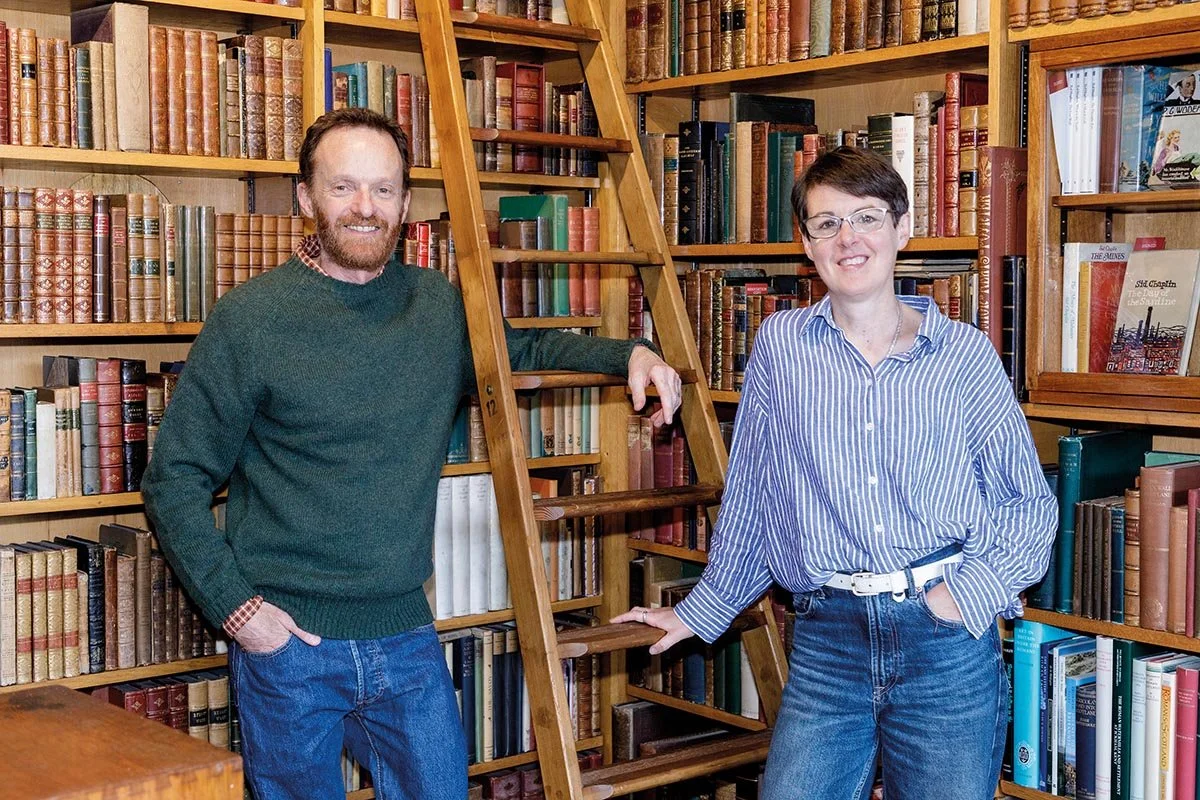
Anthony Smithson and Alice Laverty at Keel Row Books (Photos by Anna Bridson)
First published in edition 208 of The Northumbrian, Oct/Nov 2025
In a former pharmacy in Whitley Bay, Keel Row Books opens doors to centuries past. Here, Jane Pikett discovers, owners and antiquarian book experts Alice Laverty and Anthony Smithson deal not just in rare books but in fragments of human history
The book Anthony Smithson sets before me is not what I expect. I think I’m about to see the signed Harry Potter first edition I know he has catalogued meticulously, perhaps a pre-war Agatha Christie, or the handmade copy of Edmund Spenser’s epic poem The Faerie Queene dating to 1613 that he has previously mentioned. Instead, he lifts from his desk something altogether smaller, humbler, more fragile: a lady’s pocketbook.
“The Ladies Complete Pocketbook or Memorandum Repository, published by Thomas Saint,” he says, turning the tan sheep binding in his hands. “Published in 1777, it is extremely rare. There is only one other copy I have been able to locate. It’s in Newcastle City Library and was used by Thomas Bewick. The owner of this one has put her name in it – Elizabeth Ward, of Edmundbyers, May 5, 1778.”
On one page, Elizabeth has written a love poem partly in cipher. Decades later, a second hand takes over – probably her son’s, Anthony believes – filling the same pocketbook with farm accounts, journeys on turnpike roads, and stagecoach trips into Scotland. “Paper was expensive, so you would re-use it. Their entries give us an insight into rural life in the late 18th century,” Anthony says. “This is about salvaging a piece of history that might otherwise go unnoticed or forgotten.”
Keel Row Books in Whitley Bay is the kind of place people walk into and gasp. “People come in the door and say, ‘wow, it’s like something out of Harry Potter’,” says Anthony. “For a lot of people it’s the first time they have been in an antiquarian bookshop.”
The shop moved into its present home in August 2023: a double-fronted former pharmacy that has stood on Park View since the turn of the last century. For a while it was a branch of Boots, then it lay empty for five years before Anthony and his partner Alice Laverty stripped away the high street fittings to uncover the magic beneath.
I’m barely through the door before Anthony presses a postcard into my hand: a 1930s image of the father and son owners of Golightly’s Pharmacy in these premises, taken from a glass negative found in a cupboard under the stairs. A fascinating snapshot of family and social history, Alice explains: “Golightly adopted his son after he was orphaned in World War I. The son went on to qualify as a pharmacist, having to get up at 4.30am each day to cycle to Sunderland to train. We know because his daughter, now in her seventies, told us.”
The ghosts of the old pharmacy linger in the fabric of the building, but the light-filled spaces Alice has shaped – she was an interior designer before turning full-time to books – are dedicated to other kinds of alchemy. “The building had amazing cheekbones,” she says with a smile, showing me around more book-lined rooms upstairs, including the rare books library, where the couple’s reference collections line the walls. “This is essential to the rare book trade,” Anthony explains. “You cannot rely on the internet; you have to have all this reference material. If someone is buying a rare book from us, they need to know that it is accurately described and exactly what we say it is.”
It is here that Anthony prepares the extraordinary catalogue descriptions he sends me later – accounts so detailed they read like miniature biographies of the books themselves. He has been immersed in this world since he was a teenager. “I was supposed to do a degree in sociology at Sheffield University, but I thought I would probably come out with no job,” he recalls. Instead, aged 18 he badgered the then-owner of Keel Row Books, then in North Shields, into giving him a job. Two years later in 1991, he opened his own stall in Newcastle’s antiques market. He has been a self-employed bookseller ever since.
“This is basically treasure hunting,” he says. “The book trade has a 500-year history and Newcastle has a rich and deep print heritage and culture. 18th century Newcastle was awash with printers, wood engravers like Thomas Bewick, and bookbinders. It was a boom time throughout the 19th century. It has a long history of booksellers and printers and I have immersed myself in it for the last 30 years.”
For him, books are living links to people and events. He tells me about finding the diary of James Fort, a Royal Navy surgeon, which contained “a completely new account of the Charge of the Light Brigade which he observed from the heights overlooking the charge.” The diary also included the earliest known photograph of the winner of the earliest surviving Victoria Cross. Anthony read all 900 pages. “It’s like having a time machine. A first-hand account is the closest you are going to get to something.”
Much of what Keel Row handles is rare, but rarity alone is not enough to make a book sought-after. “It’s about supply and demand – if there is a big market for the book and there are very few copies available, it drives up the price,” Anthony explains. Sometimes the most fragile, ephemeral things – he shows me a Suffragette souvenir napkin printed on crepe paper sold for a penny on the streets of London as an example – are among the most astonishing survivals.
Condition matters above all. Anthony pulls modern first editions from the shelves, showing me how the edges of wood-pulp paper from the late 20th century are already browning, while a 400-year-old page made from cotton rags looks like it was printed yesterday. Then there are dust jackets. “They were only meant to keep the book in good condition between the bookseller and the buyer,” Anthony says. “If I were selling you a book in 1900 I would take the dust jacket off, crumple it into the bin and then sell you the book.” Copies of The Hound of the Baskervilles, he explains, were exquisitely bound with gilt titling, yet the few surviving copies in their plain paper jackets are the ones worth vast sums. “The last time I checked there were five known copies of that book in a dust jacket. I think Stephen Fry owns one,” he adds.
Provenance, too, can turn an ordinary book into a unique treasure. Keel Row Books recently handled a signed first edition of Harry Potter and the Goblet of Fire. “Authenticating JK Rowling’s signature is not an easy task,” Anthony says. “Hers is the most forged signature of any writer: ebay is awash with them.” But his knowledge is forensic. “I know that book was signed at Waterstones in Newcastle in 2000 and I know she used a black pen at that signing. So if it had been in blue and for instance on the front endpaper rather than the dedication page I would know it was wrong. She never signs on the front endpaper unless it is a big gift inscription to someone she knows.”
Keel Row is part of a national and international network. Anthony and Alice are members of the prestigious Antiquarian Booksellers’ Association (ABA), the senior trade body for booksellers in England and the oldest organisation of its kind in the world. Election to it, Anthony says, is dependent on “knowledge, integrity, and expertise.” Membership allows them to exhibit at fairs such as the prestigious Firsts: London’s Rare Book Fair at the Saatchi Gallery in London, where buyers fly in from around the world.
The couple are also educators. In 2014 they set up the York Antiquarian Book Seminar to teach people how to become rare booksellers. “Every year it was fully booked and there was a waiting list for the next year,” Alice says. The ABA now runs it and it draws students – from aspiring dealers to major institutional librarians – from around the world.
Back in Whitley Bay, local and regional heritage is important. Anthony’s friend, the historian Dan Jackson, “used this shop as his reference library when he wrote The Northumbrians.” And despite the catalogues and international fairs, the shop is far from elitist. “Yes, we have serious collectors,” Alice acknowledges, “but we are also very much invested in the community and we have a busy second-hand department where kids come in for £2 paperbacks.”
Upstairs, this second-hand room is light, airy, and crammed with such gems as orange Penguins and green crime classics. Cushioned window seats invite browsing. “People come in for this, then they find they want to buy modern first editions or good quality art or photography books,” Anthony says. “They buy antiquarian books as well, particularly local history.”
For many collectors, he explains, it starts with a cheap paperback, a chance find, and then slowly, incrementally, a collection grows. “Rare book collectors don’t jump out of bed one morning fully formed and buy a book for £1,000. They get there incrementally over years. They gradually learn about the books and the trade and what to look for. They slowly spend a little more and a little more and build a collection which can be a real treasure to behold and might be wholly unique to them.”
Alice puts it more simply: “The nice thing is that we have second hand and collectable books, so you can start with second hand and then learn to climb the ladder. It doesn’t have to be an expensive hobby. There’s a book for every interest.”
Even the building itself yields stories. In a back room, Anthony and Alice uncovered a Victorian kitchen range that had been boxed in. In another, Anthony shows me John Brand’s famed The History and Antiquities of the Town and County of the Town of Newcastle Upon Tyne, published in 1789. From its pages springs an illustration of the carved oak River God Tyne figurehead that once hung outside a Grey Street bookshop and now resides in Newcastle’s city library, thanks to Anthony’s persistence in getting it there. “Now, every time I walk up the stairs in the City Library I get to see it and that is very satisfying.”
He loves these connections, the way printed matter, wood carving, civic history, and chance survival braid together. “A lot of what we do is storytelling. It’s about the story you can weave around the book.”
As I prepare to leave, Anthony digs once more in his office and emerges with something truly staggering: the second book ever printed in Newcastle, in 1649. King Charles I, marching north to suppress the Scots, had brought his printer with him. The type, the paper, the press itself trundled through the city gates. It is a reminder, if any were needed, that books are not just vessels of stories, but stories in themselves. From Elizabeth Ward’s ciphered love poem in a sheep-bound pocketbook to a Suffragette napkin that somehow survived a march; from Agatha Christie in her dust jacket to JK Rowling’s signature in black ink – every item in Keel Row is a fragment of human history. Alice calls manuscript material “a portal into the past.” Anthony prefers “time machine.” In this beautiful, book-lined former pharmacy in Whitley Bay, they amount to the same thing.