Call of the wild
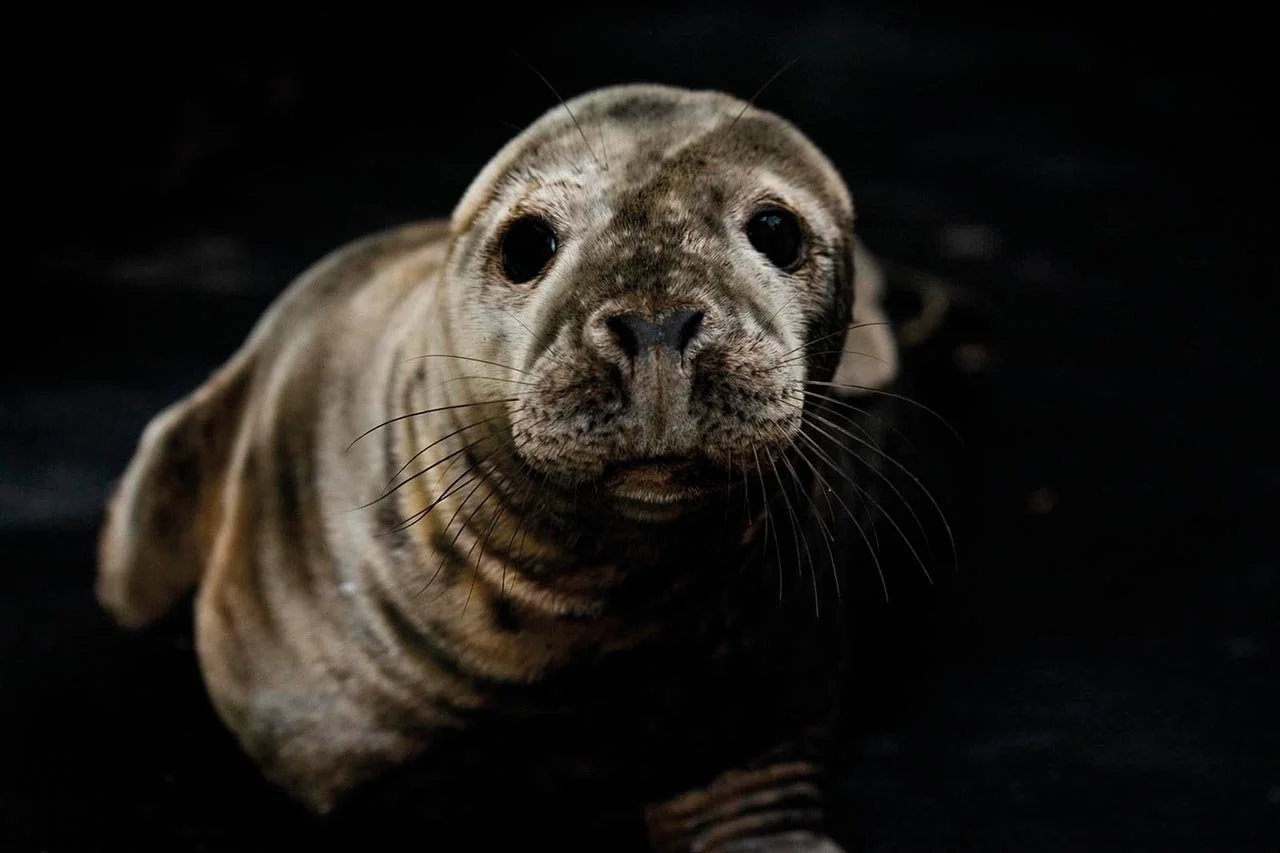
A seal pup recently cared for by Blyth Wildlife Rescue
First published in edition 204 of The Northumbrian, Feb/Mar 2025
A routine dog walk turns into an otter rescue expedition for Rosie McGlade, and leads to the discovery of the wildlife heroes looking after sick and injured animals
Under the brambles and shrubby young holly was an animal, I guessed, from the delighted way my two dogs were barking. I chased them back and went to look. And there in the back woods of Newcastle on an early January afternoon, as large as life, was an otter.
It didn’t seem injured but didn’t run away. Should I try and take it home? I put my jacket down thinking maybe to pick it up and it immediately thrust its teeth in. It was both terrified, and a bit scary if I’m honest. But incredible. An otter!
An otter in distress. “Do you know anything about wildlife?” I asked the one passer-by. I rang the RSPCA and got through to a voice message about how to report cruelty, which this wasn’t, presumably. Who do you call in these situations?
I set off towards the Gosforth Nature Reserve boundary 10 minutes away, where the passer-by had seen someone. That person suggested I ring the nature reserve office, where I was told to call Blyth Wildlife Rescue. The otter was still where we’d left it on our return, its beautiful little face peering out, its back all curved, and I marked where it was hiding with sticks.
Back home a while later I was arming myself with an old cat box and the sturdiest gardening gloves I could find when I received a call back. It would not be a good idea to try to catch the otter myself, John Anderson told me. It would probably tear my skin off. He and his Blyth Wildlife colleague Teri would be with me in half an hour.
By the time we all met in the woods, of course, the otter had disappeared. John, with a large net and catch pole, strode around huge tracts of ground almost silently. Teri played recordings of an otter mewing on her phone.
It was dusk when I left them, crossing the little stream to the ploughed field where a dog walker stopped me. “Are you looking for an otter?” she asked, to my amazement. “It’s on the other side of the field by the hedge.”
The otter was a female, it turned out, but she didn’t make it. This article was supposed to diary her recovery and eventual release and I felt heartbroken, but she had a lot of infection, and the vets did everything they could.
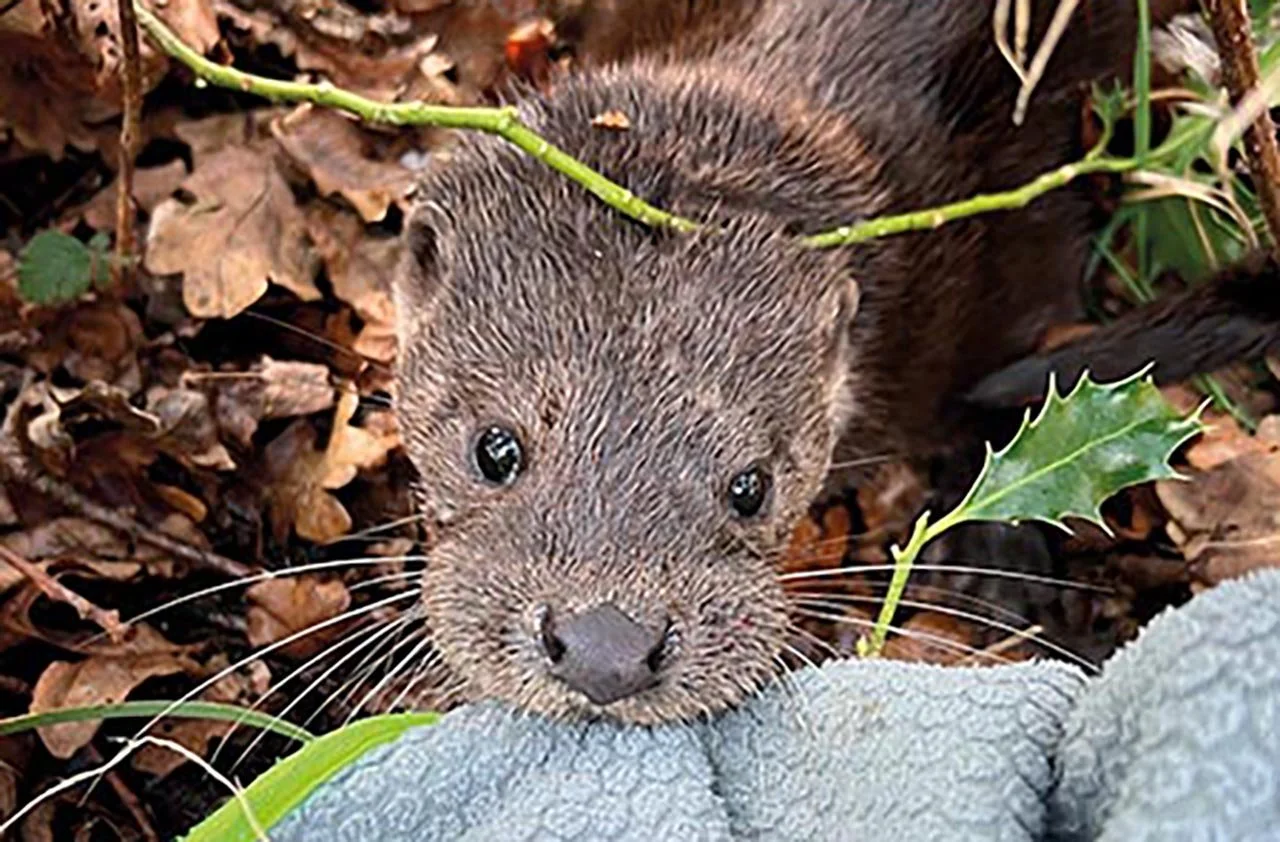
The otter found by our writer, Rosie McGlade
I told Jane, The Northumbrian’s editor, it had died. I told her about John, who had downed tools from his job as a joiner and come as fast as he could to the animal’s rescue; and about Teri, who’d dashed out from her work, as they and their team do numerous times a week all across the region, all of them, bar one part-time staffer, working as volunteers.
They rescued three otters last year that were released back to the wild, I’d discovered while we were searching the woods. One went to the Isle of Skye.
To be honest, I’d always assumed they just covered the Blyth area, that there were several organisations you could call and they’d come out and rescue an animal or a bird. That there was even government support if an animal was rare. But no. This is the only group in the whole of Northumberland which provides this service, and then rehabilitate the animal and release it back to the wild. Foxes, deer, seal pups, badgers. Hedgehogs and pigeons. “Interview them,” Jane said.
John Anderson founded the trust as a teenager with his mother, after rescuing and rehabilitating baby birds and injured animals in Blyth. He and his mum did this for a long time, winning awards, and then in 2006, seeking to expand the service, John founded Blyth Wildlife Rescue. Last year there were more than 12,000 calls and messages to the helpline, and the team rescued more than 2,000 rehabilitated animals numbering around 100 different species
Some are rescued by members of the public and collected by volunteers, some by the small team of trained medics who specialise in handling larger animals, like my otter. There is no public admittance to the charity’s premises so I am to meet Sara Dunn, the one part-time staffer, at a café (John Anderson, not unlike the wildlife he supports, being no great fan of attention).
So now for some stories with happier endings. Sara joined the trust nearly three years ago. She has three sons, aged 18, 13 and 12, and at the time, her youngest, Ben, who has autism, wasn’t able to attend full-time school. “I couldn’t get a job because of that unpredictability, and I saw a post on Facebook and got involved here. And it just snowballed. People who want to volunteer first start as collectors, picking up animals rescued by members of the public and bringing them to the centre.” Her first collection was a wood pigeon with an injured wing.
Ben has done incredibly well, and Sara has trained up as one of the centre’s five medics, meaning she is able to perform rescues of bigger animals and support with expert rehab. She is the one part-time member of staff. Her favourite animals, not of course that you should have favourites, are red foxes. “We’re not supposed to name animals or even speak to them because they’re here to rehabilitate back to the wild, but foxes often need quite long rehabs, sometimes over several months, and you get to know their characters and personalities.
“This one fox we nicknamed Drainpipe, and she is often the animal I think of first,” Sara says. “She’d come in with a section of drainpipe around her neck like a big, horrible collar, and her paw was also stuck inside where she’d been trying to pull it off. A member of the public had been feeding her every evening in her garden, and when she didn’t turn up, she called us. We put some food in a trap and within two hours we’d caught her.”
Drainpipe was riddled with infection and fly strike. The pipe left a huge open wound and all in all she was in a very poor state. But she rallied, and after two months was set free. “She went on to have cubs,” Sara says. “The lady who was feeding her got in touch. Because she was fed every day, she wasn’t vicious in any way. She was absolutely beautiful.”
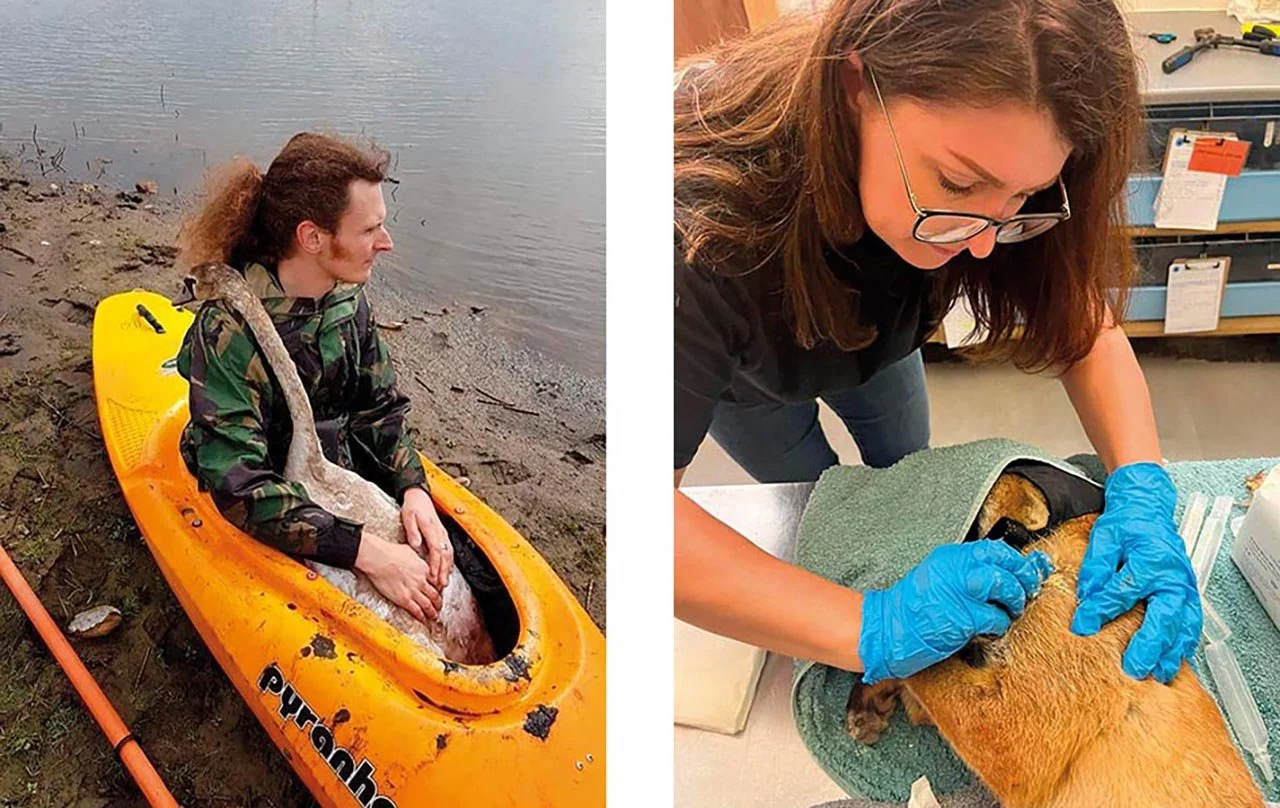
Left: John after rescuing a young swan.
Right: Part of Sara’s role as a medic is to attend specialist rescues and large animal rescues. This red fox was captured with drainpipe stuck around her head and armpit, restricting her movements, causing infection and great pain. After surgery, rehabilitation and the correct care, around two months later she was released back to the location she was found
There was the gang of Tyne Bridge kittiwakes, about 15 of them, which had fallen one by one from their nests on the bridge’s towers and were picked up by members of the public, fluffy and helpless. “It’s too high to even think about putting them back and so they come here. When they’re big enough we take them to our aviary where they’re left to learn to swim and preen themselves, and then to the sea for release.”
There was the swan in the Asda delivery bay they had to corner and grab by the neck because it was trapped without a long enough runway to take off and fly. Sara has had numerous bruises from swan wings – you have to be careful. The cygnet John rescued in his kayak, and the many swans caught in fishing lines or with hooks down their necks. The kestrel that flew into a car radiator as it was setting off recently, and got trapped. The fox cubs trapped under a collapsed school shed that John went and dug out. Baby owls blown out of trees. Hedgehogs caught up in the plastic rings that beer cans come in. “Litter is a huge problem,” Sara says.
Sara and team are currently feeding three baby grey seals who came in very underweight – white, fluffy and tiny having been washed up and abandoned on North East beaches. They are fussy (only herring on the menu), and hungry. Last year the trust spent more than £6,000 on herring for the 18 pups it took in, eight of whom are now, fingers crossed, fishing happily away in the North Sea all by themselves. Tagged, one was recently spotted off St Mary’s Lighthouse by a wildlife photographer.
“They’re very smelly, and quite vicious,” Sara says. “We have to ‘jump’ seals in care and straddle them in order to safely restrain them for feeding and medical treatments.” As they mature, they get whole fish, which they have to learn to grab, nose-in-air, so they can thrust them down their throats. All the same, it’s a heard-hearted person who wouldn’t find them adorable. Once big enough, off they go to the Tynemouth Seal Hospital to gain valuable swimming experience before release.
Due to a continual downfall in donations and ever-rising running costs, the charity made the decision to only take in larger animals so as not to be overstretched over winter, but that will change soon. “Spring will be a very busy time with juveniles flying the nest and we want to be able to be there for as many birds and animals as possible,” Sara says. “We’re expanding. And as a charity we don’t discriminate.” It may be on the red list, it may be a pigeon. “If it’s in the interests of the animal, we will help it. Up and down the country there’s a real shortage of this kind of service and vets often have to put down animals or birds that could otherwise be saved. Sometimes, young birds have infections their parents can’t help with, but we can treat them.”
Their costs are pretty high – and they get no dispensation from vets. The otter in our story was X-rayed, anaesthetised, and bloods taken, in addition to the running costs of the centre and the three charity ambulances.
Along with vet bills, their biggest outgoings are rent and heating. “It’s very much a second chance that we provide. We can’t guarantee everything that comes through our door will survive, it’s just that it definitely won’t if it doesn’t. It’s a terrible shame to put something like a baby seal to sleep which might otherwise survive.
“Some people say let nature take its course. But if you can help an animal, and it just needs food and warmth and care, why not do that for that animal. I love it. It’s the best job in the world.”
Blyth Wildlife Rescue is contactable 24 hours a day at 0330 229 1710 or via Facebook Messenger.
You can donate at www.facebook.com/BlythWildlifeRescue. The organisation benefits most from monthly giving, even if it’s just £2 or £3 a month.
To donate via text, text BLYTHWILDLIFE to 70085 to donate £5.
Contact the group to volunteer as a wildlife casualty collector.
A website will be up and running soon at: www.b-w-r.org.uk