
Northumbrian Greats: Alexander Knox
First published in edition 209 of The Northumbrian, Dec 2025/Jan 2026
Stephen Roberts documents the life of Alexander Knox, Oscar-winning actor, writer, and quiet radical who made Berwick his home after McCarthyism upended his Hollywood career
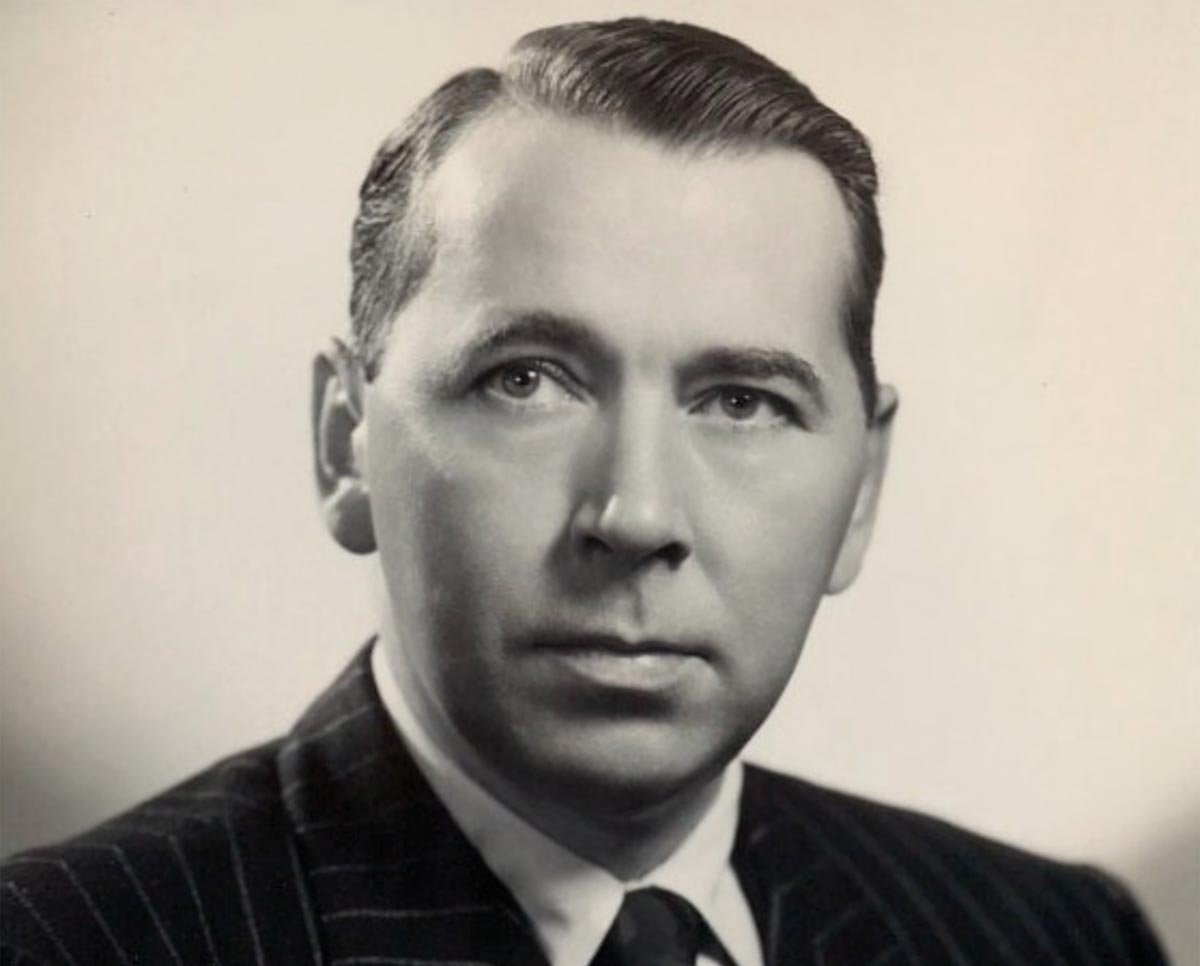
The Canadian-born actor and writer Alexander Knox spent the latter half of his life in Berwick, a quiet refuge after McCarthy-era persecution derailed a glittering Hollywood and Broadway career. Celebrated for his performances of quiet depth, Oscar-nominated Knox became a Northumbrian by choice, building a life far from the glare that once sought to silence him while continuing to act and write into his 80s.
A softly spoken man known for his gentle manners, early in his stage career Knox was noted for “leaping to life” as “mournful of face with a voice dripping melancholy,” (obituary, The Independent, May 1995), suggesting an acting range typified by the portrayal of quiet emotion.
He was born in 1907 in Ontario, Canada, to Scottish parents, his father a Presbyterian minister. He studied English literature at the University of Western Ontario, during his time there playing the lead in an amateur production of Hamlet. He then moved to Boston, Massachusetts, to appear on stage with the Boston Repertory Theatre while moonlighting as a journalist with The Boston Post. In the same year that he made his professional theatrical debut there (1929), however, the theatre company went bust, and Knox headed back to Canada, to London, Ontario, to take up journalistic duties with The London Advertiser.
That paper went bust in 1937, but Knox swerved that, moving to London, England in the early 1930s. There, he made his name in film and on stage, notably at the Old Vic, where he began a long theatrical association with the acclaimed producer/director Sir William Tyrone Guthrie (1900-71). After war broke out, Knox returned for a time to the US, starring on Broadway in 1940 in AJ Cronin’s play about two doctors who fall in love, Jupiter Laughs, opposite Jessica Tandy (who went on to win a Tony in 1948 for her portrayal of Blanche Dubois in the original Broadway production of A Streetcar Named Desire, and in 1990 became the oldest actress to win an Oscar for Best Actress for her role in Driving Miss Daisy). Also on Broadway in 1940, Knox was Friar Laurence in Romeo and Juliet with the theatre and Hollywood greats Laurence Olivier and Vivien Leigh, then in 1942 he took a leading role in a star-studded revival of Chekov’s The Three Sisters.
His first American film role was in The Sea-Wolf (1941) with Edward G Robinson; followed by a role in None Shall Escape (1944, also featuring Northumbrian-born Henry Travers, later Clarence, James Stewart’s guardian angel in It’s A Wonderful Life and profiled in this magazine, issue 195, Aug/Sept 2023). There was then Over 21 (1945) with Irene Dunn and Charles Coburn; Sister Kenny (1946) with Rosalind Russell; and The Judge Steps Out (1948) with Ann Sothern.
These were stellar years for Knox, including in 1944 marriage to the actress Doris Nolan, and a starring role as President Woodrow Wilson in Daryl F Zanuck’s Wilson, for which Knox was nominated for an Oscar. He was beaten to the Academy Award by Bing Crosby for Going My Way, but he did win a Golden Globe. Later, in 1949, he appeared with Doris in a Broadway production of his own play, The Closing Door.
So, all was very well, but then, like so many others, Knox’s career in the States was blighted by McCarthyism. Named after US Senator Joseph McCarthy, this early Cold War period of paranoia about so-called Reds Under the Bed saw scores of people working in the creative arts outed as Communist sympathisers, whether they were or not.
Knox’s liberal views brought him to the attention of McCarthy’s zealots, as did his advocacy for the Committee for the First Amendment, formed in 1947 to support the so-called Hollywood Ten – a group of screenwriters, directors, and producers imprisoned for contempt of Congress in 1947 for refusing to answer questions from the House Un-American Activities Committee (HUAC) about their political affiliations. The HUAC hearings marked a systematic blacklist that would impact hundreds of people in Hollywood, while others like Knox were ‘greylisted’ and their careers suffered.
Knox and Doris, wounded, fled to the UK in 1952 and settled in Berwick, with a home in London. His career was not over, however, and he want on to play major roles in Man in the Saddle (1951) with Randolph Scott; Paula (1952) with Loretta Young; Roberto Rosselini’s Europe 51 (1952, also known as The Greatest Love), with Rosselini’s wife Ingrid Bergman; The Sleeping Tiger (1954) with Dirk Bogarde; and The Vikings (1958) with Kirk Douglas, Tony Curtis, Ernest Borgnine and Janet Leigh. He also managed to fit in an appearance in the TV series The Saint (1962) with Roger Moore, and roles in the wartime epic The Longest Day (1962); the sci-fi horror The Damned (1962); the spy comedy Modesty Blaise (1966); Accident (1967), written by Harold Pinter, starring Dirk Bogarde and Stanley Baker, and, like Modesty Blaise and The Sleeping Tiger, directed by another refugee of McCarthyism in the UK, Joseph Losey. There was also a brief appearance in the Bond movie You Only Live Twice (1967); and Nicholas and Alexandra (1971).
In 1979, Knox appeared in the acclaimed BBC TV adaptation of John Le Carré’s Tinker Tailor Soldier Spy in the role of Control, head of British overseas intelligence. In 1981 he received an honorary doctorate from his old university, and his final film role was in 1985 in Joshua Then and Now with James Woods and Alan Arkin.
As well as being an accomplished actor, he was a published author. He penned adventure stories set in the Great Lakes during the 19th century, and wrote plays, essays, screenplays, and detective novels. His novels include Bride of Quietness (1933), Night of the White Bear (1971), The Enemy I Kill (1972) republished as Totem Dream (1973), Raider’s Moon (1976), and The Kidnapped Surgeon (1977). There were other plays and detective novels written prior to 1945 under a pseudonym which he never divulged.
Sadly, Knox and Doris were shattered in 1987 by the loss of their only child, Andrew, born in 1947, who’d followed his parents into acting, appearing in the TV series Doctor on the Go (1975-77). He’d been married briefly in 1979 to the actress Imogen Hassall, but they separated after only a few months and she took her own life the following year. Andrew disappeared seven years later from a ferry during a crossing from Jersey to England.
Seven years later, Knox died in Berwick, aged 88. He had appeared in more than 100 films, television and theatre productions. His wife of more than 40 years, Doris, passed away three years later. He was a softly spoken socialist, of intellectual appearance and aptly tended to play men of integrity; such was he.