
The architect and the making of a modern city
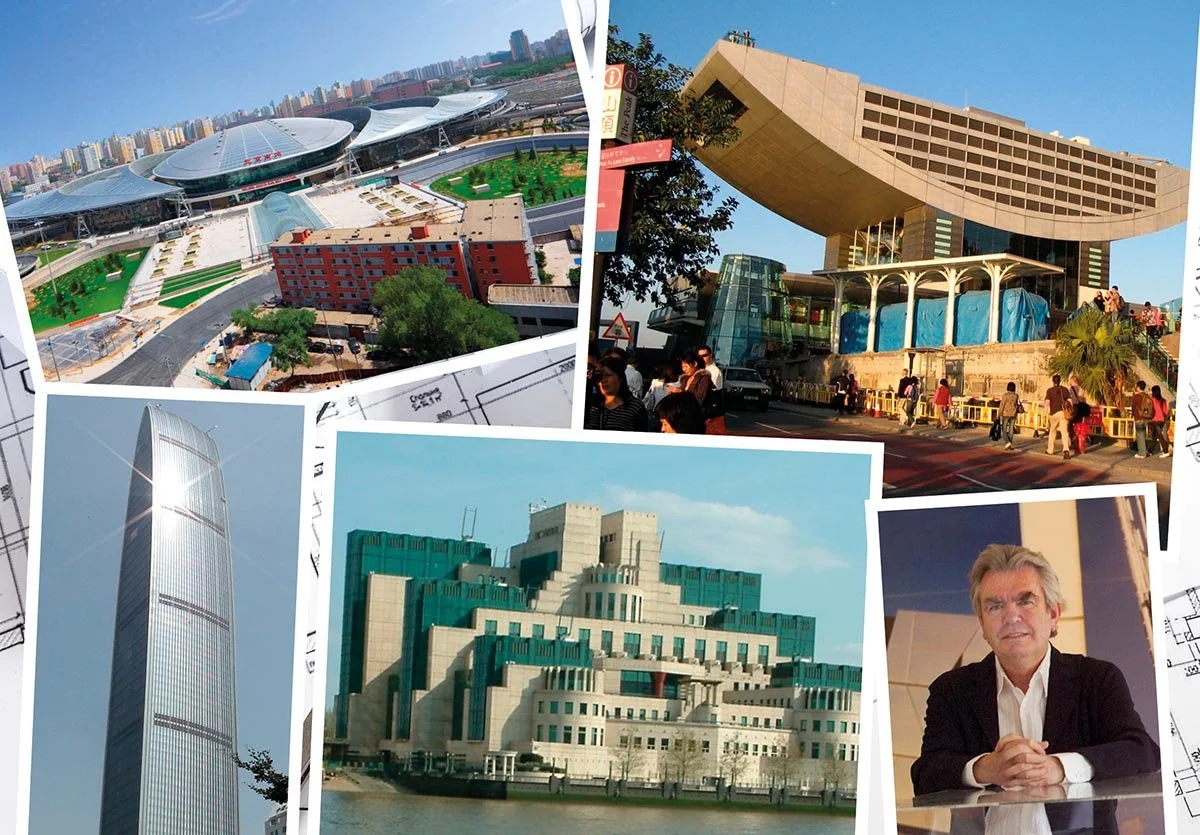
Clockwise from top left: Beijing South railway station (photo: Max Farrell); The Peak Tower, Hong Kong (photo: Minghong); Sir Terry Farrell (photo: Alan Williams); MI6, Vauxhall, London (photo: Tagishsimon); KK100, Shenzhen (photo: JHH755)
First published in edition 209 of The Northumbrian, Dec 2025/Jan 2026
Following the death of one of the most influential architects of his generation, John Grundy reflects on Sir Terry Farrell’s enduring impact on Newcastle – the city that shaped him
Sir Terry Farrell died on September 25, aged 87, one of the world’s best, and best-known, architects. If you dip your toe into Google you’ll find a whole heap of articles written within days of his death which will stun you with the scale and scope of his national and global reach.
There are vast transport hubs and extraordinary hotels in China, Hong Kong, and Malaysia. London is rich in his work, including the iconic MI6 HQ by the Thames. And among the tributes to his legacy in splendid places there is an article on the BBC News website about his impact closer to home. Written by Pamela Tickell, its title is Terry Farrell, architect, and his ‘profound effect’ on Newcastle. I liked it, and I bet you would, too.
Terry was born in Sale, Cheshire, in 1933. You can’t blame him for that, and when he was very little his family moved to Newcastle, where he was brought up, possibly in a council house on the Grange Estate near where I live in Gosforth. He went to St Cuthbert’s Grammar School and then studied architecture at Newcastle University, by which time the family seems to have moved to Ryton, near Gateshead.
He went to Newcastle Uni, and in a sense never really left it. And though his architectural practice was in London and his commissions worldwide, nor did he really leave the city, though he didn’t do many actual buildings here. No, the ‘profound effect’ Pamela Tickell wrote about was mainly to do with town planning.
Over the centuries, Newcastle has seen several great waves of town planning. The greatest of them, its magnificent heart created in the 1830s, was devoted to splendour. The city was rich from coal, and its leaders wanted to establish it as a regional capital. The great classical palaces that still line its then-new streets continue to express that ambition to perfection.
A century later, in the 1960s and 70s, planners swapped that drive for splendour with one for commercial success. To achieve it, they tore down a fair amount of the city, because that was believed to be the thing to do: to be successful you had to be modern. Old buildings were replaced almost willy-nilly with uncompromising, concrete modernism.
Terry Farrell was then among the most influential of a new generation of architects and planners. He didn’t want to knock things down and he didn’t want things stripped down to severe modernism. He was moved, he said, “by the beauty and excitement of cities.” His work, he said, was marked by “a desire to confront and celebrate all that is full of wonder.”
With that in mind, he worked in the city for the next 25 years and developed an idea he called the Geordie Ramblas, referring to the street of that name that wanders through Barcelona, allowing pedestrians to drift through the city and experience its beauty and variety. His Newcastle version began at the Civic Centre and pottered down as far as the Quayside.
You would be generous to claim Terry’s Newcastle version of the Ramblas has been completely achieved, but you’d be churlish not to recognise that we are closer than we used to be. Back in the day, for example, the only safe way to cross lower Northumberland Street at rush hour was via a high, unsightly metal footbridge. We took it for granted that the town’s principal shopping street was a traffic-choked nightmare. You might even recall me documenting, after the traffic was removed, an elderly gentleman who expected to drive straight up Northumberland Street on his way to Alnwick, stopping his car and demanding of me, a passer-by: “How the bloody hell does one get out of this town?”
This part of the Ramblas idea is still developing in a quite encouraging way. Northumberland Street is being given a level of enhanced potterability that we wouldn’t have dreamt of in the past; the Monument is beautifully pedestrianised; and Grey Street is more driftable, with pavement cafés and whatnot. This brings us to the Quayside, which is where the Farrell/Newcastle planning story began. He was striving for places that were desirable to be in, and the first bit of the town for which he created a vision was the East Quayside.
In 1990, this bit of the riverside was hideous; an abandoned dump from which the shipping world had fled. A while ago, I led a walk for a group of retired doctors who had trained in Newcastle in the 1980s. We met by the Millennium Bridge and I asked them about their memories of the area from university days. Not one of them could remember visiting it; it was a no-go area. Well, it’s changed. I went there this morning – a brilliant if cold October morning – and it was beautiful and buzzing with activity.
Terry’s plan was all about variety in a way that nobody expected in modern developments then. He mingled office and residential buildings: there were hotels, restaurants and bars, street art, children’s playthings, seats, keep-fit stuff. An avenue of trees sweeps in front of the buildings. It’s smashing and varied, and it’s difficult to remember how radical such a vision was as recently as the 1990s. There is even an older building now in use as a hotel among all the new ones, and that wouldn’t have got past the planners of the past, who would have whipped it away.
It started life in 1899 as a reinforced concrete warehouse belonging to the Co-op. In 1993, as the Quayside was being redeveloped, I was training to be a listed building person. I recall my colleague Grace showing a slide of this grey, unpromising industrial relic to a gathering of trainees from all over the country. She put it forward as worthy of being listed and incorporated into the Quayside scheme, only to be met by pursed lips and disbelief. Concrete warehouses weren’t things to be preserved and admired! But look at it now. It became the Malmaison hotel and it looks splendid; a beautiful centrepiece of the design.
That was Terry’s first foray into the urban landscape of Newcastle. After enjoying it earlier today, I caught the Q3 bus back up to the Haymarket to explore the other end of his Ramblas vision. You could easily be fooled here into thinking not much has changed, but you’d be wrong (‘wrang’ if you speak Geordie) because in recent years subtle but major changes have taken place, inspired by Terry’s creative imagination.
From 2000 onwards his practice was engaged in improvements around Barass Bridge and the Civic Centre. First with a new plan for the university, which led to the re-development of the Hancock Museum (now the Great North Museum: Hancock); and then a piece of public-realm planning at the Civic Centre. This has made a huge difference to this important part of town
The work at the university is ongoing, and you get a glimpse of the scope and approach at the south end opposite the Civic Centre. By the main road is the new, glossy and glassy Gateway Building, which is effectively a new front door for the university. It’s built on what was a hideous car park in front of the Playhouse (now Northern Stage). Now, you approach the theatre pleasurably, surrounded by students pottering up King’s Walk, which leads into the heart of the university and the beautiful spaces around the theatre’s entrance.
On the right of the Gateway Building, at the foot of Claremont Road, is Great North Museum: Hancock. Opened as The Hancock Museum in 1878, it is a splendid classical building. Elsewhere, the university had the Museum of Antiquities and its terrifically important collection of Roman history, and a smaller collection of Ancient Greek art at the Shefton Museum. In 2005, permission was sought to bring them together under one roof at the Hancock.
Terry Farrell wrote about this as “everything bundled together in an overlapping way,” and it is – you can leap from subject to subject with the greatest of ease and back again. Terry himself extended the building at the rear to provide space for exhibitions and events, and the overall effect is terrific. It has been massively popular from the moment it opened in 2009. My granddaughters would have cheerfully lived there if it were possible.
If I sound excessively enthusiastic, it is because you can sit in the Greek section and ‘enjoy’ listening to me reading Greek myths; or you can admire the replica skeleton of a Tyrannosaurus rex, the most exciting purchase order ever processed by my daughter Caroline, who worked on the project for several years.
So, we in the Grundy family love this place, and the view from its front door across its lawn to the Civic Centre and the green area around it. This is the public-realm space by Terry Farrell’s practice mentioned earlier. It looks simple – a sward of grass dotted with trees, a single path crossing it, lots of seating. When I was there earlier today almost every seat was taken. People of all ages and ethnic backgrounds were chatting, strolling, reading, and eating al fresco lunches. A little earlier in the year, it would be covered by families with children playing, there would be students from both of the city’s universities, and workers from the Civic Centre and local offices.
The buildings that surround it are few but splendid. There are St Thomas’s Church and the magnificent Civic Centre, the University Gateway and the Great North Museum: Hancock, and between those last two is the only building to publicly announce that Terry Farrell had a role in all of this. His name is attached to its façade on the corner of Claremont Road and Barass Bridge. It is a charming, rather fanciful late Victorian building with a tearoom on the ground floor. Above and behind is the Farrell Centre, which explores the planning and nature of cities. It was awash with children when I was there – a fitting memorial to an architect who left his enthusiastic mark on the city where he grew up.