
Pilgrimage
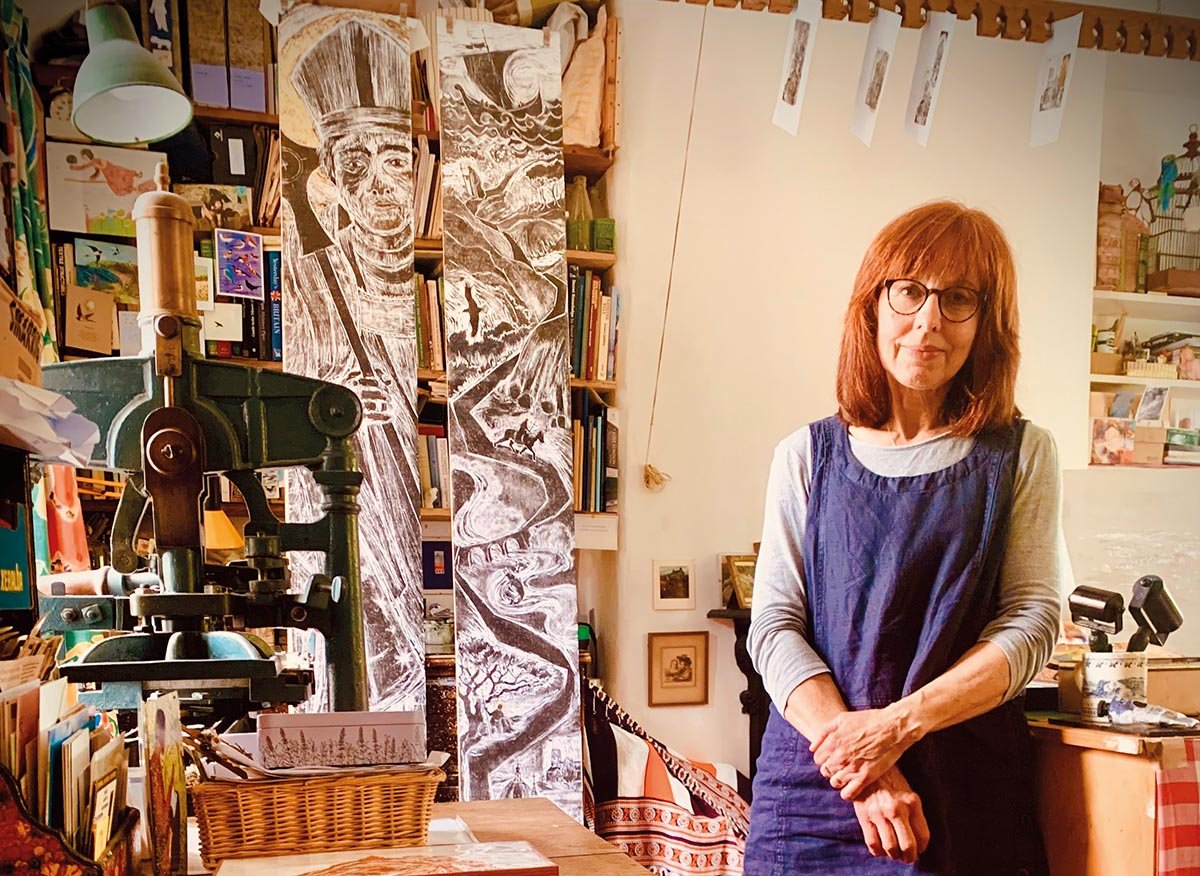
Jo Westgate in her studio with the Wilfrid banners behind her
First published in edition 206 of The Northumbrian, June/July 2025
As printmaker Jo Westgate brings St Wilfrid’s spiritual journey to life in a striking new visual commission for Corbridge Chamber Music Festival, Jane Pikett discovers her richly layered work blends history, landscape and family to capture the whispered imprint of the past on the present
When printmaker Jo Westgate was invited to create a visual exhibition for the Corbridge Chamber Music Festival – an event hitherto dedicated solely to sound – she was handed a blank canvas and a formidable muse in St Wilfrid. It is a challenge she has embraced wholeheartedly, responding with a profound body of work that intertwines image, place, and pilgrimage in a rare synthesis of art and spirituality.
St Wilfrid, the 7th-century founder of St Andrew’s Church in Corbridge, was no quiet recluse. A spiritual trailblazer and indefatigable traveller, his influence extended through Ripon Cathedral, Hexham Abbey, and well beyond Britain’s borders. Fittingly, Jo’s central piece includes two monumental banners, each 3 metres tall, depicting Wilfrid’s geographical and spiritual odyssey.
They hang for now in Jo’s studio upstairs at her cottage near Corbridge. The space is a creative sanctuary: a sun-dappled retreat filled with the scent of paint, wood and ink, and alive with the clutter of artistic life. Sketchbooks spill across bookshelves, tools and brushes lie beside sketches, and historic presses wait silently for the next inking.
Bits and bobs – dried flowers, cards, photos, sea sponges – gather, half memory, half muse as she works on the commission, which she describes as “a chance to draw together several threads including history, landscape, journeying, and personal reflection.”
Her resulting exhibition is far more than a visual add-on – it is a symbolic meditation on pilgrimage, rooted in both sacred geography and family. At its heart is a wooden cross composed of woodcut portraits. Wilfrid occupies the centre, surrounded by four gazes – north, south, east, west – formed from woodcut portraits of Jo, her husband Austin, and their daughters, Nina and Marcie.
Each direction on the compass connects with a location that has spiritual and personal resonance. North points to the Isle of Harris, home of composer Piers Hellawell, whose new piece for the festival shares the same inspiration. South gazes over the terraced Roman land around Corbridge. East reaches towards the sacred stillness of Holy Island. West stretches to the Long Stone and the Lake District, with Hadrian’s Wall marking the landscape like a scar of ancient movement. Together, they map out a life, and a legend.
“Wilfrid walked to Rome three times. If he didn’t get the answer he wanted in disputes, he just went to the Pope,” Jo says, admiringly. “That sense of determined journeying really struck me,” and it was this which became a lens for her own explorations physical and spiritual.
Each direction in the compass is captured through drypoint printmaking, a process that speaks directly to Jo’s patience and precision. Using sharp steel points, she scribes line by careful line into an aluminium plate, creating burrs like the ridges thrown up by a plough. After inking and delicately wiping the plate, a sheet of dampened paper is laid on top and pressed through a heavy, mangle-like press.
“It’s a particularly rewarding way to work,” she says. “You wipe and polish carefully so that every tone emerges. And yes, you have to draw everything backwards. Slightly bonkers, really.”
Unlike etching or engraving, drypoint’s beauty lies in its almost ghostly softness, like a whisper of a landscape. The burrs created during the scribing hold the ink and give a velvety richness to each line. But those burrs are delicate, so a plate can only be used a dozen or so times before the detail is lost.
Her banners, meanwhile, are a feat of artistry and engineering. Printed from woodcuts onto delicate Japanese paper and mounted on muslin, they will flank the crossing at St Andrew’s Church, framing the performers as they play. “This is by far the largest piece I’ve ever done,” Jo says. “It had to be printed in sections and invisibly joined. There’s a whole engineering subplot involving pulleys, Velcro, and muslin stiffeners. I’m hoping it doesn’t collapse
mid-performance!”
She explains that in woodcutting, different woods are used to create distinct textures. Fine end-grain blocks from box or cherry trees offer clean, detailed lines. Coarser plywood brings rugged texture and resistance, allowing the grain to emerge as part of the final print. Each drawing is made directly onto the wood and carved out with gouges and knives, leaving the design in relief. Ink is rolled across the surface and transferred to paper either by rubbing or pressing.
Amidst the monumental, there is also the miniature. Jo has painted exquisite watercolours of objects found at the site of each drypoint view: thistles, feathers, pieces of sea glass – small relics symbolising each compass direction. These delicate pieces ground the larger themes in the tactile and the real, making them feel as intimate as they are expansive.
While her humour is ever-present, the reverence behind her work is unmistakable. Materials matter. Birch ply for its clean, crisp cuts. Muslin for its blend of strength and transparency. A 1950s etching press and a magnificent Albion letterpress from 1836 for memory.
This huge cast iron press was a precious gift from a former tutor at Chelsea Art School, Richard Beer. “He had cancer and no longer had the physical strength to operate it,” Jo says. “He left it to me, but said he’d like to see me using it before he died.” Hence, he gave it to her some years before he passed on, and it remains a cornerstone of her studio and a daily reminder of their shared devotion to the craft.
Jo’s path as an artist was shaped early. Encouraged by her artist mother, she later studied under Mike Reeve and Margot Waters at Queen Elizabeth High School in Hexham – “lovely people who still keep an eye on me now.” Then came Don McKinley during her art foundation in Manchester. “He’d come in every morning and say, ‘Right, what did you do last night?’ And the answer wasn’t allowed to be ‘I watched telly’. It had to be art.”
At Sheffield, she honed her skills in printmaking. “You could take a 15p bus ride to the Peak District and come back to use the presses,” she recalls. Her tutor, Stan Jones, once advised: “If a beam of light hits one field, wipe that bit clean in the print. It gives a wonderful focal point.” That notion of contrast – of light selected deliberately – has never left her.
Then came her postgraduate studies at Chelsea, and Richard Beer. “On day one he tap-danced into the studio with a bottle of wine and asked who wanted a drink – at 11am. We were all terribly anxious, but he made us relaxed. At that point, your mind is open.” Their relationship grew into a deep creative friendship. “He was one of the great influences of my life.”
Her daily practice begins with drawing. “I’ve got sketchbooks that date back over 20 years,” she says. “There are some gaps – illness, travel, bereavements – but mostly I draw something every day, even if it’s quite mundane.” One entry was prompted by the discovery of a toy panda inside the biscuit tin, “so I drew that.”
Photography, while useful, will never replace drawing. “I want to make that translation through my eyes and hands, not through a camera lens,” she says. Often, her best drawing happens while her mind drifts elsewhere – an embodied rhythm that feels both meditative and productive.
She works slowly and intensively. For a single exhibition, she might spend two to three years creating 20 to 30 finished pieces. “It takes a long time, because you can’t always guarantee that everything you do is something you want to put on the wall.” And she’s ruthless with editing. “Some pieces I’m glad to see the back of. It’s important to allow work to develop – and not all of it needs to be kept.”
While the Corbridge exhibition runs, Jo will also show pieces from her wider back catalogue at Hexham Abbey. The connection between the two sacred spaces, founded by Wilfrid in 674 and 675, is meaningful to her. “The path between the churches is well worn. And the Abbey is very important to me.”
Faith, for her, is present – if quiet. “It’s one of the implied things, rather than overtly present,” she says. Her artwork rarely features human figures, yet human presence is never absent. “You might think it’s a wild place, but it’s still got an imprint from the people who’ve lived there – textures in fields, the way trees are planted.”
That quiet trace – the evidence of unseen lives – mirrors her sense of the spiritual. “In the same way, I think, probably, if I were to try and explain faith verbally, it’d be like that – a spiritual reaction to a place.”
Though she cherishes her studio, Jo says her deepest creative source lies just beyond it. “Being in a beautiful place is a great luxury and privilege,” she says. She walks daily through varied terrain – from intimate riverbanks to wild moorland – and lets the land speak. “I find it endlessly inspiring to draw.” And with that, it’s back to work. Deadlines, like pilgrimage paths, wait for no one – not even artists with ink-stained hands and the patience of saints. St Wilfrid, her muse, would surely approve.