Stitches in time
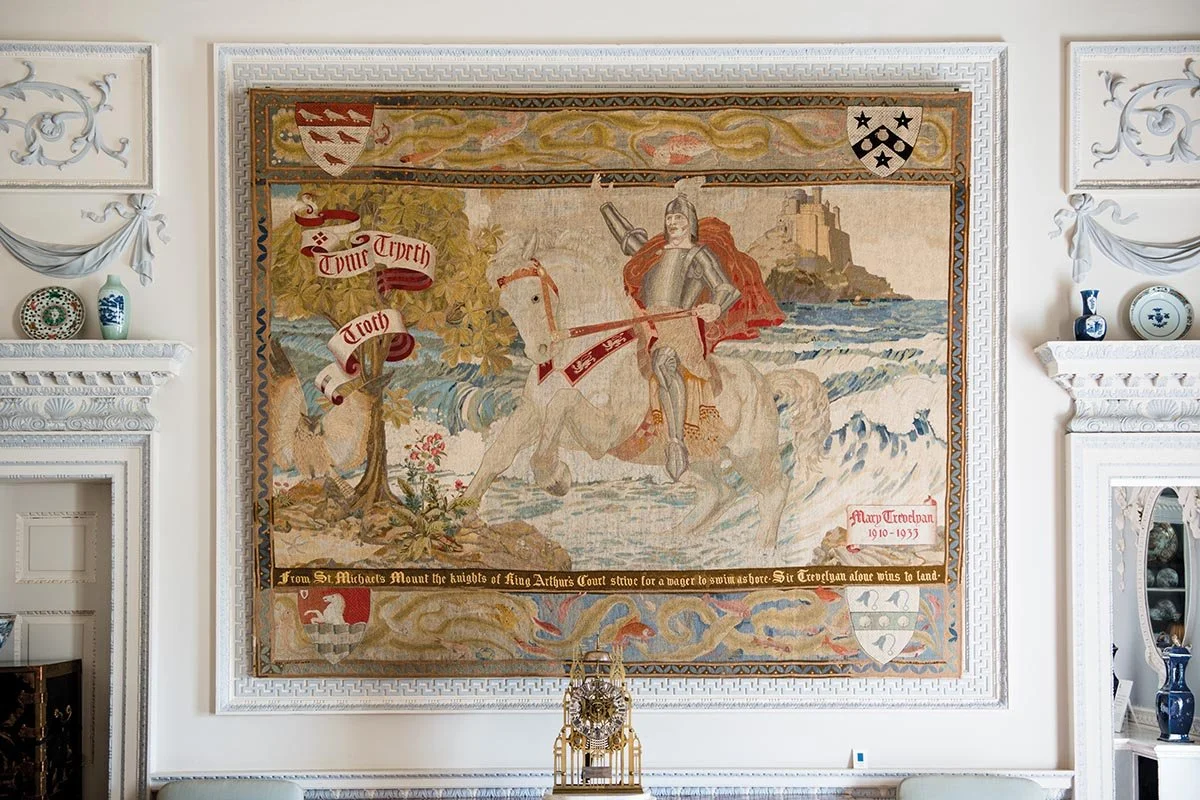
The embroidery (Photo by Nick Thornton)
First published in edition 206 of The Northumbrian, June/July 2025
Inspired by a National Trust tribute to women artists, Janet Hardie reflects on her grandmother Mary, Lady Trevelyan’s monumental embroidery of the Trevelyan legend, which hangs at Wallington
A recent edition of the National Trust magazine featured an article celebrating the unique contributions of female painters, embroiderers, costume designers, ceramicists and illustrators. I immediately thought of my beloved grandmother, Mary, Lady Trevelyan (known as Molly) who created a fascinating needlework which hangs in the drawing room at Wallington, now a National Trust property. It portrays the Trevelyan legend, and to me as a young girl frequently staying there with my mother and grandparents, it seemed so romantic and vibrant; while the knowledge that my grandmother had taken 23 years to make it was awe-inspiring.
I have a book written by Molly entitled The Number of My Days based on the diaries she kept from the time of her marriage to Charles Trevelyan in 1904. It features several entries about the needlework, which offer some background. She writes that on their honeymoon she and Charles had spent their time in Cornwall, “walking a hundred miles.” I can imagine them talking about the Trevelyan family’s legendary connection with King Arthur and a wager between the knights of Arthur’s Court, in which Trevelyan was the only survivor among those who swam on horseback from St Michael’s Mount to the mainland.
Molly had always been interested in crafts and was constantly knitting socks and gloves, embroidering collars, working on seat covers using Florentine stitches, and even doing upholstery repairs. She much admired the needlework screens and panels at Wallington made 200 years earlier by Julia Calverley, a Blackett heiress whose daughter married into the Trevelyan family.
Molly writes that she pondered for some time about depicting the Trevelyan legend in a grand embroidery. She knew that Charles would inherit Wallington on the death of his parents and she must have hoped that in due course it would occupy a fitting space in the magnificent drawing room. In 1910, at an exhibition of students’ work at the College of Art in London, she was introduced to a shy, prize-winning student, John Edgar Platt, 19 (who later became principal of the Edinburgh School of Art). Molly spoke to the young artist about her idea, “and before I knew where I was, I found myself committed to the scheme, and though I had moments of regretting my temerity it was too late to withdraw . . . ” (The Number of My Days, p88). Platt drew up a design which presented a very specific location – Mount’s Bay in Cornwall – against the background of St Michael’s Mount crowned by a medieval fortress.
But how was it to be made, with what, and where? To answer these questions I visited a nearby cousin, Frances Dower, who now lives at Cambo House, where Molly began on the needlework in 1910. Frances herself is a gifted embroiderer, and I knew she was particularly interested in Molly’s work. I was greeted with much enthusiasm and knowledge, and was shown beautiful embroideries by Frances and her mother-in-law, Molly’s daughter Pauline Dower, on the walls of the same south-facing parlour where Molly began her work
Apparently, she would usually stitch for an hour in the early morning when the sun would light her work. One of her daughters, Kitty, recalled in her 1962 autobiography that her mother would allow her to “pull the needle through as she stabbed it from above” (Fool in Love, Katharine Trevelyan, 1962). Frances told me that crewel work demands a tough cotton material which does not have the ready-made holes you find in canvas. A crewel needle has a long eye for the wool and sharp point to pierce the material so the stitches can be of various lengths and be placed wherever the embroiderer wishes. This gives the work a liveliness, the stitches picking up, for example, the flow of the horse’s mane and tail, the feathers of the owl, and bubbles of sea foam.
Molly started the work on July 6, 1910, at the top left corner so that her initial, rather amateur stitching could not be observed too closely, and in time her workmanship improved. The design was divided into three large parts – a chestnut tree with the Calverley owl and Trevelyan motto on the left, the central figure on the horse, and the fortress on St Michael’s Mount. Each section was worked on a frame, the larger areas done on a standing frame laid on specially made trestles with screws to ensure the tautness of the material. Some of the frames were small enough to be packed away with her work and transported with the family when they went to their London house.
Frances showed me the remaining French wools used by Molly. They are, she says, very strong and will not fray on the needle, and the dyes have kept their subtle colours. During the war years Molly was unable to acquire these wools, so she used an English version, but these were not so well dyed nor as strong, and consequently have faded, as can now be seen. Molly, Frances says, gave the wools to her friend Laura Richardson during the war, thinking she might use them at the occupational therapy classes she gave to convalescing soldiers. In the 1980s Frances visited Laura, who was a relation, and when she told Laura about her own crewel work Laura found the large hessian sack of those very wools in her attic and handed them over – so eventually the wools returned to Cambo House, where Frances still uses them.
We decided to revisit the original work at Wallington, requesting access before the house opened to visitors to allow Frances, my husband Alastair and I to spend time with a torch and camera, zooming in on the work, which is a huge 82ins x 100ins.
We knew that over the years Molly worked on it she incorporated public and private happenings, and we hoped to find them. We had a list, and were able to find most of them, though one or two had faded with age. For example, the bottom border features the ominous words May 1917 at War, while elsewhere a gold line on a wave in the Trevelyan crest indicates the 1918 Armistice. The 1919 Treaty of Versailles is shown on the horse’s red collar.
The birth dates of two of Molly and Charles’ children are stitched into the knight’s helmet (Marjorie, 1913) and the horse’s saddle-cloth (Geoffrey, 1920). I had a few moments of panic that there was no reference to the birth of my mother, Patricia, and her twin, Hugh, in 1915. However, I found a brief note about their births in Molly’s book. Here, she refers to the darkness of the First World War years, and the tragic death of Hugh in 1916. A most moving and sad exclusion. Apparently, one of the small fish in the border bears the date 1931 for the birth of the first grandchild, Susan Dower, but we couldn’t find it.
References to Charles’ political career are featured. He became president of the Board of Education in Ramsay Macdonald’s Labour cabinet, and this is marked by the initials JRM 1924 at the top of a red scroll depicting the Trevelyan motto Tyme Tryeth Troth. Six years later, when Charles resigned his office, his election colours of green and white were worked into the scroll bearing Molly’s name on the bottom right. If you crane your neck and peer at the sea under St Michael’s Mount there is a small boat bearing a red flag to mark Charles’s retirement from politics in 1931.
The central image of the knight on a white charger is dominant, and there is a charming story about his face. Molly tried to stitch a likeness of her handsome husband, but felt it did not do him justice. She writes, “it did not turn out well, and I felt I could not live permanently with a caricature of his beauty . . .” (The Number of my Days, p89) so she asked an aunt, an accomplished needlewoman called Florence Johnson, to work a new face from a drawing by John Platt. It was sewn on top of the face worked by Molly. I wonder if one day the original may be revealed by X-ray?
Four heraldic shields, one in each corner, represent different branches of the families connected with Wallington. There are the Fenwicks’ red and white martlets, the Blacketts’ stars and scallops, the Trevelyans’ horse rising from the waves, and the hawk’s bells and lures of Molly’s family, the Bells. The large owl with wings outstretched is the crest of the Calverley family.
Molly stitched for 23 years, from the age of 28 to 52, except during the war years when there were other commitments. The banner in the bottom right corner, Mary Trevelyan 1910-1933, refers to her years spent on the work, though sometimes visitors are heard expressing their mistaken regret that she must have died very young.
She was obviously dedicated to completing the needlework, but how did she find the time? Well, she was a member of the upper classes, who in those days had servants to do all the necessary childcare and housekeeping. It is interesting to contemplate what her thoughts might have been as she stitched, and she writes that Charles would sometimes read his beloved northern ballads to her as she did so. However, “if I was wrestling with a very difficult problem – how to make the horse’s eye see . . . I had to give my whole mind to the work and could not listen.” (The Number of my Days, p90).
In summer 1933 Molly sewed the three main sections together and embroidered over the joins so that it is almost impossible to see them. She had at last completed her creation, and wrote, “I wrought hard to finish it, and yet I was loath to come to the end . . . It had been my help in difficult times, the confidant of many of my troubles, the source of interest and hope in which I could become so absorbed that no other thought could enter my mind. As I dismantled the big frame, I felt as if I were parting from a dear friend who had shared my life for many years.” (The Number of my Days, p139).