Rest in peace
Merlin Wood
First published in edition 208 of The Northumbrian, Oct/Nov 2025
Brace yourself. This is a feature about death, and how we handle it. Or more particularly, how it’s handled by young husband-and-wife team Laura and Scott Clarehugh, who run the region’s first privately owned crematorium. Rosie McGlade discovers a place of peace, beauty, Spitfires and goats
Here’s a thought you’ve probably never had – how would you design the perfect crematorium? When Laura Clarehugh was growing up she never thought she’d have to worry about this either, but at the age of 29 she and her husband Scott, then 30, inherited a burial ground.
It was under tragic circumstances. Scott’s father Steve Clarehugh, original owner of Northumberland Woodland Burials just off the A1 between Morpeth and Alnwick, had been killed in a road accident shortly before Christmas 2015. His was the first funeral they organised on the site, attended by some 600 people.
“I was a programme leader in Interior Architecture & Surface Design, Scott was a quality inspector in the oil and gas industry in Byker,” Laura says. “We were living on the Quayside in Newcastle. But coming here felt like the right thing to do.”
For the first few years, they ran the business much as Steve had done, but it was still a niche service with busy months and very quiet ones. There were 38 acres of land Steve had bought adjacent to Eschott Airfield near Felton, which obviously had to be maintained, which was costly. Wondering what they could do with the land that didn’t impact on its serenity, Scott became aware there were no crematoria in the area. If someone from Rothbury died, for example, their family had to choose between Blyth or Melrose.
Northumberland Woodland Burial and Crematorium, as it became known, was formally opened in 2022 by the Duchess of Northumberland who, Laura feels, was sensitive to these frustrations.
Steve Clarehugh had been a pilot instructor at Eshott Airfield. One day he happened to be teaching funeral director Jacob Conroy, who told him there was a gap in the market for woodland burials. Steve had bought the 38 acres to fly his microlight – it was right there below them as they chatted. “He started it in 2001 and ran it for 14 years,” Laura says. “I think it was a side thing for him really. At the time, you could see the A1 alongside, so he applied for a Forestry Commission grant and planted 20,000 trees. We held his funeral in the hangar on the airfield. We put his coffin in his beloved old Ford Transit minibus and people followed it along the runway. It was an absolute sea of people.
“That was our crash course. His grave is number 155. Today we have just buried number 510.”
Steve’s son Scott is an inventive man and the idea of a crematorium wouldn’t go away. Laura says she was horrified at first. Not by the concept, but by the daunting nature of getting it right. “My husband used to joke that I took longer to convince than the council,” she says. “There were no objections and we got the planning permission within six months. With the business plan and planning permission granted, we found obtaining financial backing much simpler than anticipated.”
They visited other purpose-built crematoria around the country and did a stack of research. “People have no choice about coming here; it’s because someone has died,” she says. “We just wanted to provide a calm and peaceful setting for them to say their final farewells. And to feel good about coming back and feeling close to their loved ones whenever they wish.”
The goats are a very intentional part of the design. You see them as soon as you pull off the A1 and turn into the grounds, nibbling away at the grass or playing on their climbing equipment. “This moment of driving into a crematorium is a very heavy one for families,” Laura explains, “and the goats are a light distraction. Something to think about other than sadness.
“We now employ 10 people after starting with four. It’s grown so much more quickly than we thought. We’ve served people here from as far as Yorkshire as there was nowhere closer to home they could have a woodland burial.”
Arriving at the beautiful stone building, I’m not quite sure which door I should use and I’m relieved when I see her. The first service doesn’t start until 12.30pm, but someone is about to be cremated, Laura says. This is a Direct Cremation, taking place with no formal service or family in attendance, and since Covid they have become more common.
“Although no service takes place, families often walk the grounds while the cremation takes place and we carry out Direct Cremations every day,” Laura says. “As their popularity has risen, we have witnessed that this leaves some families missing some form of closure, so we’ve introduced two types of Direct Cremation, an Unattended Direct and Attended Direct. At the Attended Direct Cremation families have the opportunity to witness the arrival of the coffin, play music at the chapel entrance for a moment of reflection, and lay flowers on the coffin before it enters the chapel on the wheeled bier. We are the only crematorium in the region which offers this type of Direct Cremation, providing both simplicity and closure. I think some people prefer this simplicity, the lower cost and more informal approach to a funeral.”
The crematorium serves a maximum of eight people a day, which allows for five full services with an hour and a quarter between each one. This means no family sees the hearse of another. The chapel itself is full of calm. Light and modern, the trees outside form the main feature through the windows at each side. There are none of the usual curtains at the front, but an alcove where a reclaimed Victoria bier – a carriage built specifically for this purpose – fits, having carried the coffin in from the porch, mourners on either side holding the rails. 175 years old, it would have originally been pulled by horses, Laura explains, adding, “We wanted it to be peaceful and welcoming, and we wanted people to sit here and see the woods.”
At the front, two large sofas stand in front of the wooden seating. “They’re for hugging,” Laura says. “It really got me, the thought of one day sitting here with my sister and seeing my Mam’s coffin. I know I would want to cuddle her.”
Families enter through the main porch and leave by a side door. “I think there’s something psychologically helpful about leaving through a different exit,” says Laura. A walkway constructed of oak from the Forest of Dean allows people to greet each other after the service out of the way of the weather. And we’re facing Merlin Wood where people bury or scatter their loved ones’ ashes.
“When we opened, 80 per cent of the population were opting for a cremation and the number is increasing every year,” Laura explains. “I don’t know why. I think there’s something maybe about cremation that isn’t as final. We had a lovely woman who buried half her husband’s ashes here and put the rest in a firework and sent him off. There are so many options now.
“Of course you can take them home. The amount of people with their husband or dad in their sock drawer, and this can be a comfort to so many. Some people choose to scatter or bury the ashes quite quickly following the service, some keep them until a significant date, others keep them until it’s their time and they can be buried or scattered together.”
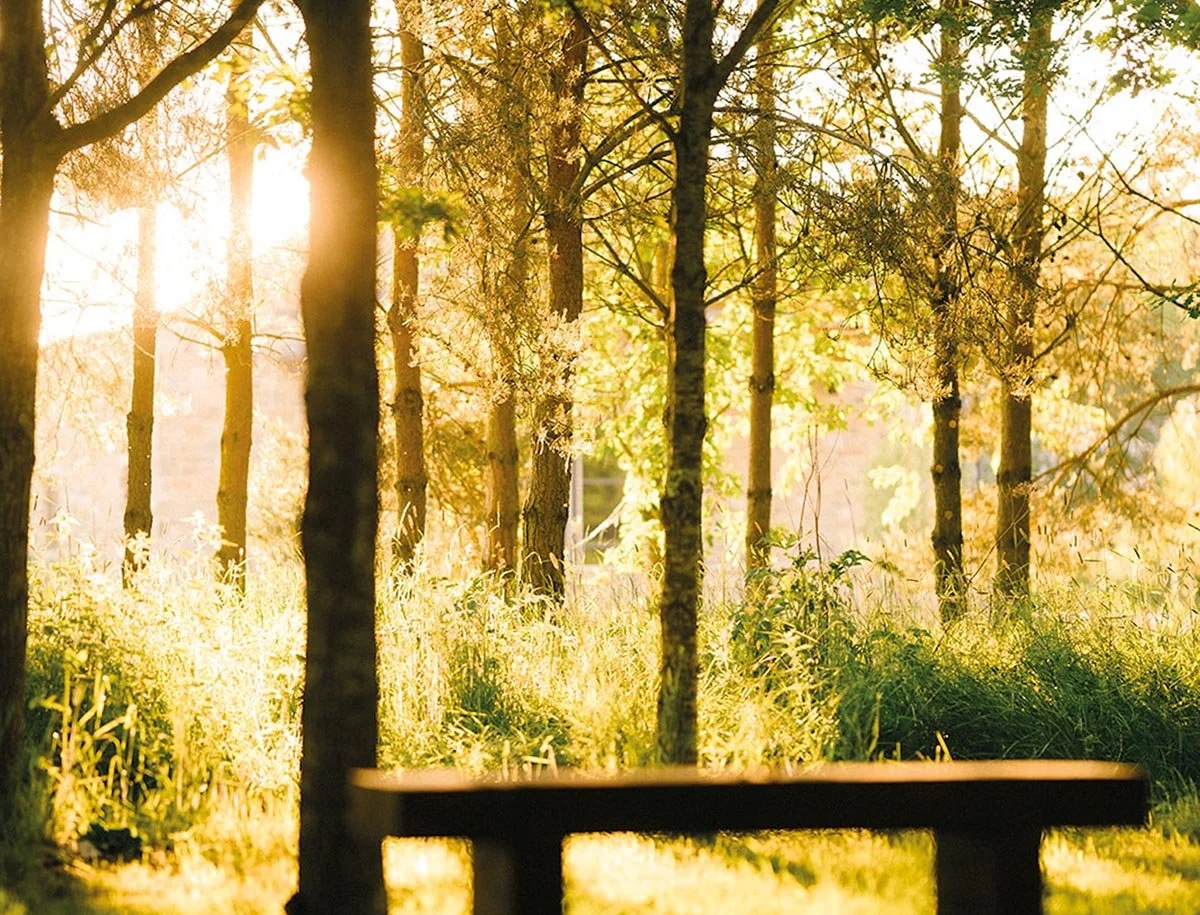
There are no headstones in the grounds, just a small sandstone or slate plaque with a name and a personal message laid flush to the ground. Merlin Wood is planted with oak, rowan, Scots pine and cherry. The trees stand in straight rows and at the foot of a great many is a small engraved plaque and a dressing of leaf mulch. Come April, it’s full of spring bulbs which people plant in their special places. When the weather is nice, they turn up with picnics and camping chairs on the strip between the wood and the goat field.
In contrast to the 25-year-old trees, the nearby Eternal Oak was planted just three years ago, with saplings and wildflowers forming the shape of the Woodland Burial logo: a tree-of-life design with expansive branches, and a heart at the centre of its roots. Another of Scott’s ideas, you can see the design very clearly on iPhone Maps. “As it matures it will become more and more distinctive, but it will always stay very natural. This is one of our dedicated scattering areas, where ashes can be dispersed with wildflower seeds mixed in.”
On still days, small planes take off and land all day long on the neighbouring airfield, their engines put-putting as they take to the sky. There is a timeless feel to it. “The amount of people who come and say, do you know, my Granddad would have loved that,” Laura says.
During the war this was an airbase, RAF Eshott, with up to 100 Spitfires based here at times for pilot training activities. “This was an original tie-down pad made of really thick concrete,” Laura explains as we come to the site’s own Spitfire. “We didn’t want to damage or change them because of their history. It was Scott’s idea to buy a life-sized replica. It’s a museum piece and lots of people come to see it.”
The Spitfire commemorates the lives of two young pilots whose planes collided above the site during training manoeuvres two weeks before the Normandy Landings. “We had a historian advise on its story, the paint and the markers. We held a dedicated memorial service with members of the RAF and cadets in attendance to unveil this special landmark, and an RAF padre came to bless it as a war memorial.”
On the other side of the Spitfire is a huge wildflower meadow, one of Scott’s many labours of love, and beyond, a field of sunflowers. They plan to create a meadow of colourful annuals people can pick to lay at loved-ones’ plaques. And then there is the woodland burial ground itself, expansive, and very natural. Out of interest, would Laura choose to be buried or cremated herself? “I sway between the two,” she says. “I used to want to be buried until we opened the crematorium and it changed my perspective completely. We have a son now, and this site is going to be here long after my and Scott’s time. Maybe I will choose to be buried in the heart in the Eternal Oak Wood.” And has this changed her attitude to death? “One hundred per cent. I don’t fear it. I’m quite a spiritual person and believe that when your body is no longer here your spirit lives on. When people meet me it’s always a surprise what I do. I usually say I work in a crematorium. Saying I own one is a big ball to throw in! But we both love this work. We just live over there on the other side of the airfield.”
They have an annual open day so people can visit and ask questions. Up to 100 people turn up. “People ask about plots, funeral plans. Maybe they’ve passed us on the A1 and are curious. There are so many myths, which we try our best to dispel and put people at ease,” Laura explains.
Just to dispel a few of the common ones: UK law requires that only one coffin is cremated at a time and modern cremators are built for a single coffin. There are checks and nameplates throughout the process to avoid mix-ups. The ashes you receive are from that one individual only. Crematoria follow strict protocols to clean out the chamber before the next cremation. Identity discs travel with the coffin and stay with the ashes until collection. Ashes are primarily the mineral bone fragments left after cremation, processed into a fine powder. The coffin combusts almost entirely and there is very little of it present in the final set of ashes that families receive.
There are no funerals at weekends and the gates are left open so that people can walk freely in the grounds with their memories. “The amount of people who have said to us that they and their loved one drove past on the A1 and said, that will do for me, just pop me under a tree there and let me feed the flowers,” says Laura.