
Speaking truth to power
First published in edition 205 of The Northumbrian, Apr/May 2025
The Bishop of Newcastle, Dr Helen-Ann Hartley, is the only bishop to have publicly called for the resignation of the Archbishop of Canterbury (he went) and his number two, the Archbishop of York (he didn’t). This is a woman unafraid to speak truth to power, but what effect is that having on her relationships with her episcopal colleagues, and how determined is she to remain in her lonely pulpit? Jane Pikett meets her to find out.
She appears, to all intents and purposes, to have been sent to Coventry by most of her fellow bishops. Yet the Right Rev’d Dr Helen-Ann Hartley stands by her calls for the resignations of the archbishops of Canterbury and York following criticism of their handling of sexual abuse cases. She acknowledges that the last few months, during which she has been embroiled in this storm, have been trying, but she is sticking to her guns – a single voice faced with what she has called “a wall of silence” from the episcopal colleagues she thought would have her back.
Ask most people on the streets of Britain to name a bishop and they might struggle. But thanks to her public criticism of the top two men in the Church of England, most of them will have heard of the Bishop of Newcastle. “I didn’t wake up one day and decide right, I’m going to call for the Archbishop of Canterbury to resign today,” she says of the day she did just that last November. “But I had to give a clear answer when I was asked the question. It was the right thing to do.”
This followed the release of the Makin Review, an independent investigation into the Church of England’s handling of allegations against the serial abuser John Smyth. There have, she adds, been some “wild assumptions and theories” about her motivation for speaking out. “But I just believe in clarity. There’s nothing worse than an answer that goes around the houses or avoids the question. When you’re asked a question, just answer it. And if you don’t know the answer, say so.”
At the time of writing, none of her fellow bishops have publicly backed her, and she has stated that she has faced a “wall of silence”, leaving her feeling frozen out by her colleagues and prompting her to absent herself from the bishops’ robing room at the House of Lords. Is she still in a metaphorical Coventry? “It’s hard to say because I haven’t been in the House of Lords for a while, but I’m due to be there the week after next so I’ll find out. My robes are still not in the robing room, though, and I’ll probably leave them where they are at the moment. I think I’m on a journey back into a relationship with my episcopal colleagues.”
In a Sky News interview in November, Bishop Helen-Ann discussed a reluctance among bishops to speak out due to what she called “a prevailing culture of fear”. She emphasised the need for transparency and accountability, adding: “I think genuinely they’re motivated by fear, just keeping their heads down and not feeling able to speak out.” In December, she went further, stating that some were remaining silent because they wanted the top job. “Some are certainly silent I think because they see themselves, sadly, as potentially taking over from Archbishop Justin,” she told BBC Radio 4’s Sunday programme, with a frankness that indicates the journey to reconciliation with those colleagues may well be long.
“Some have been in touch recently and I’ve had one or two constructive conversations, but I think there’s work I have to do to figure out how I operate in that space when we’ve all, me particularly, not that it’s about me, been through a sort of seismic experience. I just need to attend to my wellbeing as best I can.”
It doesn’t seem very Christian, freezing someone out like this? “Well, it’s disappointing, isn’t it?” she says. “Some have reached out, but my concern has consistently been that nobody spoke out to support any of the interventions I made publicly. It was personally disappointing; I expected some would, and nobody did. Damage has been caused to relationships because of that. It will come right, it has to because I can’t spend the rest of my episcopal ministry in Coventry, as it were, even if it’s a self-imposed bubble. Difficult conversations lie ahead, I suspect.”
Archbishop Justin’s resignation stemmed from the Church of England’s mishandling of allegations against John Smyth, a serial sex offender who ran Christian summer camps in the 1970s and 1980s. The Makin Review criticised the archbishop for not ensuring that reports of Smyth’s abuse, which he became aware of in 2013, were properly followed up. The report also found it “unlikely” that Justin Welby was unaware of concerns about Smyth at the time of the alleged offences, as he had claimed.
Facing mounting pressure from victims, some clergy, and a public call to step down from Bishop Helen-Ann, the archbishop resigned, to take “personal and institutional responsibility” for the Church’s failures, he said. That left his number two, the Archbishop of York, Stephen Cottrell, in charge. But then followed criticism for his handling of abuse allegations, this time against Rev’d David Tudor. Despite multiple accusations, including a 1988 conviction that was later quashed, Tudor continued in ministry, despite paying £10,000 to settle a civil claim of abuse (without admitting liability) in 2012. Then, in 2015, during Stephen Cottrell’s tenure as Bishop of Chelmsford, Tudor was appointed an honorary canon.
Critics argue that Cottrell failed to act upon learning of Tudor’s past, allowing him to remain in ministry until his suspension in 2019. The archbishop maintains he acted appropriately within legal constraints, and has expressed deep regret. He remains in post, despite substantial dissatisfaction voiced at the recent General Synod, the Church’s parliament, when a fifth of members joined a failed attempt to bar the archbishop from addressing the gathering. This, and a call to resign from Helen-Ann Hartley, who told BBC Radio 4 in February, “I do not think it’s appropriate for the Archbishop of York to be in post.” Again, she was a lone voice among bishops.
The former Archbishop of York, Dr John Sentamu, has also fallen foul of Bishop Helen-Ann. In May 2023, she suspended his permission to officiate in the Newcastle Diocese following what she considered inconsistent statements regarding his handling of abuse disclosures during his tenure as Archbishop. She deemed his comments, “inconsistent with the tone and culture I expect around safeguarding in Newcastle.” Later, she accused archbishops Welby and Cottrell of using “coercive language” in a joint letter to her in a bid to persuade her to reinstate Sentamu. So that’s three archbishops who have removed her from their Christmas card list? “Actually, I did get Christmas cards from York and Canterbury,” she says. “Though I think those are signed quite some time in advance...”
Bishop Helen-Ann has long been an advocate of fully independent safeguarding in the Church. After the publication of the Makin Review in November, she told BBC Radio 4: “The Church of England needs placing in special measures in terms of its safeguarding provision. There has to be something pretty drastic … it needs a complete rethink and a review. The credibility of the Church has been shattered by this.” Today, she is keeping up the pressure. “I’ve been clear that where the words transparency, accountability, and independence come from is in the response to the crises that have befallen the church because of its failings in safeguarding. We need transparency in terms of process and how we deal with difficult issues, and accountability in the way the Church and its leadership are held to account, because there have been elements of cover-up, silencing and fear.”
Strong words indeed ... “Yes, and it’s truly shocking,” she says. “And it’s not historic, actually, it’s current. The Church is an institution of the Establishment and that brings privilege and entitlement. It’s been a boys’ club. Female leadership is still very recent [she has said previously she does not expect the top job to go to a woman]. A lot of the reasons for cover-ups are deeply ingrained; an idea that the institution doesn’t want people to know these things have been going on. Or protectionism, fear of being exposed, but the Makin Review opened the floodgates to the wider public becoming aware. It is a huge disconnect for me that I have to assume that my colleagues think it’s okay that we have an Archbishop of York who, in many ways, lauded and protected somebody [Tudor] who abused young women. I can’t understand that, and neither can most people I speak to.”
But she has to work with the Archbishop of York, so how’s that going? “It’s very difficult. I have to think about how I position myself and interact with him. I think of the victims and survivors. What would they say if, for example, I invited him to the diocese? I know I couldn’t do that.” Hers is the only diocese in the Church to have a chaplaincy support service for victims and survivors of church abuse – something Bishop Helen-Ann would like to see replicated elsewhere. And what of the credibility of the Church in light of recent events? “I think the failures in safeguarding have seriously challenged our credibility as an established church, and I completely get why people ask why we allow bishops to be in the Lords. Maybe you could go as far as to say it has lost its right to be the established church if it cannot get its house in order. Let’s have the debate about bishops in the Lords, but until then I’ll use the privilege of my position there as best I can to be a voice for the region.”
Unlike her episcopal colleagues in the Lords, other peers have rallied round. “I’ve found it to be a very welcoming, encouraging environment, and in the past few months I’ve had many positive comments from other members of the house, particularly female peers. The first time I was in Westminster in the immediate aftermath [of her calling for the Archbishop of Canterbury to step down], they sought me out and scooped me up. They keep an eye on me. That means a lot.”
Former colleagues from her six years in New Zealand, where she was latterly Bishop of Waikato, have also reached out. “It’s been interesting, how much support has come from New Zealand, particularly from the Maori, who have a strong heart for justice, for what’s right, and for speaking out on behalf of the marginalised and the vulnerable. Some of the messages I’ve had from New Zealand have been incredibly powerful.”
Her friends have been particularly supportive. So how would they describe her? “Gosh, that’s hard. I think they’d say that I’m somebody who is curious, compassionate and determined. And fun to be around, hopefully. I’m a human being with joys and challenges and life experience and all the little bits that make up who we are, and I happen to be Bishop of Newcastle, which means that I have a public role and quite a lot of responsibility, but that is something that I feel God has called me to. If I think I can’t do something, I know there are people around me who will pick me up and say, yes you can – off you go.”
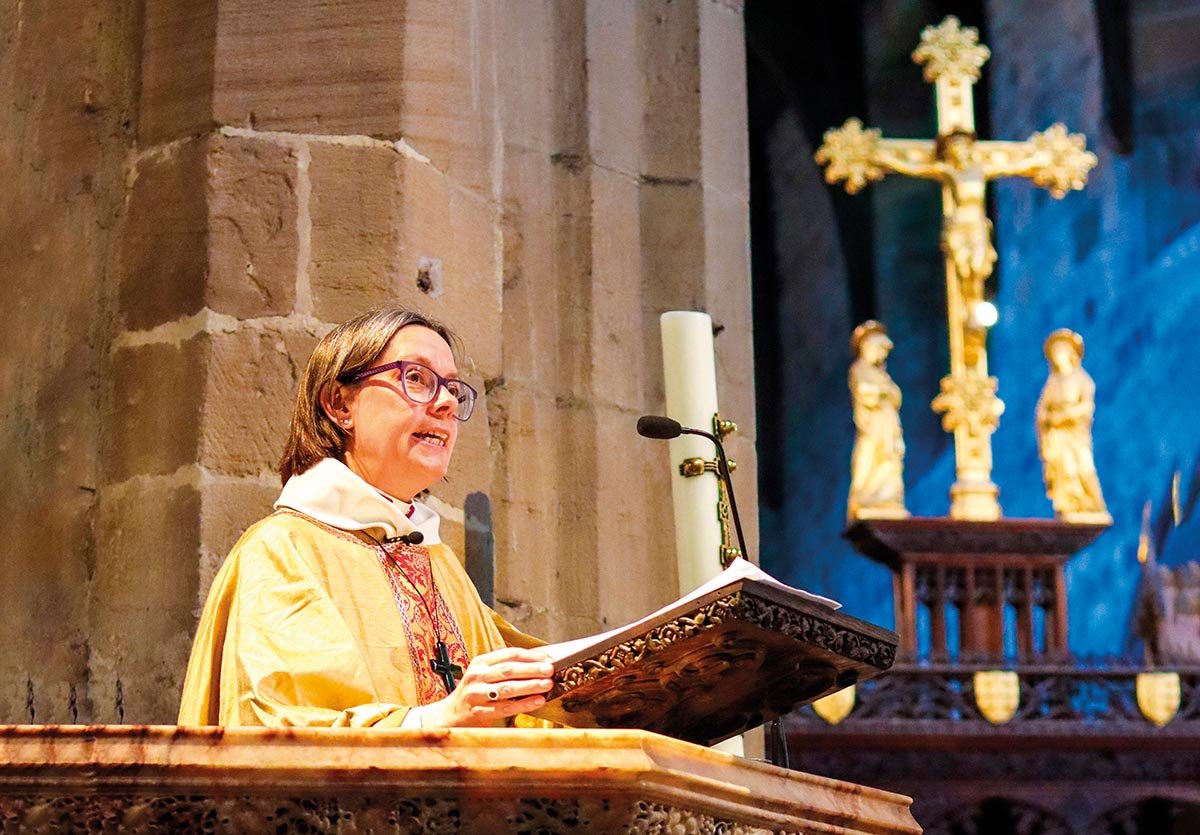
Bishop Helen-Ann is known in her diocese for her visits to churches to preach on Sunday mornings. She is an engaging speaker, with a friendly, informal approach. “Most Sundays I’ll be out in a parish somewhere. It’s a lovely thing to do and the welcome I receive means a great deal. It also gives me a chance to thank people for what they do and encourage them.” She is keen to express her appreciation for the sterling work done in parishes throughout the Church of England, where safeguarding is at the heart of everything. “We mustn’t forget that there is really good work at the local level from people who, for the most part, volunteer. That makes it even more unfortunate that the institution has undermined public confidence. There is an idea that churches are not safe. What does that say to people who are working really hard to make sure they are?”
So how does the Church remain relevant? “By being present, available, open, active in the community, responding to human need, community need,” she says. And how would she say that to a disillusioned public? “We’re here for you. There’s work to be done, but as a Church we are not just about ourselves, we’re about the people around us. I think the importance and relevance of the Christian faith is as live and as vital today as it has ever been.”
Time, and potentially the next Archbishop of Canterbury, will tell...