Northumbrian gold
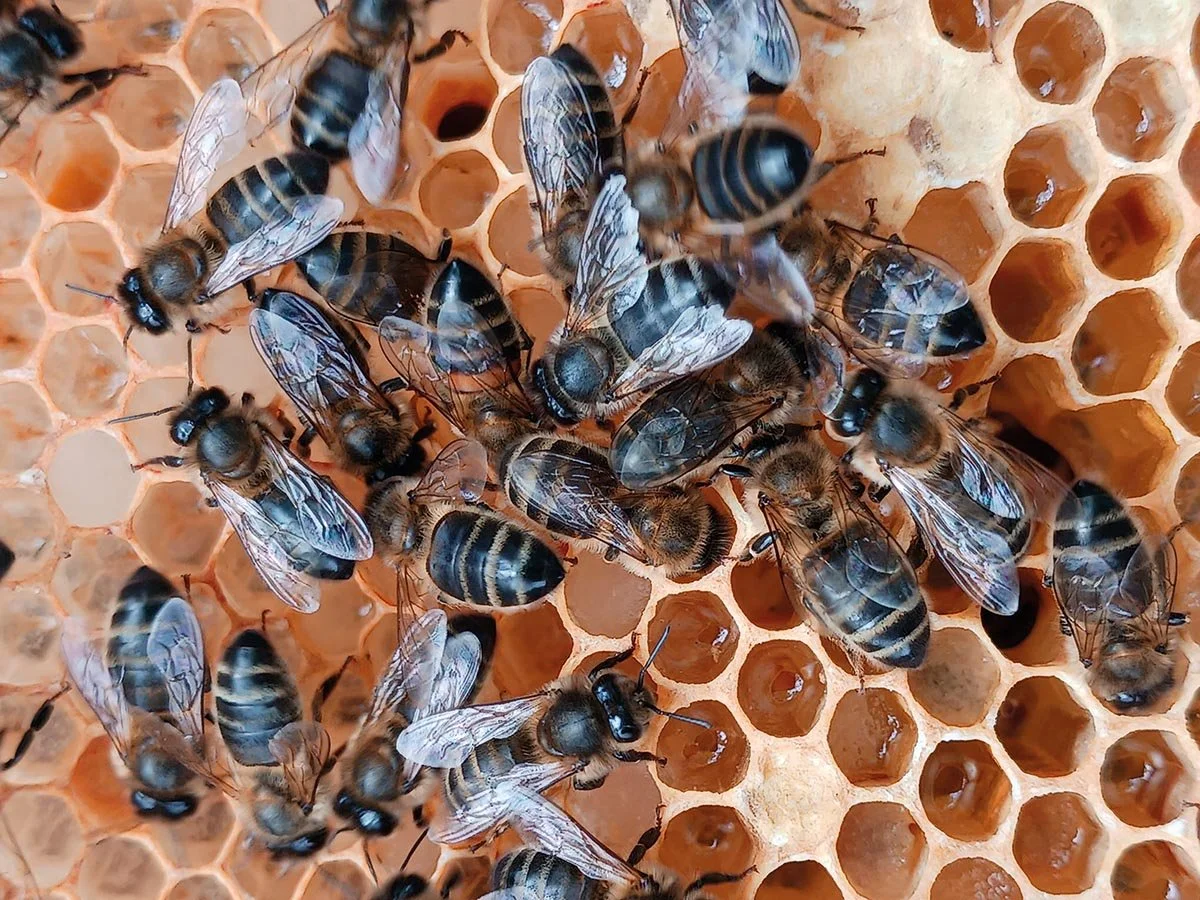
Some of Mark’s Northumbrian black bees (Photo by Mark Swearman)
First published in edition 206 of The Northumbrian, June/July 2025
In the quiet borderlands between Northumberland and Scotland, Mark Swearman of Bamburgh Bee Company tends his hives with reverence, patience, and a sense of purpose he is now passing on to others, as Jane Pikett discovers
On a mild spring day, somewhere between the borderlands of Northumberland and Scotland, the hum of bees blends with birdsong and the whisper of a light breeze. This is where one beekeeper has quietly turned a long-standing hobby into a source of solace, inspiration, and enterprise, thanks in no small part to the enduring mentorship of Willie Robson of Chain Bridge Honey Farm up at Berwick.
“I’ve had bees a long time,” beekeeper Mark Swearman of Bamburgh Bee Company explains, standing beside a cluster of hives. “And we’ve overwintered Willie’s bees here for many years.” Each autumn, Robson moves hundreds of hives off the exposed heather moorlands to more sheltered farm steadings. “You can’t leave them up there with nothing to feed on – it’s too harsh. Down here, behind big stone walls, they’re protected,” says Mark.
Robson, now 80 and still overseeing around 2,500 hives, produces many tons of honey a year, Mark notes, half in admiration, half in awe. “It’s a lot of work. And he’s been very good to me. He’s a mine of information.”
Indeed, it was Robson who helped Mark take the first steps. “I remember meeting him on a back road. Most people wear bee suits, right? Not Willie. He was there among the bees in a Harris tweed jacket and open-toed sandals. He asked me to hand him a smoker and said, ‘Don’t let them see you’re frightened.’ I told him, ‘But I am frightened!’” That moment became a lesson in calmness and respect – principles that now define Mark’s practice. “If you’re rough, they remember. Next time you show up, they come to tell you they’re not happy. But if you’re calm, they respond to that. They teach you to be gentle.”
Over time, what was once a sideline grew into something more serious. After a diagnosis of cancer led him to step back from his building business, Mark found himself drawn increasingly to the bees. “I didn’t want the mental anguish of the business, so I focused on the bees. And they’ve been a real inspiration. You watch them in all weathers, working with absolute purpose just trying to care for their queen and put up a box of honey.”
Bamburgh Bee Company is now run by Mark alongside his wife Sue, who also attests to the calming nature of beekeeping and the health benefits of local honey and wax.
Mark keeps the Northumbrian black bee, which is thrifty and well-suited to the climate of the Borders. Unlike some imported continental bees, “they won’t rush into laying thousands of eggs they can’t feed. They wait. But when the nectar flows, they work like mad.”
In a good year, a hive might produce three or four boxes of honey – up to 100lbs. But for this beekeeper, honey is a by-product. “Our focus is on raising bees and teaching new beekeepers. Willie sells honey; we don’t try to compete with that. What we offer is education.”
Through a series of hands-on lessons, complete novices learn how to manage a hive. “They come for about five two-hour sessions. Then they take away a nucleus colony – five frames, with baby bees and food – and they build from there. If they overwinter those bees, they’re in full production the next year.”
Mark is dedicated to preserving the genetic line. “We are into queen development, maintaining our strain and building new colonies. Along the way, we teach swarm control, how to keep your bees – because bees will swarm. That’s their way of reproducing. It’s nature saying all is well.”
In swarming season, calls come thick and fast. “There’s a black cloud outside my kitchen window!” people exclaim. Mark chuckles. “People get worried, but they’re not aggressive. They’ve gorged on honey ready to move so they’re really docile.”
He recalls swarms turning up in unexpected places. “I once got a call about a swarm in someone’s letterbox. Another in the church belfry. We’ve done removals from chimneys, even from inside a wall.”
The observation hive here reveals the secret workings of the colony. “You can see the whole lifecycle – eggs, larvae, workers. You can watch a baby bee hatch and see that without being taught, it knows what to do. It cleans its cell, lines it with propolis, and gets to work. Over its 46 days, it might be a nurse, a guard, a forager, even an undertaker.”
He speaks with reverence about the queen and her Shakespearean rise to power – killing her rival sisters – and the drone congregation areas where she mates mid-flight. “She stores sperm from up to 14 drones in a tiny organ, drawing just a little at a time to fertilise eggs for years.”
There’s science here, certainly, but also poetry. Bees, Mark says, “are a barometer of the environment.” Where bees do well, farms are likely flourishing too. “If they’re thriving, everything else usually is too.” Farming, he notes, has changed significantly. “Farmers used to think of insects as pests. Now they’re planting wildflower mixes, they want the bees around.”
Even in loss – winter die-offs, drone-laying queens, bad weather – there are lessons. “Bees teach you patience. Humility. Respect. If you’re in a rush, if you’re in a mood, they’ll let you know. But if you’re present and careful, they welcome you in.” He shrugs, looking towards the hives. “They think the queen’s in charge, and she thinks she’s in charge. It seems to work out.”
He delights in seeing new beekeepers catch the bug. “One lad came on our course and now he’s got 20 hives. It’s addictive.” Taster days offer a gateway into this world. “We put people in a bee suit and let them open a hive and you see this change come over them. They start nervous and end up fascinated.”
Beekeeping, he reflects, “is not about control. It’s about partnership. They’ve got their own wisdom, and if you listen, they’ll show you.” When he gives talks, he recounts fascinating stories of bee biology and behaviour. “It’s a fact-based hobby,” he insists, but also one of fascination. Take, for instance, the legendary waggle dance – a bee’s method of communicating food locations. “That dance translates into a coordinate in relation to the sun’s movement – constantly adjusting. The precision is astonishing.”
He might spend hours watching bees return laden with pollen – the equivalent of a human carrying a concrete block under each arm. “Bees force you to slow down. I’ll sit for an hour just watching them bring back pollen.” Mark describes how moving a colony even a few miles causes them to recalibrate their ‘home’ location through orientation flights. “If moved less than 3 miles, they’ll stubbornly return to their old location.”
Worker bees access only their home hive, which is guarded carefully, while drones can access all hives in search of virgin queens. Contrary to popular belief, “You’re not making honey, you’re extracting it.” The honey comes from boxes above the brood box, capped with wax then removed and spun in a centrifuge. Mark never heat-treats or filters his honey, preserving the enzymes and pollen that commercial honeys often lose. Honey varies widely in taste and texture, depending on the foraged flowers, and natural crystallisation is a sign it’s the real thing. “If it stays liquid and looks like yellow paint, it’s probably adulterated,” he says.
Beeswax and propolis have found new life in artisan cosmetics and health products. Propolis – an antibacterial, resinous compound – has found uses from wound care to homeopathy. Some even swear by bee venom therapy. “In America, people use stings to trigger pain relief for arthritis. There’s also purified air from a hive – some find it therapeutic.” Mark’s approach respects the bees’ natural rhythms and the honey they produce is reported by many locals to have healing properties. “Honey was the original medicine. We can even use it to treat wounds and bee stings.”
Mark’s apiary is surrounded by wildlife – red squirrels, otters, deer, sea trout in the nearby burn, and rich birdlife. It is open for bee experience days complete with protective suits and hive visits, while tasting events matching honey with local cheese showcase the variety of flavours from floral heather to iron-rich ivy. Mark sums it up simply: “Bees are tough, inspiring, and fascinating. They teach us patience, balance, and respect for nature. And if you’ve had a stressful life, keeping bees might just change you.”