
The cunning non-plan that actually came together
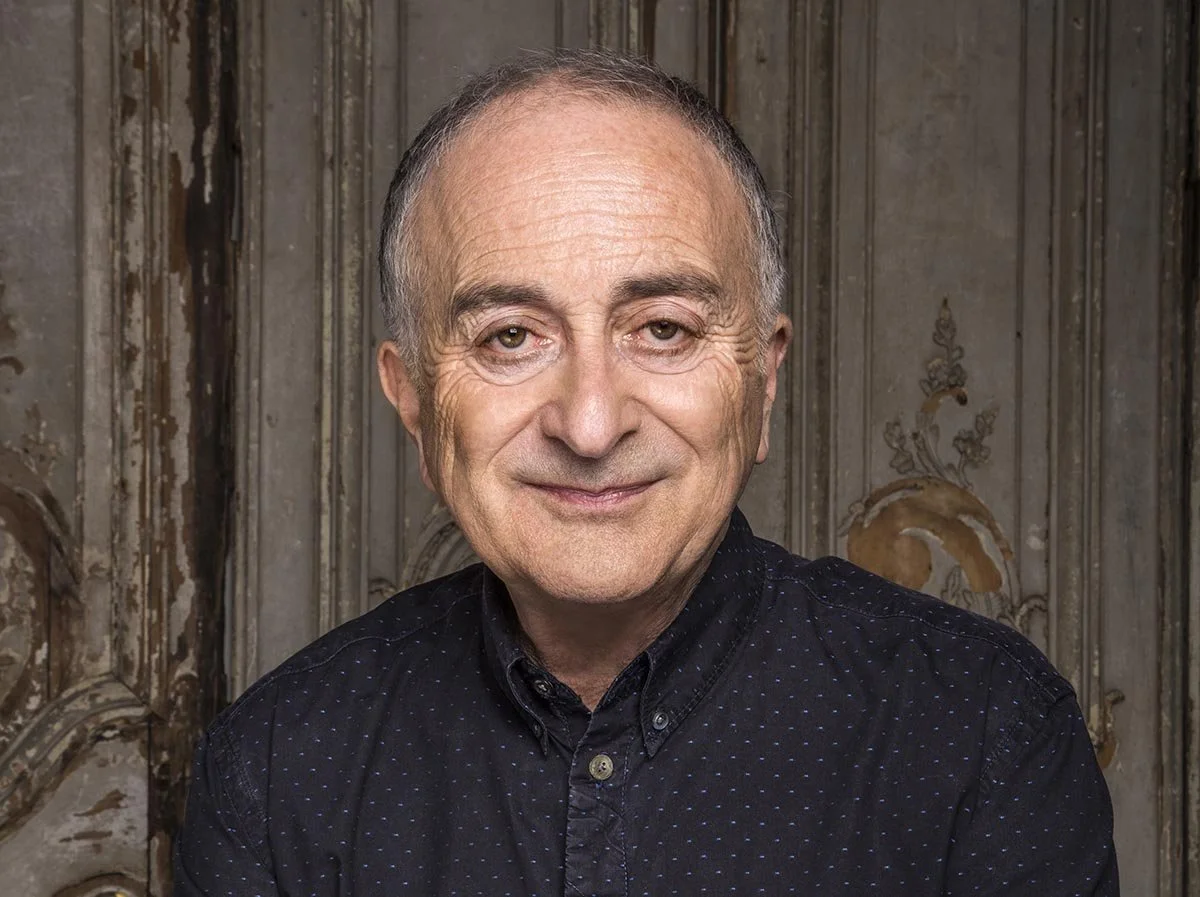
Sir Tony Robinson (photo: Paul Marc Mitchell)
First published in edition 209 of The Northumbrian, Dec 2025/Jan 2026
Filming the first series of Blackadder (then entitled The Black Adder) in Alnwick in 1983, Tony Robinson had no idea his role as the dim-witted Baldrick would make him famous. Four decades on, Sir Tony tells Jane Hall about the place Northumberland still holds in his heart and its role in his new historical novel, the Anglo-Saxon epic, The House of Wolf
February 1983 was noteworthy for the people of Alnwick. Firstly, for the weather. Even by usual standards, it was remarkably wintry, not just in Northumberland, but across Britain. One of the coldest Februarys ever, the weather dominated the news headlines, but it wasn’t the only talking point in Alnwick, where a welcome diversion was provided by the arrival of the cast and crew of a new BBC comedy.
Alnwick is no stranger to film crews, having featured in numerous movies and TV shows including Elizabeth, Harry Potter, Robin Hood: Prince of Thieves, and Downton Abbey. This BBC production, starring Consett-born Rowan Atkinson, Brian Blessed, Elspet Gray, Tim McInnerny, and Tony Robinson, was The Black Adder (later shortened to Blackadder) and marked the first outing for Sir Tony’s best-known role, the incredibly stupid, germ-infested Baldrick – he of ‘I have a cunning plan’ fame.
More than 35 years after the fourth and final series of Blackadder aired, those five words remain among the most recognised comedic catchphrases of all time. But in 1983, the future popularity of Blackadder’s loveable but dim sidekick was the last thing on Sir Tony’s mind as cast and crew battled against the weather. He recalls: “Tim [McInnerny, who played Lord Percy Percy, Duke of Northumberland] and I were in the first ever Blackadder shot outside Alnwick Castle, and during the course of that scene we still allege that we experienced eight different kinds of snow.”
Sir Tony, who is chatting animatedly from his home in London via the wonders of Zoom, adds that when the series was screened in summer 1983, snow could clearly be seen in the outdoor shots. Hampered by the weather, uppermost in everyone’s minds was keeping warm, sticking to the tight three-week filming schedule in and around Alnwick and Brinkburn Priory near Rothbury, and staying within the £1m budget (nearly £3.5m today – a phenomenal sum at the time for an unproven comedy).
Set in 1485 at the end of the Middle Ages, The Black Adder contends that rather than Henry Tudor winning the Battle of Bosworth to take the crown of England, Richard III was victorious. In this alternative history, he is quickly succeeded by Richard IV, whose morally dubious son Prince Edmund (played by Atkinson) adopts the title The Black Adder, and with the help of the dull-witted Baldrick, schemes to overthrow his father.
Despite winning an International Emmy, it was not the success its writers Richard Curtis and Atkinson hoped for, and it was three years before Blackadder returned, Ben Elton co-writing it with Curtis. Sir Tony has his own views as to why the first series failed. “The history was too convoluted and it was a series of in-jokes which no-one would get apart from a coterie of medieval historians. We didn’t need the wide filmic canvas, it was essentially a sit com. Ben Elton recognised that immediately and he reshaped it.”
Thereafter, Baldrick came into his own. “I was living in Bristol, just concentrating on the school run and work, and it was a long time before I understood how popular it was. When I did realise, I knew my life was transformed. John Lloyd, our producer, had said to me on the way up to Alnwick for the first series, ‘how do you think it’s going to feel, being famous?’ I said, ‘don’t be daft,’ and he said ‘no, I mean it, you’re Rowan Atkinson’s sidekick. Of course you’ll be famous.’ We laughed and forgot about it, and then the series failed anyway. But that little exchange turned out to be prophetic, though I had no cause to think it would happen.”
Future series were mainly studio-based, the only nod to Northumberland being McInnerny’s reprisal of Lord Percy in Blackadder II, the story pushed forward a century to the court of Elizabeth I. The change of tack didn’t end Sir Tony’s dealings with Northumberland, though. He has returned time and again, mainly as one of Britain’s foremost faces of popular history, both as a presenter of 20 seasons of Channel 4’s popular archaeology programme Time Team, (notably at Lindisfarne, Beadnell, Bamburgh, and Low Hauxley), and his documentary series Walking Through History. An episode of the latter, entitled The Dark Age of Northumbria, followed him as he travelled in the footsteps of St Cuthbert from Melrose through the Tweed Valley and the Cheviot Hills to Holy Island.
He says: “I’ve walked Cuthbert’s way, I’ve spent time on the Farnes, in Sunderland, Durham and Newcastle, I’ve walked Hadrian’s Wall and stayed en-route, but that’s like a big L around the side of Northumberland really. The dark heart of it I don’t really know at all.” He is looking forward to becoming more familiar with it, however. Having written more than 30 children’s books and several non-fiction works, including his 2016 memoir, No Cunning Plan, he has, aged 79, just published his debut novel for adults, The House of Wolf. The first in a trilogy focused on Alfred the Great and the making of England, it is a pacy, page-turning epic focusing on the Anglo-Saxon kingdom of Wessex and the marauding Norlander (Viking) invaders of the mid-9th Century.
There is blood, bawdiness, betrayal, and a surprising amount of humour as the action flits between Winchester, Rome, the Frankish Kingdom, Lindisfarne and the Farne Islands, from where the brutal Viking leader, Guthrum, plots to wipe Wessex from the map. It’s fair to say Northumbria doesn’t get that much attention in the novel, but Sir Tony promises it will “really come to life” in the second instalment.
“All those Northumbrians reading this book and begging me in irritated fashion to concentrate more on Northumbria, don’t worry. I’m like a dour batsman in the first half of his innings who really lets the bat rip in the second half. I already have a Northumbrian princess [Moira, wife of Aethelhawk, King Aethelwolf of Wessex’s second son]. She’s one of my favourite characters and not only will she return, but she will be back in her native habitat.”
Sir Tony – who was knighted in 2013 for political and public service, including as an ambassador for the Alzheimer’s Society – took two-and-a-half years “pretty much full-time” to write the book. It might never have made it into print after the first five handwritten chapters (he writes propped up in bed on two pillows using a fineliner art pen), and three years’ worth of research were stolen from his car on holiday. Luckily, the story was still in his head and he was able to get it back down on paper, to be scanned and typed up by his PA later.
His choice of King Alfred – he of the legend of the burnt cakes – as the focus for the novel was motivated in part by a favourite childhood book, which he jumps up mid-interview to retrieve. This is Ladybird’s King Alfred the Great, its cover showing a regal Alfred and a Viking warrior wearing an historically inaccurate winged helmet. “I remember that picture from about the age of eight,” he says, “this very thoughtful, lordly man and the Viking. I always keep it on my bookshelf, and somewhere in it is the famous illustration of Alfred being scolded by a peasant woman for burning the cakes she’s left him to look after. That book inspired me enormously. They’re great those Ladybird books, aren’t they?”
Sir Tony is stirred by Alfred. “He’s the only king we’ve ever called Great,” he says. “He performed some miraculous acts of kingship, and also of sleight of hand. With his son and grandson, he created England, and I think that’s worth highlighting at a time when the whole nature of Englishness is up for debate.
Known for his political activism, Sir Tony was involved in Labour politics for decades, serving on the party’s governing National Executive Committee from 2000 to 2004. Unhappy with the party’s stance on Brexit, among other things, and its refusal to fully endorse a second referendum, he quit the party in 2019 after 45 years. “I don’t want to make it a polemic novel, but the irony that England comprises Saxons from Germany and Vikings from Scandinavia can’t help but put a smile on my face.
“I think Alfred must have been an extraordinary man. The only real detail we get about him is from his biographer, Bishop Asser. Apparently a friend of Alfred, Asser’s history of him is a PR exercise in justifying Alfred’s house ruling England, so it must be taken with at least a fistful of salt, which is great for someone writing history. I don’t feel obliged to tick a series of historical boxes in order to make it feel authentic.
“A big question in my mind is, all these things he did – reforming the currency, defeating the Vikings, transforming transport, architecture, defence and the legal systems – he can’t have done all that on his own, so who was he surrounded by? Having had the privilege of being close to governments throughout the late 1990s and early 2000s, I had a feel for how things operated, how decisions were made, the conversations and the factions.”
As he approaches 80, he has no intention of slowing down. He is touring the UK promoting The House of Wolf, is set to begin soon on the next instalment, and still does occasional TV, such as the Madame Blanc Mysteries on Channel 5. Ask him how he describes himself – actor, writer, comedian, theatre producer, historian – and he says: “I really don’t try to define myself. I’m blessed to have as much work as I’m likely to want for the next decade, by which time I’ll be 89 and may have to start pitching myself again. Who knows?
“My work is my pleasure. It defines me more than anything apart from my family, so I will continue doing it for as long as I’m capable.” And if everything should come crashing down around Sir Tony’s ears, he’s sure to have a cunning plan.
The House of Wolf by Tony Robinson is published by Sphere, priced £25