
A shop window into history
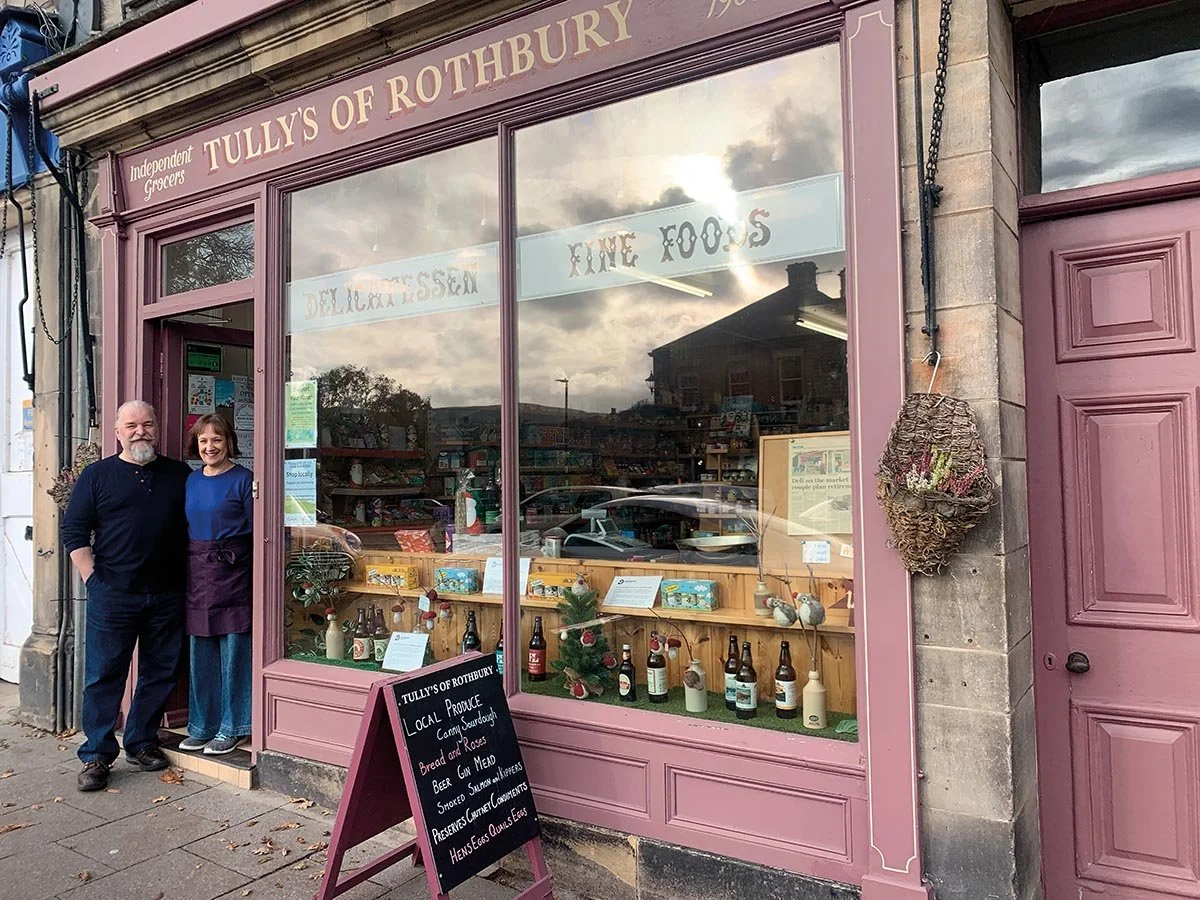
Rich and Sue Hurst at Tully’s of Rothbury today
First published in edition 209 of The Northumbrian, Dec 2025/Jan 2026
For more than a century the Coquet Valley’s last grocer’s shop has mirrored the valley’s people and traditions. Now, as its owners prepare to retire, Jane Pikett explores a window into history
On Rothbury’s High Street, a shop door opens on a timeless scene. Wooden shelves are stacked with preserves and pulses, cakes and pastries, craft beers and spirits. The fridges are full of deli goods, fish and meat, and behind a counter sit wheels of Northumbrian cheese waiting to be cut to order. This is Tully’s of Rothbury, a grocer and deli that has served the Coquet Valley for more than 125 years – a shop as much about stories as it is about food.
For the past 27 years, those stories have been tended by Rich and Sue Hurst. Now, as they prepare to retire, they are reflecting on one of the town’s most cherished institutions. “We’ve always seen ourselves as custodians,” Rich says. “Now it’s time for someone else who understands why it matters to carry it on.”
When they bought Tully’s in 1998, they hadn’t imagined it would become their life’s work. “It was supposed to be a 10-year plan,” Rich says. Both were looking for a new challenge when they heard Edwin and Mary Tully – the third-generation owners – were ready to sell. “We just looked at each other,” he recalls. “It felt like fate. We’d always been interested in food, especially wholefoods, and here was a shop with history.”
What they acquired was more than a business: it was a web of relationships. Edwin, still hands-on at the time, collected vegetables from local farms (it was a big day in Rothbury when the year’s first cauliflowers arrived . . .) and delivered across the area. When the Hursts took over, Edwin drove Rich around the farms, introducing him to growers and suppliers who had long sustained the shop.
The store itself was then a “Happy Shopper” and fitted out like a convenience store. The Hursts saw the potential behind the metal shelving and stripped the shop back to its Victorian bones, revealing sash windows and pine panelling. In doing so, they uncovered a trove of artefacts: a century-old coffee grinder, now back in daily use, and an antique bacon slicer. A bench salvaged from the old courthouse found its place in the shop, and as the work went on they heard stories from tradespeople whose families had worked in the area for generations.
The shop soon drew attention. A television props director once asked to buy the vintage bacon slicer for the final series of TV’s Open All Hours, but the Hursts said no, believing it belonged in the valley. Outside, in a narrow passageway, another piece of living history reveals itself: a “wall of fame” signed by passengers who once waited there for the bus, later joined by signatures from personalities including the football legend Jack Charlton and the Rothbury-born actor and comedian Alexander Armstrong. “People come into the shop for the first time and you can see it in their response,” Rich says. “It feels authentic – traditional, but alive.
“We always knew we were buying into a legacy,” Rich says. “The Tully name matters. It stands for something – a way of doing things, trust with the community.” Honouring that legacy meant preserving customer choice and supporting local producers as wholefoods, vegetarian, vegan and gluten-free lines and artisan goods from Northumbrian makers gradually filled the shelves. Today, roughly half the shop’s range is local – honey, preserves, bread, meat, cakes and more. “What makes it exciting is the connection,” Rich says. “Talking to producers, hearing their stories, then sharing that with customers. You don’t get that in a supermarket.”
The deli counter evolved too. “People are more adventurous with their cheese choices now,” he says. “We stock around 60 different cheeses, mostly local. Twenty years ago most people wanted plain black or green olives. Now we’ve got jars of every kind. Wholefoods and ingredients have grown massively.”
At the back of the shop, Tully’s Tiny Tea Room offers tea in china cups, coffee and slices of Selkirk Bannock. “We wanted it to be a place where people could just sit, slow down, and feel part of things,” Rich says.
For the Hursts, celebrating the legacy of the three generations before them has always been central. Tully’s became for them a kind of second home – a shared pantry for local people. Rothbury’s high street originally grew from the needs of Cragside’s workforce, and Tully’s was part of that early ecosystem, delivering to remote farms by horse and cart. As the years passed, Rich has become increasingly determined to document this history before it disappears. The Hursts hope a valley heritage centre will one day record memories from those who recall the transformations of the high street. Much has changed – the railway line closed, the riverside racecourse vanished – but the sense of continuity remains. Customers now regularly urge the owners to sell only to someone who will protect that heritage.
What sets the shop apart is its responsiveness to its customers. Regulars are greeted by name, offered samples and recommendations. The staff take pride in knowing the producers behind the products. Through crises from foot-and-mouth to the pandemic, Tully’s has remained a familiar anchor. Many visitors remark that they wish they had a shop like it where they live – a sentiment that has reinforced the Hursts’ belief in independent, community-led retail.
Long before the Hursts’ tenure, the Tully’s horse and cart travelled as far as Otterburn and the North Coquet valley, where farming families met them at known trading points. Rich picked up the baton in the early years when there was still a demand, driving groceries up and down the valley. “I must have been in almost every house in the valley at one point,” he says. “You got to know people, hear their stories. Some of those customers were the older generation then, and they’d tell you about life here decades earlier. That connection was priceless.”
Tully’s has also long served as an unofficial hub, the place to queue for pantomime tickets or buy a raffle ticket for the duck race. “We’ve seen Rothbury change a lot,” Rich says, “but the essence of the town and its businesses is still here. We’ve been proud to be part of that.”
Founded around 1900 by Jane Tully, the shop first stood further up the High Street before moving into its present premises after another grocer retired. Jane’s son Andrew ran it for more than 30 years before passing it to Edwin and Mary in 1956. At its peak, Rothbury had 14 general stores and several more in the valley’s villages; now only Tully’s remains. “We’ve come to the end of what’s achievable for us,” Rich says. “It’s time for fresh ideas, modern methods – but from someone who loves the traditions as much as we do.” He is clear about the kind of buyer he hopes for. “The person who takes this on will be someone who loves tradition and understands why this business matters.” That responsibility, he adds, comes with enormous rewards. “Everything we sell is shaped by what customers ask us for – not what a supermarket tells them to buy. That’s the joy of it.”
For Rich and Sue, the greatest reward has always been the relationships, the rhythm of the shop and the knowledge that they were part of something woven into the life of the valley. “It’s been a great adventure,” Rich says. “We’ve been custodians for nearly three decades, and now it’s time for the next chapter.
“But I can guarantee this: whoever takes it on will discover the same thing we did – the joy of working with food, with people, and with a history that still matters today.”