From soil to song
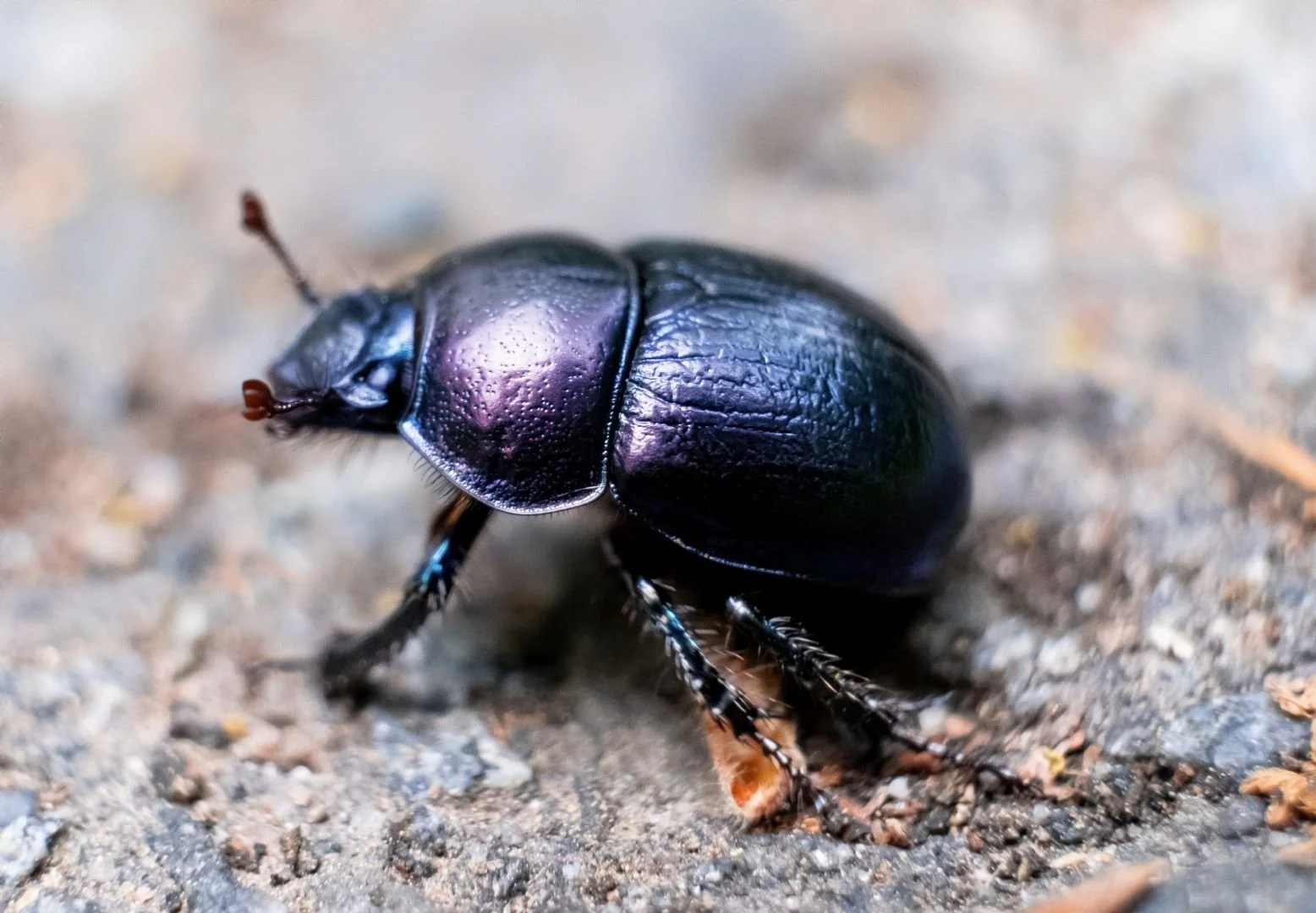
Mr (or Mrs...) Dung-Beetle
First published in edition 197 of The Northumbrian, Dec/Jan 2023/2024
This week, Charlie is musing on the circle of life
This year, a new tool came into my life which has profoundly improved my knowledge of the birds on the farm. It is an app called Merlin, and when you’re wandering about gardens, streets, or the countryside it detects the species of birds around you. It is also intuitive and easy to use, even for a Luddite like me.
Birds are largely territorial and with this app you quickly learn that, for example, a series of whistles and snaps and pops aren’t three birds, but a single sedge warbler.Dog walks that used to take 45 minutes now take hours, which is good for dogs and not good for getting to meetings or the school run on time, and this amazing free technology has dramatically changed my understanding of the birds on our farm.
Another group of animals which play an equally important role in determining how the environment ticks are farm animals. Plus, you don’t need an app to spot them, as what you have just trodden in is usually a fairly good pointer.
I have a deep affection for farm stock. I think the reason lies in my family history. I was once asked about my Welsh heritage (though it wasn’t put that politely, but I don’t want you spilling your tea...). My new acquaintance had found out that I was called Bennett and concluded that I must be Welsh (we were watching the rugby in a pub in England, so you can guess who was playing who). Anyway, having extricated myself more or less in one piece from this conversation, I was left wondering – could I be Welsh after all?
I phoned my all-knowing aunt and was put in the picture pretty quickly that my great-grandfather had indeed come to Leeds from Swansea. As you know, I am a sucker for a rabbit hole, so into one called www.ancestry.co.uk I dived. After two days of pounding the keyboard, I traced my Welsh ancestors back to 1527, when Nicholas Bennett moved from Derbyshire to Wales to farm the lands of the Earl of Dudley, who was a favourite of Elizabeth I.
That told me I had hundreds of years of family history in Wales, but that I wasn’t necessarily Welsh, though I now have a deeper affinity for that amazing country. I also now know that farming has been in my blood for a very long time. Combine that with my mother’s side of the family, who are also a long line of farmers and, bingo, you have farm stock hard-wired into your DNA.
I think farming in general gets a hard press about its effect on the countryside. A lot of that comes from the aftermath of World War II, when farmers were put upon to produce more food with little regard for the consequences. At the same time, machinery was developing in leaps and bounds and new wonder chemicals were popping up left, right and centre in a perfect storm for the environment. But the farmers were doing as they were told and made a very good job of it. I feel for them, as suddenly their world has turned on a sixpence and now, as if by magic, you have to farm for the environment.
That’s easier for me as it’s my thing, but not so easy for other farmers who have invested time, money, and generations in getting their farms to produce food for us and keep bread on their own tables. To their credit, they are quickly learning new practices and I am optimistic about the future of farming and the environment.
So, what are farm stock doing for the environment? Well, to answer that question we might focus on the thing you trod in that indicated a cow was in the neighbourhood. That’s cow poo, or to use a more charming description, The Cow Dung Community. A cow pat and indeed a sheep’s dottle is home to a lively, integrated collection of organisms that have a profound effect on a myriad of wildlife. Or, to use our local wildlife expert George Dodd’s description – a place going from soil to song.
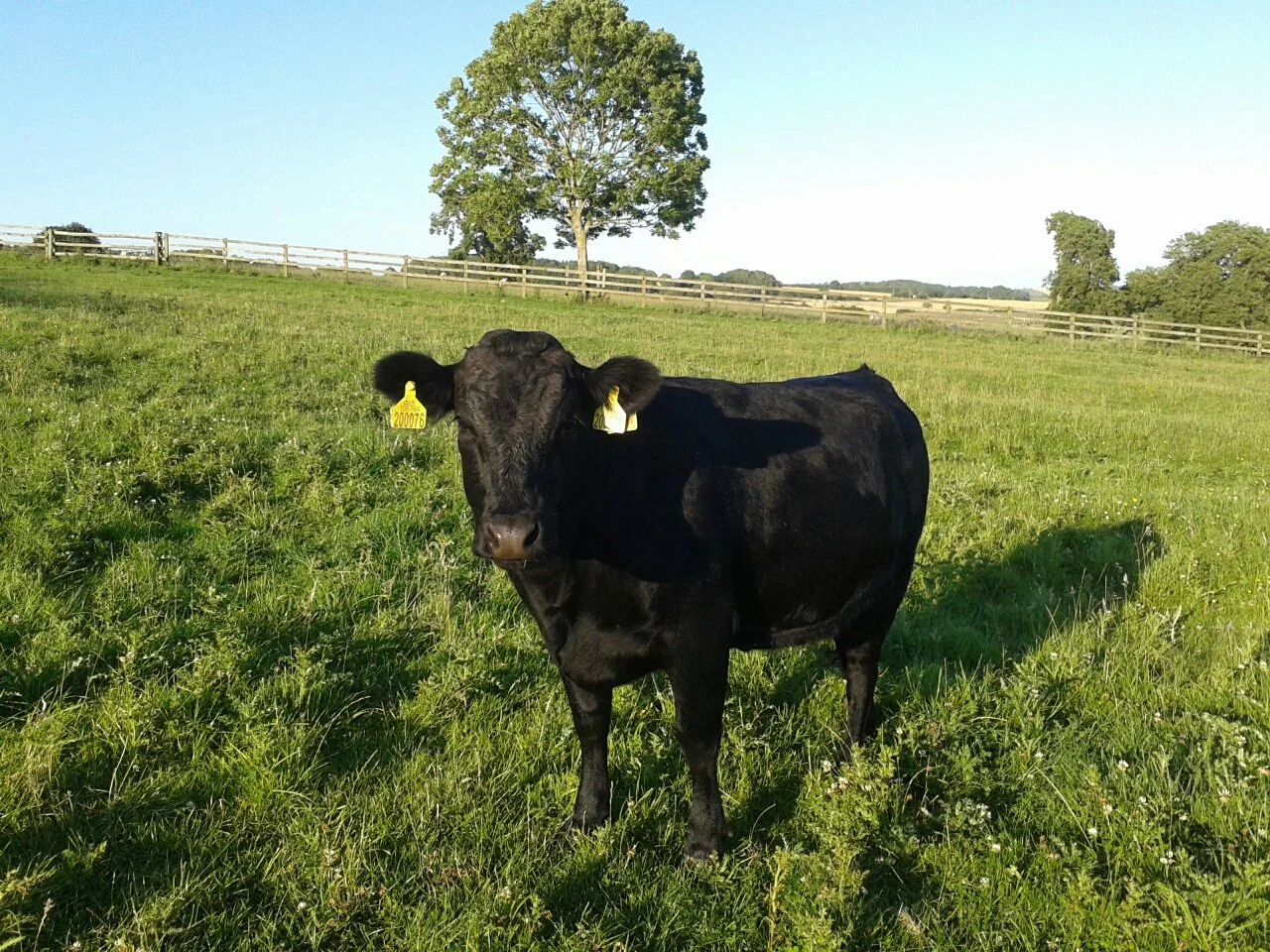
One of Charlie’s Dexter cows
Cattle can digest cellulose because they have cellulose-digesting bacteria called ruminococcus in their rumen. These bacteria produce an enzyme called cellulase that can breakdown cellulose to glucose which in turn can be used to create energy for the cow. This process is not 100% efficient and when the cow ejects what it can no longer digest the resulting pat is full of a host of nutrients for our dung community. And, like any village, a dung community is made up of different characters doing various jobs; the result of their labour being that the dung enriches the soil and allows a plethora of creatures to feed, breed and multiply.
So let’s have a look at a few of the characters we might meet at the bar of The Pancake Inn. Take the shiny, portly gentleman and his wife at the bar. That’s Sid and Marjory Dung-Beetle, and they’ve just had a family of a few thousand little Dung-Beetles. Their type of beetle lay their eggs in the dung and once the eggs hatch, the larvae crack on with eating it. Their cousins have other ways of spreading their prodigy – some burrowing below a cow pat and pulling the dung into chambers, some rolling it into holes – but the end result is the same; nutritious dung transferred from the surface and into the soil.
Meanwhile, the legless fellow in the snug is Mr Wyatt Worm. He’s also had a busy day, he and three of his relations having been busy eating the dung and dragging it down into the soil, which is again the beneficiary.
But not all those propping up the bar are dung eaters. The brown flies playing darts, which are often seen crawling on the surface of a pat laying their eggs, are in fact predators eating smaller flies. In fact, the dung pile is a regular Serengeti of hunters and prey. For example, the phoretic mites which catch a ride on Mr and Mrs Dung-Beetle are on the look-out for fly eggs. This is a symbiotic relationship as fewer fly eggs means fewer grubs eating the dung beetles’ breakfast. So, the two species rub along just fine.
Lounging by the fire is Roberta Rove-Beetle. She is a streamlined hunter doing as her name suggests – roving the dung pile in search of prey. She has a broad palate and will have a go at mites, beetle larvae, aphids, and small caterpillars both in adult and larvae form.
If I were to describe all the residents of any small human community, I’d need quite a hefty volume, and one pile of dung in a field is equally well-populated. I will list a few more residents to give you the complete picture, and if you’d like to learn more you can pop into the Lit & Phil in Newcastle and request CVs on them all. They include nematodes, slugs, woodlice, centipedes, millipedes, springtails, harvestmen, spiders, mites, earwigs, and parasitic wasps.
This cornucopia of life doesn’t go unnoticed by larger residents on the farm. Crows will flip the piles of dung (perhaps that is why these offerings are called pancakes...?) and small birds like wagtails will pounce on flies gathering around a fresh deposit. Meanwhile, larger mammals like badgers will have a rootle for worms.
It’s easy to make the mistake of looking at the wild areas on a farm as places where nature abounds. It does, but that is not the complete picture. By combining wild habitats with productive pasture, we can promote a wildlife knees-up only ever seen in places like the bar at The Pancake Inn. Cheers… mine’s a large one.
Charlie Bennett and his wife Charlotte own the Middleton North estate near Wallington, where they work to support existing wildlife and attract new species alongside sustainable stock farming designed to add to the diversity of wildlife in the area. www.middleton-north.co.uk
• To enquire about volunteering, email charlie.bennett@middleton-north.co.uk
• Charlie’s book, Down the Rabbit Hole, the Misadventures of an Unlikely Naturalist, is available in hardback at: www.charlie
bennettauthor.co.uk